
Out of Breath on the Stairs: How to Improve Your Fitness
If three flights of stairs leave you gasping, you do not need more willpower, you need a smart plan: easy cardio as the base, a few intervals and strength training.
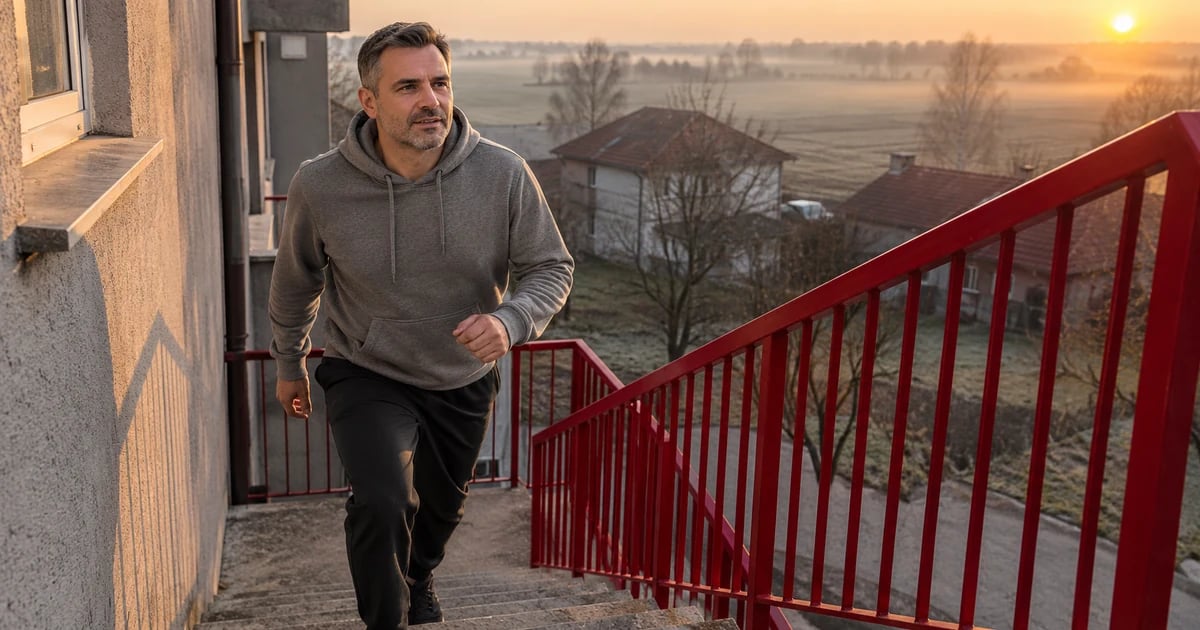
If you get out of breath on the stairs, you improve your fitness by combining three things: plenty of easy cardio at a pace where you can still talk, one shorter interval session a week, and leg strength training twice a week. Most people feel the first difference within three to four weeks, and stairs get easy in two to three months.
I'm Igor Koprivica, a personal and online coach from Bijeljina. My page says we train so you do not get out of breath on the stairs, and that is not an accident. It is the sentence I hear most often at a first consultation, from people who are 25 and from people who are 55.
Why you get out of breath on the stairs
Stairs are a short but intense effort. Your legs work against your own body weight, your heart rate jumps within seconds and your heart has to deliver oxygen to the muscles fast. If your aerobic base is weak, your body very quickly reaches the point where it cannot supply enough oxygen. That is the familiar gasping on the third floor.
There are three common reasons:
- A weak aerobic base. Your heart and muscles are not used to regular work, so every effort quickly feels hard.
- Weak legs. When your thighs and glutes are weak, every step takes a big share of their maximum strength and fatigue comes fast.
- Extra body weight. You carry every kilogram up every step. That is why losing weight often improves fitness on its own.
An important note: if being out of breath comes with chest pain or pressure, dizziness, fainting or a racing heartbeat, that is not a fitness question. See your doctor before you start training.
The base of everything: easy zone 2 cardio
Most of the work is done by easy cardio, often called zone 2. It is a pace where you can talk in full sentences but still feel that you are working. You could not sing, but you are not panting. Brisk walking, uphill walking, easy cycling or rowing.
Why easy? Because exactly this kind of work builds what you are missing: a stronger heart, more small blood vessels in your muscles, and muscles that use oxygen better. When the base is strong, stairs become an effort your body handles easily.
The World Health Organization recommends 150 to 300 minutes of moderate activity a week for adults. That sounds like a lot, but it is 30 to 40 minutes of brisk walking five days a week. Bijeljina is flat, so walking or cycling to work is an ideal place to start.
Intervals: a little, but smart
Once you have a few weeks of easy cardio behind you, add one interval session a week. Intervals teach your body to handle the sudden effort that stairs demand.
An example to start: a 10 minute warm-up of easy walking, then 6 to 8 rounds of 30 seconds of fast uphill walking or harder pedalling, with 90 seconds of easy recovery between them. Finish with 5 minutes of easy walking. After a few weeks, stretch the work to 45 to 60 seconds.
One interval session is enough. More is not better when you are starting out, because fatigue from intervals can easily knock you out of rhythm for the rest of the week.
Strength training: the forgotten part of fitness
Most people think fitness means running. It does not. When your legs are stronger, every step takes a smaller percentage of your strength and tires you less. That is why I put strength into every fitness plan twice a week.
- Squat to a chair or box. Teaches you to stand up using your legs.
- Step-up onto a bench. The closest exercise to stairs there is.
- Split squats. Strength and balance on one leg.
- Kettlebell deadlift. Strengthens the hamstrings and back.
- Loaded carries. Two dumbbells or shopping bags, walk tall. Your trunk and grip work together.
Two to three sets of 8 to 12 reps are enough at the start. Technique before weight, always.
Small tricks for the stairs while you build fitness
While your base grows, a few small things make stairs easier right away:
- An even pace. Do not rush the first flight and then stop on the second. A slower, steady step from bottom to top costs less.
- A breathing rhythm. Breathe evenly, for example in for two steps and out for two. Do not hold your breath.
- The whole foot on the step. Push through your heel and thigh, not just your toes. That way the stronger muscles do the work.
- Stand tall. Leaning forward makes breathing harder.
What a week for better fitness looks like
| Day | Session | Duration |
|---|---|---|
| Monday | Full body strength | 40 to 45 min |
| Tuesday | Brisk walk or bike, zone 2 | 30 to 40 min |
| Wednesday | Rest or easy walk | optional |
| Thursday | Full body strength | 40 to 45 min |
| Friday | Intervals | 25 to 30 min |
| Saturday | Longer walk or bike, zone 2 | 45 to 60 min |
| Sunday | Rest, mobility | 10 to 15 min |
If this is too much to begin with, start with two strength sessions and two walks. Less and regular beats a lot and then nothing.
How to know you are improving
You do not need to buy a heart rate watch. It is enough to track a few simple things:
- Which floor you reach before you have to stop or slow down.
- How long it takes for your breathing and heart rate to settle after the stairs.
- How fast you cover your usual walking route at the same feeling of effort.
Write these down at the start and test again after four weeks. Numbers keep you motivated when the feeling lets you down.
The most common mistakes
The first mistake is starting too hard. People get annoyed that they are out of breath, so they start running every day. Ten days later their knees hurt and they quit. The second mistake is skipping strength. The third is expecting it all to be fixed in two weeks. Fitness comes slower than you want, but it stays once you build it.
If you also want to lose a few kilos alongside better fitness, read how I coach weight loss clients in Bijeljina and online. And if you are coming back after a long break, I would start with my article on getting back into training after a break.
Let's make the stairs easy
Conditioning is my home ground. I race OCR and triathlon myself, and with more than 300 clients I have worked on giving people energy for the whole day, not just for the workout. I build the plan around your schedule and your starting point, in person in Bijeljina or online. The first consultation is free, so let's see where you are starting from. Everything you need is on my page, X-Hibrid with Igor Koprivica.
FAQ
- How long does it take to improve fitness?
- Most people feel the first difference after three to four weeks of regular training. Climbing stairs without gasping usually takes two to three months, depending on your starting point and consistency.
- Is it normal to get out of breath on the stairs?
- Mild breathlessness after a few flights is normal. If you struggle on the first floor already, or it comes with chest pain, dizziness or a racing heart, see your doctor.
- Is running or walking better for fitness?
- For beginners, brisk walking, especially uphill, is an excellent start because it is easier on the joints. Add running once your base improves and walking feels too easy.
- Can I improve my fitness at home?
- Yes. Brisk walks outside, the stairs in your building and bodyweight or single kettlebell strength exercises are enough for big progress in the first months.