
Kettlebell training for strength and conditioning: the complete guide
I'm Igor Koprivica, founder of the X Hybrid System. Here is a complete kettlebell guide: swing, get-up, clean and press, complexes, and why the bell is a perfect tool for hybrid athletes.
I'm Igor Koprivica, a personal and online coach from Bijeljina and founder of the X Hybrid System. Over five years I have trained more than 300 clients, and I still race OCR and triathlon myself. If I had to pick one piece of equipment to keep, it would be the kettlebell. The bell trains strength and conditioning in the same movement, fits in the corner of a room, and has never let me down. In this article I give you a complete guide on how to use it properly.
The short answer
The kettlebell is one of the best tools for a hybrid athlete because in one movement it blends strength, explosiveness and conditioning. Four exercises carry most of the results: the swing builds the posterior chain and cardio, the get-up builds stability and mobility, the clean and press builds full body strength, and complexes tie it all into conditioning work. Start light, technique before weight.
Why the kettlebell for a hybrid athlete
Hybrid training asks you to be strong and enduring at the same time. Most tools do one or the other. The kettlebell does both at once, which is why it holds such a big place in the X Hybrid System.
- One tool, two qualities. Heavy swings in sets raise your heart rate like running while building a strong posterior chain. Little else does both things this well.
- A movement that transfers. The bell teaches you to create force from the hips, the same movement you use when you lift something heavy or jump explosively.
- Little space, lots of work. One or two bells in the corner of a room are enough for serious training. Ideal for a home or gym setup.
- Grip and trunk along the way. Almost every kettlebell exercise builds a strong grip and a stable trunk on the side, which directly helps OCR and every carry.
The swing: the foundation of everything
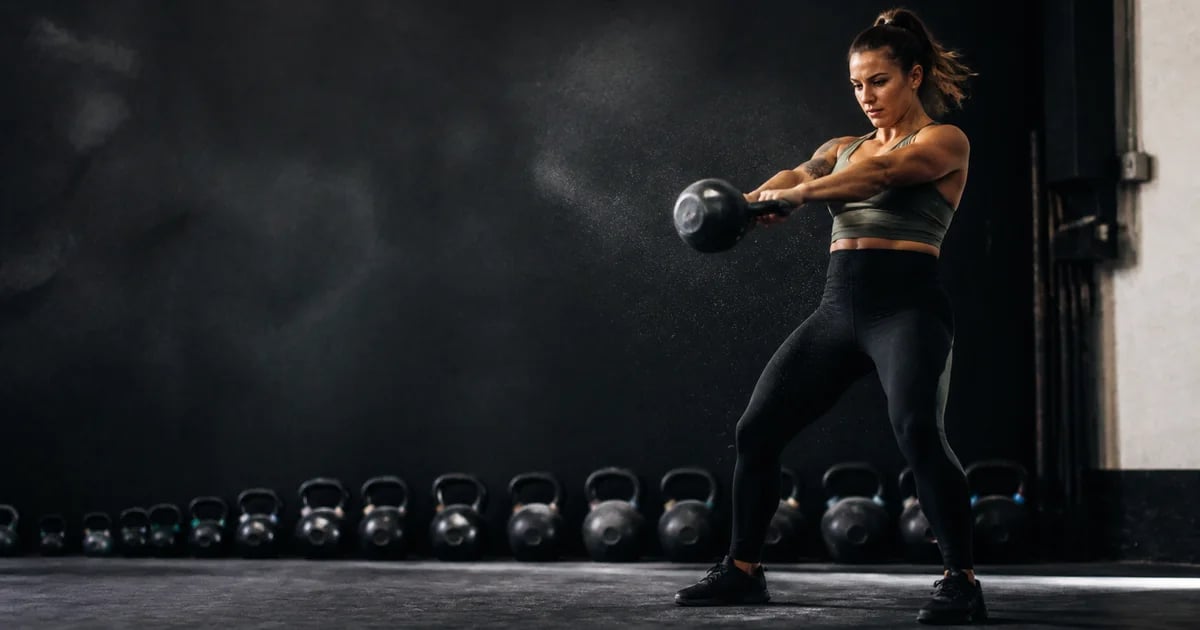
If you learn only one kettlebell exercise, make it the swing. It is an explosive hip movement, not a squat and not an arm lift. The bell swings because the hips launch it forward, and the arms are just the rope that guides it.
The key details I always fix with clients:
- The move comes from the hips. Push the hips back, then snap them forward hard. The back stays flat the whole time.
- The bell floats. At the top the bell is weightless for a second. You do not lift it with your shoulders, the hips throw it.
- A firm finish. At the top squeeze the glutes and trunk. The body is an upright plank, not a lean backward.
Swings in sets of 10 to 20 reps build both strength and conditioning. That is why I call it the foundation. Once you master it, the other exercises come far more easily.
The Turkish get-up: slow, but worth gold
The get-up is the slowest exercise in the guide, and many skip it because it is not flashy. A mistake. The get-up teaches you to keep the shoulder stable while you rise from the floor to your feet with the bell overhead. That is pure control.
For a hybrid athlete the get-up builds shoulder stability, hip mobility and the link between the upper and lower body. I do it light, with a smaller weight, two to five reps per side. This is a quality exercise, not a fatigue one. Done right, the get-up protects your shoulders for years.
The clean and press: full body strength
The clean and press takes the bell from the floor to the shoulder, then overhead. One movement that asks for explosion from the hips for the clean and full body tightness for the press. This is my main exercise when I want to build strength that truly carries into life.
The clean has to be soft, the bell rolls around the hand and does not bang the forearm. The press starts from a tight trunk, not from a loose back. I do it in lower reps when the focus is strength, or in longer sets when I want conditioning. Same movement, two different effects, depending on how I program it.
Complexes: when the kettlebell becomes conditioning
A complex is a series of kettlebell exercises done one after another without putting the bell down. For example five swings, five cleans, five presses, five squats, and only then you set the bell down. It is conditioning work that builds strength at the same time, and my secret for hard days in the X Hybrid System.
- No pause inside the complex. Moving from exercise to exercise keeps the heart rate up and turns strength into conditioning.
- Pick the weight by the weakest exercise. The bell has to be light enough to do the hardest part of the complex with clean technique.
- Short and hard. A few rounds of a complex in about ten minutes give more than half an hour of dull cardio.
How to fit the kettlebell into your week
The bell slots nicely into a hybrid schedule because it can be a strength day or a conditioning day, depending on how you set it up. Here is how I usually place it:
- Strength day. Heavy clean and press and get-ups in lower reps, with plenty of rest. Here you build force.
- Conditioning day. Swings in sets and short complexes. Heart rate up, short and intense.
- As a finisher. A few sets of swings at the end of a barbell strength session, to add cardio without a separate run.
A beginner starts with two kettlebell sessions a week, using a lighter weight with a focus on technique. Only once the swing and get-up look clean do I add weight and complex complexes.
Let me build your kettlebell plan
The kettlebell is a simple tool, but its easy technique fools people into doing it badly and then their back hurts. If you want to use it properly, I would happily put together a plan and get your technique in order. I train clients online with individual programs where I review your videos, and I also offer 1 on 1 sessions here in Bijeljina. Your first consultation is free, so we can look at your goal and how the kettlebell would work for you. Get in touch and we start.
FAQ
- What kettlebell weight should I start with?
- It depends on you, but as a guide, men often start with 16 kilograms for the swing and a lighter bell for the get-up and press, while women start with 8 to 12 kilograms. More important than the weight is clean technique. At the consultation I recommend the exact weight for your level.
- Can a kettlebell replace barbell and dumbbell training?
- For many goals it can, especially for conditioning, the posterior chain and full body strength. If your goal is a maximal squat and bench press, the barbell still leads. For a hybrid athlete the kettlebell covers a huge share of the needs with one tool.
- Does the kettlebell swing hurt your back?
- Not if the movement is correct. The swing actually strengthens the posterior chain and often reduces back pain when done with clean technique. The problem comes when people lift the bell with their arms and round the back instead of driving from the hips. That is why technique goes before weight.
- How often should I do kettlebell training?
- Two to three sessions a week are plenty for clear progress in both strength and conditioning. In a hybrid plan I usually place one strength day with the bell and one conditioning day with swings and complexes. The exact schedule depends on the rest of your training.