How to Train Without a Personal Trainer
You do not need a coach to make real progress in the gym. What you need is a proven plan, correct form, tracked workouts and a way to stay consistent. Here is the complete system for training solo.
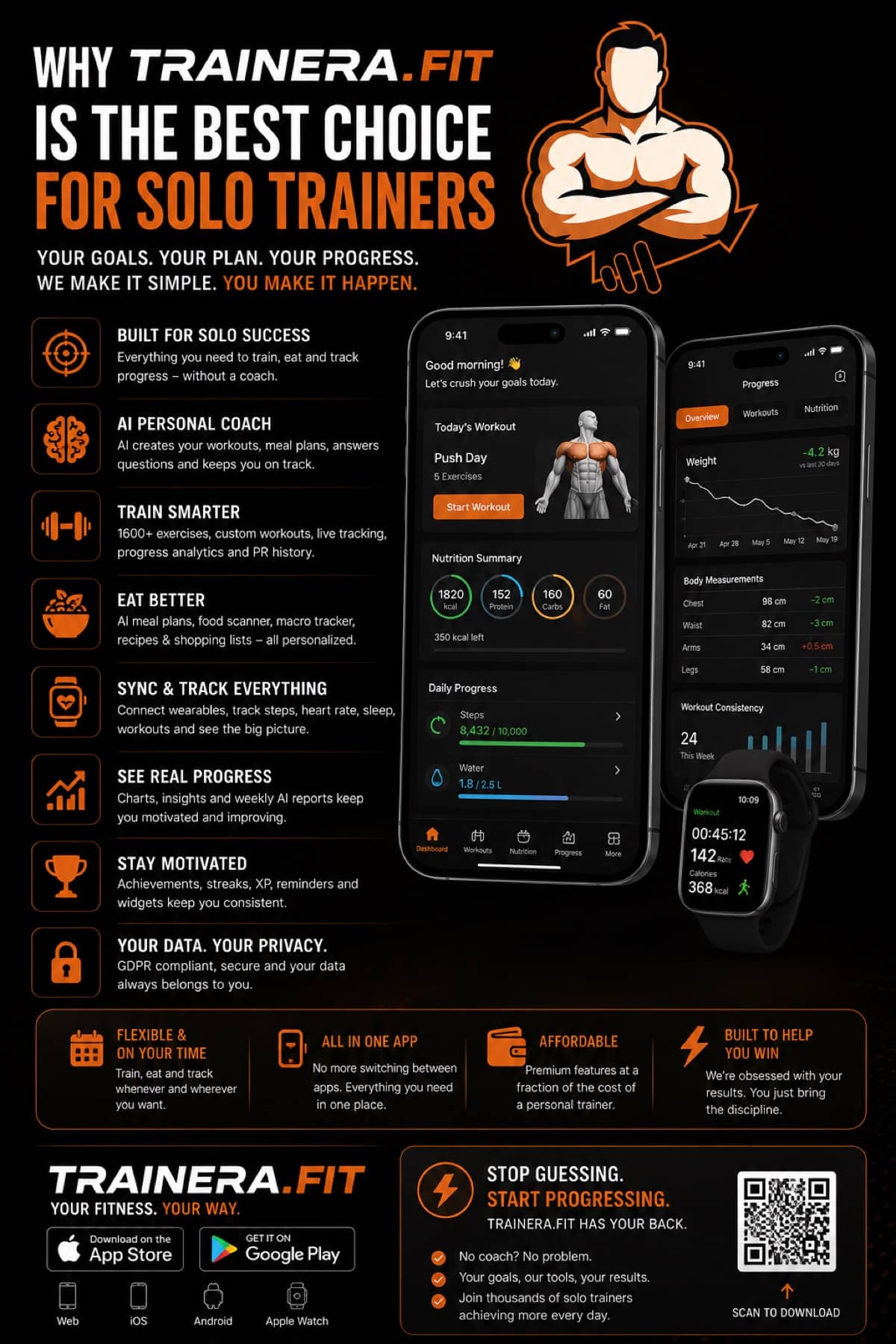
Get your free AI training and nutrition plan in 60 seconds
The Short Answer: Yes, You Can Progress Without a Coach
You can absolutely train without a personal trainer and still build muscle, lose fat and get stronger. What you need to replace is not the trainer, it is the four things a trainer provides: a proven plan, correct technique, tracked progression and accountability. Cover those four and your results come down to consistency, with or without a coach standing next to you.
The mistake most solo trainees make is skipping straight to the workout and improvising. They walk in, do whatever machines are free, never write anything down, and after six months look exactly the same. This guide gives you the system that prevents that.
What a Personal Trainer Actually Gives You
Before you replace something, know what it does. A good trainer provides:
- A program - what to train, how often, with which exercises, sets and reps
- Technique feedback - so you work the right muscles and avoid injury
- Progression - deciding when to add weight, reps or volume
- Accountability - a reason to show up when motivation dips
Every one of these can be replaced with a bit of knowledge and the right tools. Let's go through them one by one.
Step 1: Follow a Proven Plan, Do Not Invent One
The fastest way to waste a year is to improvise your training. As a solo trainee your first job is to pick an established program that matches your level and schedule: a full-body plan two to three times per week for beginners, or an upper/lower or push-pull-legs split when you can train four or more times per week.
You do not have to write it yourself. In the Trainera app, self-training mode lets you start from ready-made template plans or build your own from a library of 1800+ exercises, then follow it day by day with everything laid out. If you would rather understand the logic and construct one from scratch, our guide on how to build a workout routine from scratch walks through the whole process.
Whatever you choose, commit to it for at least 8 to 12 weeks. Program-hopping every two weeks is the solo trainee's most common self-sabotage.
Step 2: Learn Technique From Video, Not Guesswork
Without a trainer watching your form, video becomes your teacher. Before doing any exercise for the first time, watch a proper demonstration, understand which muscle should be working, and start lighter than you think you need. A few rules protect you while you learn:
- Start with a weight you can control for all reps with clean form
- Use a full, controlled range of motion, especially on the lowering phase
- If a rep needs momentum, swinging or breath-holding heroics, it is too heavy
- Film yourself occasionally from the side and compare to the demonstration
Exercise libraries with video demos exist exactly for this. Every exercise in Trainera comes with a video demonstration and a muscle map showing what should be working, so you are never guessing in front of the rack.
Step 3: Track Every Set (This Replaces Half the Trainer)
Here is the uncomfortable truth: the single biggest difference between people who progress and people who stall is not the program, it is tracking. Muscle grows when you gradually do more over time, and you cannot do more than last week if you do not know what you did last week.
Log every exercise, weight, set and rep count, every session. A notebook works; an app works better because it shows your previous numbers next to the current set and keeps your personal records automatically. When you log a workout in Trainera, the app shows exactly what you lifted last time, tracks your PRs per exercise, and runs a rest timer between sets, which is precisely the data a trainer would keep for you.
Step 4: Progress With a Simple Rule
Progression does not require a coach's intuition, it requires one rule applied honestly: each week, try to beat something. One more rep with the same weight, or a small weight increase once you hit the top of your rep range. That is progressive overload, and it is the entire engine of muscle and strength gain. Our guide to progressive overload covers the details and the ways to progress when adding weight stalls.
Combine that with staying 1 to 3 reps short of failure on most sets, resting 2 to 3 minutes on heavy compound lifts, and training each muscle roughly twice per week, and you have covered what most beginner and intermediate programming boils down to.
Step 5: Keep Nutrition Simple and Consistent
Training solo usually means handling your own nutrition too. Do not overcomplicate it: enough protein (roughly 1.6 to 2.2 g per kg of bodyweight), calories matched to your goal (surplus to build, deficit to lose fat), and mostly whole foods. The tricky part is knowing what you actually eat, which is where logging helps. Trainera's built-in diet tracker lets you log meals by photo with AI, scan barcodes, and watch your daily macros fill in, so nutrition stops being a guessing game.
Staying Consistent Without Anyone Watching
Accountability is the hardest thing to replace, because nobody is waiting for you at the gym. What works for solo trainees:
- Schedule workouts like appointments - fixed days and times, in your calendar
- Make streaks visible - achievements, XP and streak counters give your brain small wins; Trainera awards them automatically as you log workouts
- Set reminders - workout and meal notifications remove the "I forgot" excuse
- Watch the trend lines - weight, measurements and strength charts prove it is working, which is the strongest motivator there is
- Never miss twice - one skipped session is life; two in a row is a new habit forming
When Hiring a Coach Does Make Sense
Training solo is a complete, legitimate path. Still, there are moments when a coach pays for itself: recovering from an injury, preparing for a competition, breaking a long plateau, or when you simply want someone else to think for you. The nice part is that it is not all-or-nothing anymore. On Trainera you can train solo in self-training mode and later hire a certified trainer from the marketplace inside the same app, keeping all your workout history, PRs and progress data in one place.
Your Solo Training Checklist
Everything above in one list:
- Pick a proven program for your level and stick with it 8 to 12 weeks
- Learn every exercise from video demos and start light
- Log every set, rep and weight, every session
- Beat something small each week (a rep or a little weight)
- Eat enough protein and match calories to your goal
- Schedule sessions, protect the streak, never miss twice
That system, executed for months, beats talent and beats motivation. If you want all of it in one place, Trainera gives solo trainees template plans, video exercise demos, set-by-set tracking, a diet tracker and achievements to keep the streak alive, free to start, no coach required.
Related reading
Frequently Asked Questions
Can you get results in the gym without a personal trainer?
How do I know my form is correct without a trainer?
What is the best way to plan workouts without a coach?
How often should I train if I work out alone?
Keep Reading
Put this into practice with Trainera
Get your free AI training and nutrition plan in 60 seconds
1800+ exercises, wearables and progress tracking, free with no card needed. AI food scanning comes with Premium. Train solo or with a certified coach.