
Ankle Sprain: How to Return to Training Safely
How to return to training and sport after an ankle sprain: recovery phases, strength and balance exercises, return to sport criteria and the mistakes that make sprains come back.
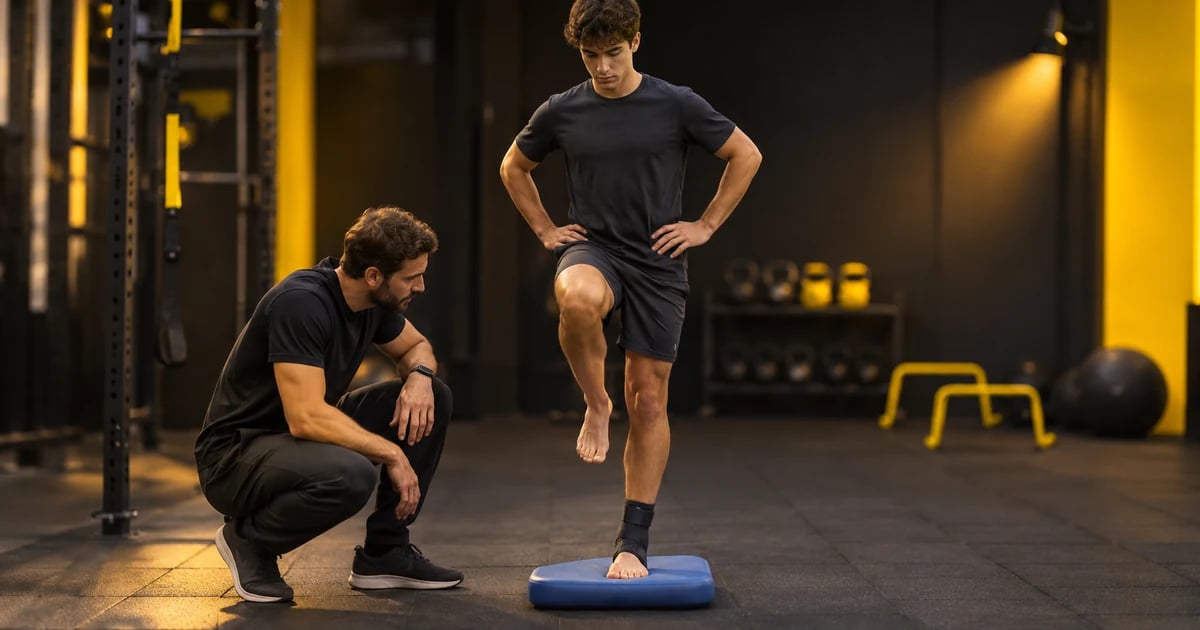
After an ankle sprain, the fastest route back to training is early, graded loading, not long rest. Protect the joint for the first days, then restore mobility, calf strength and balance, and only then add jumps and cutting. Return to sport when you pass the tests, not by the calendar. Get a serious sprain checked by a doctor first.
My name is Amer Mićivoda, a sports teacher and coach from Goražde in Bosnia and Herzegovina, and a large part of my work at FitLab is rehabilitation and corrective training. Ankle sprains are among the most common injuries I see, in footballers, basketball players, recreational athletes and people who simply slipped on a step. The real problem is rarely the sprain itself. It's that it keeps coming back, because rehab stops as soon as the pain does. In this article I show you what a sensible return looks like.
What happens in an ankle sprain
The most common sprain happens when the foot suddenly rolls inward while body weight shifts outward. The ligaments on the outside of the ankle are stretched or partly torn. Sprains are roughly graded in three levels: from a mild stretch without instability, through a partial tear with swelling and pain when walking, to a complete tear with clear instability.
Ligaments heal more slowly than muscle, and the sense of joint position is disturbed as well. Nerve receptors in and around the ligaments tell the brain where the foot is. When they're damaged, the ankle reacts more slowly to uneven ground. That's why rehab is about more than making the pain go away.
When to see a doctor straight away
As a coach I don't diagnose. If any of the following applies, see a doctor or orthopaedic specialist first:
- you can't take four steps right after the injury or later,
- the bone is painful to press, especially on the inner or outer ankle bone or the middle of the foot,
- the joint looks deformed or the swelling is very large,
- you feel numbness, tingling or coldness in the foot,
- it isn't improving after five to seven days.
Once a fracture is ruled out and your doctor clears you to load the ankle, the real work begins.
The phases of returning to training
The time frames in the table apply to mild and moderate sprains. More severe injuries take longer, and the pace is set by how your ankle responds, not by the calendar.
| Phase | Roughly | Goal | Example exercises |
|---|---|---|---|
| Protection | days 0 to 3 | settle swelling, protect the ligament | elevation, compression, gentle pain free toe and foot movement |
| Mobility and walking | days 3 to 14 | restore range of motion and normal gait | ankle circles, writing the alphabet with your foot, double leg calf raises, walking |
| Strength and balance | weeks 2 to 6 | strong calf, stable ankle | single leg calf raises, band work for the outer lower leg muscles, single leg stance, then eyes closed |
| Hops and cutting | weeks 4 to 8 and beyond | ready for sport | hops on the spot, lateral hops, figure eights, sprints with changes of direction, sport specific drills |
Throughout every phase, the rest of the body keeps training. Upper body, trunk and the healthy leg can be trained normally, and easy cycling is often possible early on. How active movement supports recovery, I explain in Active recovery: what to do on a rest day.
Why balance is the most important part of rehab
The biggest risk factor for an ankle sprain is a previous ankle sprain. People who have rolled an ankle once are much more likely to do it again, and some develop chronic instability, the feeling that the ankle gives way. Research consistently shows that balance and proprioception training reduces the risk of re-spraining.
So I never skip balance work. We start with standing on one leg on a firm surface, then with eyes closed, then on a soft surface, then while catching a ball or turning the head. Finally come single leg landings, where I watch the hip and knee as well as the ankle. Knee control on landing is closely linked to the ankle, which I cover in Knees Caving In: Knee Valgus in Squats and Landings.
Criteria for returning to sport
Pain that disappears when walking doesn't mean you're ready for a match. Before returning to the pitch or court, I want the ankle to pass several checks without pain or fear: full range of motion compared with the healthy side, roughly equal single leg calf raises left and right, steady single leg stance with eyes closed, and hops and lateral jumps on the injured leg without compensation. Only then do we add sprints with changes of direction and team training, step by step.
There is a psychological side too. Many athletes recover physically but protect the leg in their first duels and avoid landing on it. That guarding changes the movement pattern and overloads other areas, usually the opposite knee and hip. So in the final weeks of rehab I deliberately add match-like situations, so confidence in the ankle grows along with strength.
In the first months after returning, an ankle brace or tape during sport can further reduce the risk of another sprain. It's a useful extra, not a replacement for strength and balance training.
The most common mistakes
The first mistake is complete rest for two or three weeks. The joint stiffens, the calf weakens and the return takes longer. The second is going back to sport as soon as walking stops hurting, without a single balance exercise. The third is relying only on massage, ice and creams while active work is missing. And the fourth is ignoring the whole chain. A weak hip and poor knee control shift more load onto the ankle. If your ankle feels stiff after a long break, it's worth reading about mobility in Static vs Dynamic Stretching: What to Use When.
How I guide the return after a sprain
I do rehabilitation and corrective training in agreement with your doctor or physiotherapist when they're involved. First I assess mobility, strength and balance and compare the injured and healthy sides, then I build a program that takes you from the first steps back to full sport. For athletes I fit it around team training, for recreational clients around work and daily life. If you're recovering from a sprain or your ankle keeps rolling, see how I work with clients and get in touch. I coach in person in Goražde and online.
FAQ
- How long does an ankle sprain take to heal?
- A mild sprain often settles in two to three weeks, a more severe one can take six weeks or longer. Return to sport isn’t decided by the calendar, but by passing strength, balance and hopping tests without pain.
- Should I rest completely after an ankle sprain?
- Protect the joint for the first day or two, but long rest slows recovery. As soon as pain allows, start gentle movement, walking and gradually increasing load.
- When should I see a doctor for an ankle sprain?
- If you can’t take four steps, the bone is painful to press, the joint looks deformed or you feel numbness, get it checked. The same applies if it isn’t improving after several days.
- Why do I keep rolling my ankle?
- The most common reason is unfinished rehab, especially balance work and strength in the muscles on the outside of the lower leg. Without that the ankle stays unstable and the risk of another sprain is higher.