
Knees Caving In: Knee Valgus in Squats and Landings
What dynamic knee valgus is, when it really matters, the most common causes, and how I test and correct it through hip strength, ankle mobility and landing training.
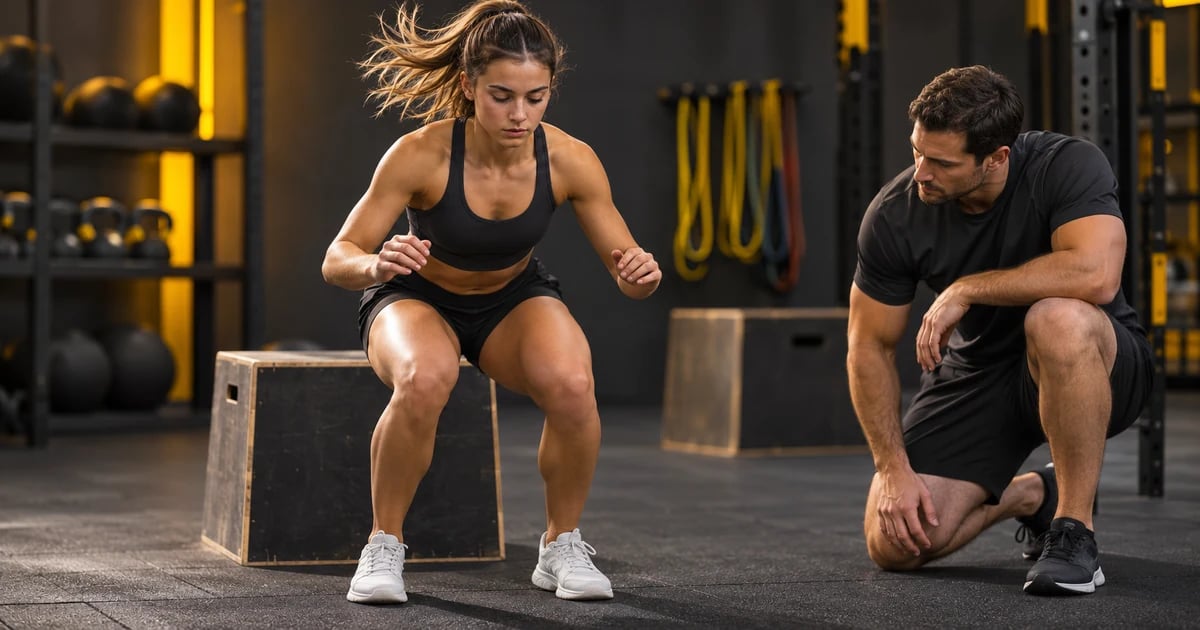
Knee valgus is when your knees cave inward, most often in a squat, lunge or landing. A small shift under heavy load is common and not always a problem. Marked, repeated valgus during landings and cutting is linked to a higher risk of knee injury. The fix: find the cause and train hip strength, ankle mobility and technique.
My name is Amer Mićivoda, a sports and physical education teacher, and my work at FitLab in Goražde, Bosnia and Herzegovina, is built on biomechanics and functional anatomy. Knee valgus is one of the first things I look at in a movement analysis, whether in front of me is a young basketball player, a footballer or a recreational lifter whose knee aches after squats. In this article I explain what valgus is, when it should concern you and how I correct it step by step.
What knee valgus actually is
When you watch someone from the front as they squat or land, the knee should roughly follow the line of the foot, over the second or third toe. In valgus the knee drifts inward toward the midline while the thigh drops and rotates inward, and the foot often collapses. We call this dynamic valgus because it happens in motion, unlike structural knock knees that someone has even when standing still.
Dynamic valgus isn't only about the knee. The knee sits between the hip and the ankle, and it usually just shows what's happening above and below it.
Is all valgus bad?
No. In very heavy squats many lifters show a brief inward knee shift out of the bottom, and that alone doesn't mean injury. Context is everything. What's risky is marked valgus in fast, explosive movements: landing from a jump, sudden braking, cutting. Forces are high there and reaction time is short. Research links that pattern with a higher risk of anterior cruciate ligament injury, and female athletes in jumping and cutting sports carry a higher risk than male athletes.
In recreational trainees without an acute injury, valgus more often shows up as pain at the front of the knee after squats, lunges or running.
The most common causes
There's rarely only one cause. In assessments I most often find a combination of these factors:
- Weak hip control: the muscles on the side and back of the hip, especially the gluteus medius, don't hold the thigh in a good position.
- Limited ankle dorsiflexion: if the knee can't travel forward over the foot, the body finds room by letting the knee drop in and the foot flatten.
- Foot control: a collapsing foot pulls the whole chain inward.
- Habitual pattern: some people have simply never learned to land and squat differently.
- Fatigue: valgus often gets worse late in a session or a match, when control fades.
How I test for valgus
Without testing, correction is guesswork. These are the tests I use most:
| Test | What I look at | What it may indicate |
|---|---|---|
| Double leg squat | knee path, foot position, symmetry | basic pattern and habit |
| Single leg step-down | whether the knee drifts in and the pelvis drops | hip control on one leg |
| Knee to wall test | how far the knee travels over the foot, left and right | ankle mobility |
| Drop landing from a box | knee position at touchdown and shock absorption | reactive control at speed |
| Side plank and single leg hold | time and quality | strength and endurance of the lateral hip muscles |
I film every test from the front, because slow motion shows far more than the naked eye. I use the same approach online when a client sends me video.
Correcting it step by step
Order matters. First I remove restrictions, then build strength, then teach the movement, then check it under speed and fatigue.
Mobility first. If the ankle is stiff, we work on dorsiflexion: calf stretches against the wall, knee-forward lunges, light load over the knee. Why mobility matters before load is something I also touch on in Static vs Dynamic Stretching: What to Use When.
Then hip strength. I start with simple exercises like side planks and side-lying clamshells, then progress to banded lateral walks, single leg Romanian deadlifts, Bulgarian split squats and step-downs. The aim isn't just to make the muscle burn, but to learn to switch it on at the right moment.
Then the pattern. In the squat I use simple cues: a tripod foot on the floor, knee follows the second toe, hips go back and down. A mini band around the knees can help as feedback, but it isn't a solution by itself.
Finally landing and speed. First we learn a static landing, then landing from a low box, then jumps forward and sideways, then single leg landings and cutting. Only once the pattern is stable do we add fatigue, because the real test happens in the last ten minutes of a match.
Young athletes
With young athletes this matters even more, because patterns learned in the teenage years stick for a long time. Structured warm-up programs that include strength, balance and landing drills have been shown to reduce knee injuries in young players. Every session should begin with that kind of preparation, as I explain in Warm-Up Before Training: What Science Really Says. For players heading into preseason, this is part of the plan in Preseason Conditioning for Footballers.
When to see a doctor first
If your knee swells after a twist, if you heard or felt a pop, if the knee locks, gives way or hurts at rest, don't start correcting it on your own. See a doctor or orthopaedic specialist first and continue training in agreement with them.
How I work with knee valgus
My approach is strictly systematic: first detect the dysfunction through analysis and testing, then remove it with targeted exercises, and only then add conditioning and load. That way you protect your knee not just in the gym, but on the pitch or court, where it matters most. If you notice your knees caving in or your knee hurts after training, see how I work with clients and get in touch for a movement analysis. I coach in person in Goražde, and I can also do the analysis online from video.
FAQ
- Is it bad if my knees cave in when I squat?
- A small, brief inward shift under heavy load isn’t dangerous in itself. Marked, repeated valgus during landings and changes of direction is riskier, especially for athletes, because it’s linked to a higher risk of ACL injury and knee pain.
- Which muscle causes knee valgus?
- There isn’t just one. Most often it’s weaker control of the hip muscles, especially the gluteus medius, but limited ankle mobility, foot control, technique and fatigue also play a part.
- How long does it take to fix knee valgus?
- With regular work two to three times a week, the first changes in control often show within four to six weeks. Making the new pattern automatic and stable under fatigue usually takes a few months.
- Do mini bands around the knees help?
- They can give useful feedback so you feel your hip muscles working, but on their own they don’t solve the problem. Without hip strength, ankle work and landing training the effect doesn’t last.