
Preseason Conditioning for Footballers in Goražde and the Drina Valley
What professional preseason conditioning for footballers looks like: assessment, aerobic base, strength, speed and the transition into the season, with prevention of the most common injuries.
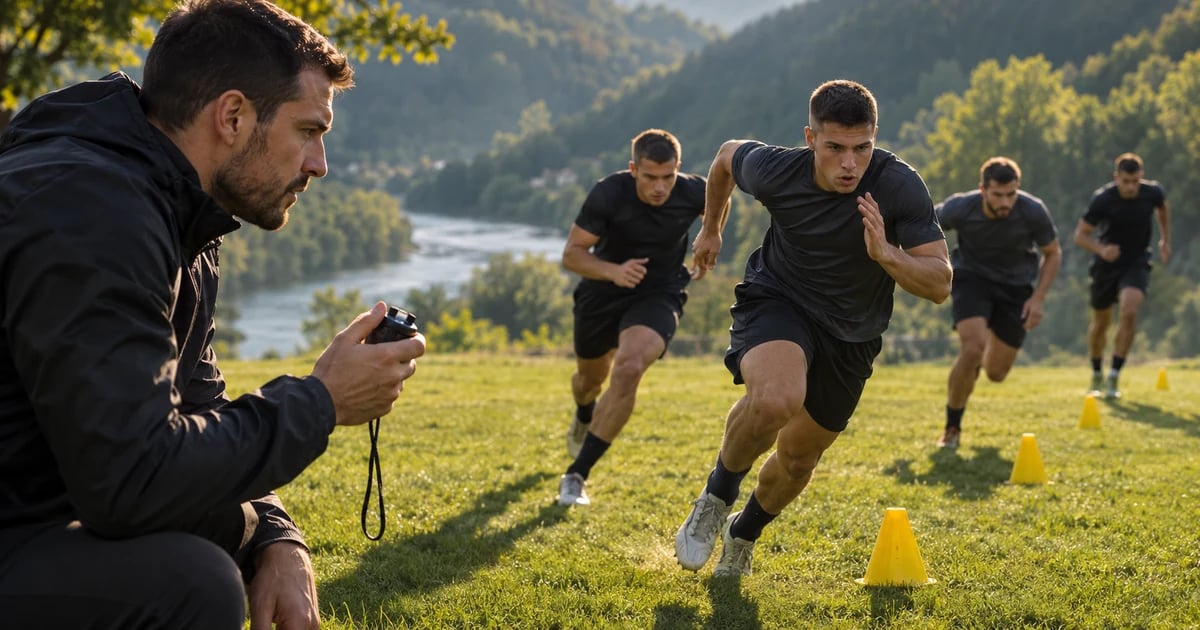
A good football preseason lasts six to eight weeks and follows a clear order: movement assessment and aerobic base first, then strength, then speed and repeated sprints, and finally a transition into the season with less volume. It starts before the first team session, not with it, and includes exercises proven to reduce injuries.
My name is Amer Mićivoda. I'm a sports and physical education teacher and a certified functional trainer (CFT, Perform Better Europe), and at FitLab in Goražde, Bosnia and Herzegovina, I work on athlete conditioning and movement biomechanics. Every year I see the same pattern: a summer break, then a first week of preseason spent running lap after lap, and by week two the pulled hamstrings and sore groins arrive. In this article I show you how to build a preseason properly, step by step, whether you play in Goražde, elsewhere in the Drina valley or train with me online from abroad.
Why most players start preseason too late
Amateur and club footballers usually get a break of four to six weeks. In that time aerobic fitness and strength drop noticeably, and the hamstrings and tendons lose some of their tolerance for fast, explosive movement. Then the first team session arrives and the coach wants to see who is ready. Volume jumps overnight and the tissue simply cannot adapt in time.
That's the classic route to the overuse problems I described in Overuse injuries: how to spot and prevent overtraining a tissue. The answer isn't running more in week one. It's arriving at the first session already prepared.
What football actually demands from the body
Football is not a marathon. During a match a player makes many short sprints, sudden changes of direction, jumps, landings and duels, with walking and easy jogging in between. That's why conditioning has to cover three things at once:
- Aerobic base: not for long runs, but because a better aerobic system means faster recovery between sprints.
- Strength and power: stronger legs, hips and trunk give you a quicker start, a higher jump and stability in duels.
- Tissue resilience: hamstrings, groin, knees and ankles have to tolerate braking, landing and cutting.
The phases of a football preseason
This is the framework I use for most amateur and club players. I adjust the details to position, test results and injury history.
| Phase | Weeks | Focus | Example content |
|---|---|---|---|
| Assessment and base | 1 to 2 | movement analysis, aerobic base, basic strength | tests, steady moderate runs, squats, lunges, plank variations |
| Strength and aerobic capacity | 3 to 4 | more strength, prevention, intervals | Bulgarian split squats, Romanian deadlifts, Nordic curls, Copenhagen adduction, 4 x 4 minute intervals |
| Speed and power | 5 to 6 | sprinting, jumping, change of direction | 10 to 30 metre sprints, jumps and landings, repeated sprints with short rests |
| Transition into season | 7 to 8 | lower volume, intensity maintained | shorter strength sessions, speed maintenance, fitting around team training |
Every session starts with a proper warm-up. Why it matters and how to structure it, I explain in Warm-Up Before Training: What Science Really Says.
Injury prevention: hamstrings, groin, knees, ankles
If I had to choose only two exercises for every footballer, they would be the Nordic hamstring curl and the Copenhagen adduction. Research in football shows that doing them regularly significantly reduces injuries in those areas. Both are introduced gradually, because they cause heavy soreness if you overdo them early on.
Knees and ankles are protected through good landing mechanics, keeping the knee in line with the foot and single leg balance. Players whose knees cave inward when they land carry a higher risk, so I pay special attention to that. I go deeper in Knees Caving In: Knee Valgus in Squats and Landings, and cover returning after a sprain in Ankle Sprain: How to Return to Training Safely.
How I test players
Without testing you don't know where you start or whether the preseason worked. You don't need expensive equipment. I use simple, repeatable tests: 10 and 30 metre sprints, a standing jump, an intermittent recovery endurance test and a single leg movement check where I watch the stability of the hip, knee and foot. We test at the start and the end, under the same conditions and on the same surface. If a player shows a clear left to right difference at the start, that becomes a priority in the program.
Conditions in Goražde and the Drina valley
Summer preseason in the Drina valley means heat and humidity, so I schedule hard sessions early in the morning or in the evening, with enough water and rest. Winter preparation for the spring half of the season brings a different problem: it's cold, days are short and indoor hall time is limited. Then we do strength work in the gym and aerobic work and sprints outdoors when the weather allows, along the river or on the pitch.
Many players from this region study or work in Sarajevo or abroad and play for their home club at weekends. For them, an online plan with a weekly check-in is often the only realistic way to arrive ready for the first session.
The most common preseason mistakes
The first mistake is making long runs the main content of preseason. An aerobic base matters, but without strength and speed a player becomes a good runner, not a better footballer. The second is skipping strength work because the legs are already tired from the pitch. Tired legs without strength are exactly the ones that get injured. The third is giving every player the same workload regardless of position, age and injury history. And the fourth: no lighter week. A short period of reduced volume before the first match isn't losing fitness, it's how fitness shows up on match day. More on that in Deload Weeks: Why Backing Off Makes You Stronger.
How I run a preseason
Every preparation starts with movement analysis and testing, because raising intensity only makes sense once the mechanics are right. From there I build a phased program that fits around team training and your other commitments, and I track progress with repeated tests. I have worked with more than 1,000 people of very different profiles, from professional athletes to recreational players, and the same logic applies to all of them: movement quality first, then load. If you're a player or a coach who wants this preseason to be different, see how I work with athletes and get in touch for a free consultation. I coach in person in Goražde and online.
FAQ
- How long should a football preseason be?
- For amateur and club players, six to eight weeks is realistic. The first two weeks cover assessment and base fitness, then strength and aerobic capacity, then speed and power, and the final weeks bridge into the season with less volume.
- Do footballers need strength training in preseason?
- Yes. Strength in the legs, hips and trunk improves speed, jumping and duels, and exercises like the Nordic hamstring curl and Copenhagen adduction have been shown to reduce hamstring and groin injuries.
- Can I do the preseason on my own if I live abroad?
- Yes. An online plan includes the phased program, video demonstrations of every exercise, a weekly check-in and adjustments based on your tests and your team training schedule.
- Which tests should footballers do before the season?
- Simple, repeatable tests work best: 10 and 30 metre sprints, a standing jump, an intermittent recovery endurance test and a single leg movement check. Repeat them after six to eight weeks to see your progress.