Compound vs Isolation Exercises: Which Build More Muscle?
Should you focus on compound or isolation exercises? Learn the science behind each type, when to use them, and how to combine both for maximum muscle growth and strength.
Get your free AI training and nutrition plan in 60 seconds
Understanding the Two Types of Resistance Exercises
Every resistance exercise falls into one of two categories: compound or isolation. Understanding the difference - and knowing when to use each - is one of the most important decisions you can make in your training program. The right balance between these two types determines how efficiently you build muscle, gain strength, and develop a proportional physique.
What Are Compound Exercises?
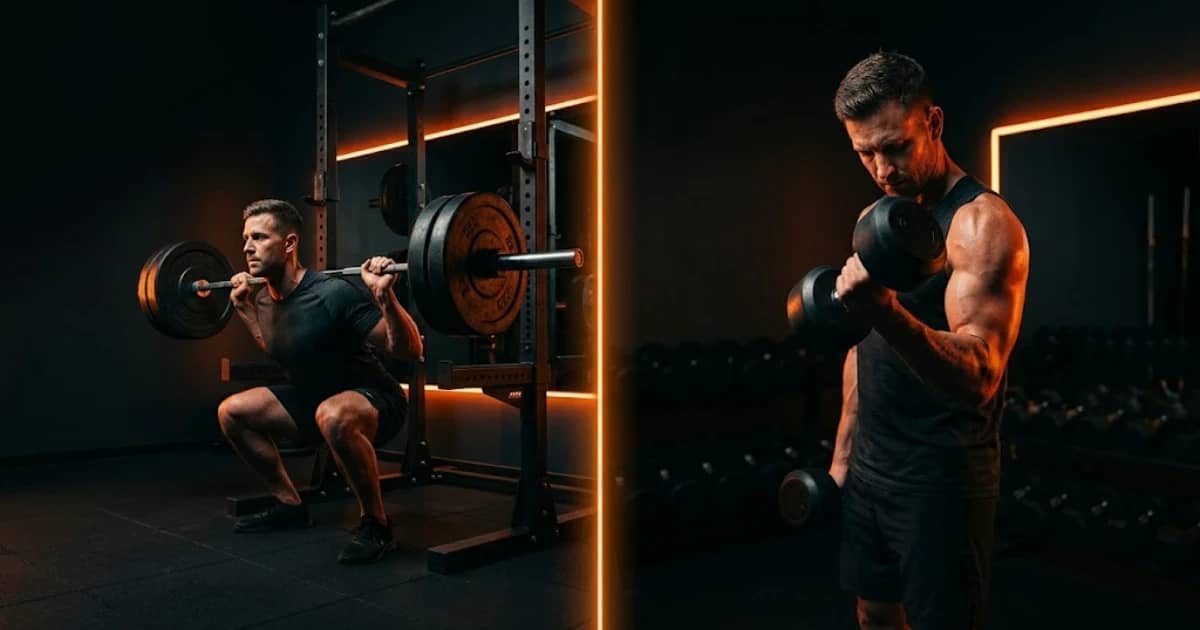
Compound exercises involve movement at two or more joints and recruit multiple muscle groups simultaneously. They mimic natural human movement patterns and allow you to lift heavier weights than isolation exercises.
The Big 5 Compound Exercises
- Squat: Works quads, glutes, hamstrings, core, and lower back
- Deadlift: Works entire posterior chain - hamstrings, glutes, back, traps, grip
- Bench Press: Works chest, front delts, and triceps
- Overhead Press: Works shoulders, triceps, and upper chest
- Barbell Row: Works lats, rhomboids, rear delts, and biceps
These five exercises alone can build an impressive physique because they target virtually every major muscle group in the body.
Benefits of Compound Exercises
- Greater muscle activation: Multiple muscle groups working together means more total muscle fiber recruitment per exercise
- Heavier loads: You can lift significantly more weight, creating greater mechanical tension - the primary driver of muscle growth
- Hormonal response: Heavy compound lifts trigger a greater release of testosterone and growth hormone compared to isolation work
- Time efficiency: Training multiple muscles simultaneously means effective workouts in less time
- Functional strength: Compound movements build strength that transfers to real-world activities and sports
What Are Isolation Exercises?
Isolation exercises involve movement at a single joint and target one specific muscle group. They allow you to focus all effort on a particular muscle without other muscles compensating.
Common Isolation Exercises
- Bicep curls: Targets biceps only
- Lateral raises: Targets side delts only
- Leg curls: Targets hamstrings only
- Tricep pushdowns: Targets triceps only
- Calf raises: Targets calves only
- Chest flyes: Targets chest with minimal tricep involvement
Benefits of Isolation Exercises
- Targeted development: Fix muscle imbalances and develop lagging body parts
- Mind-muscle connection: Easier to feel the target muscle working, improving muscle activation quality
- Joint-friendly: Lower loads and simpler movements place less stress on joints and connective tissue
- Injury rehabilitation: Strengthen specific muscles around an injured joint without loading the injury
- Muscle detail: Build the smaller muscles that give a physique its finished, detailed look
What Does the Science Say?
Research consistently shows that compound exercises produce greater overall muscle growth and strength gains when compared head-to-head with isolation exercises. A 2017 study published in the Journal of Strength and Conditioning Research found that multi-joint exercises produced superior strength gains and comparable hypertrophy to single-joint exercises in trained individuals.
However, isolation exercises are not useless. Research also shows that adding isolation work on top of a compound-based program produces greater hypertrophy in the targeted muscles than compound exercises alone. The key finding: compounds build the foundation, isolation adds the detail.
How to Combine Both for Maximum Results
The 80/20 Rule
A well-designed program should dedicate roughly 80% of training volume to compound exercises and 20% to isolation work. This ensures you build a strong, functional foundation while addressing any weak points or aesthetic goals.
Exercise Order Matters
Always perform compound exercises first when you are fresh and can lift the heaviest weights safely. Follow with isolation exercises to finish off specific muscles with targeted volume. Doing bicep curls before deadlifts would compromise your grip and reduce deadlift performance.
Sample Upper Body Workout
- Bench Press - 4 sets x 6-8 reps (compound)
- Barbell Row - 4 sets x 6-8 reps (compound)
- Overhead Press - 3 sets x 8-10 reps (compound)
- Lateral Raises - 3 sets x 12-15 reps (isolation)
- Bicep Curls - 3 sets x 10-12 reps (isolation)
- Tricep Pushdowns - 3 sets x 10-12 reps (isolation)
Sample Lower Body Workout
- Barbell Squat - 4 sets x 6-8 reps (compound)
- Romanian Deadlift - 4 sets x 8-10 reps (compound)
- Bulgarian Split Squat - 3 sets x 10-12 reps (compound)
- Leg Curls - 3 sets x 12-15 reps (isolation)
- Leg Extensions - 3 sets x 12-15 reps (isolation)
- Calf Raises - 4 sets x 15-20 reps (isolation)
When to Use More Isolation Work
There are specific situations where increasing isolation volume makes sense:
- Muscle imbalances: If one muscle is visibly lagging behind (e.g., small side delts despite heavy pressing), add isolation sets for that muscle
- Injury prevention: Strengthening rotator cuff muscles or the posterior chain with targeted work reduces injury risk
- Advanced lifters: After years of training, compound lifts alone may not provide enough stimulus for smaller muscles to keep growing
- Bodybuilding goals: If your goal is aesthetic proportion, isolation exercises let you sculpt specific areas
Build a Balanced Program with Trainera.fit
Knowing the difference between compound and isolation exercises is valuable, but programming them correctly - with the right volume, intensity, and progression - requires expertise. Trainera.fit connects you with certified personal trainers who design periodized programs that balance compound and isolation work based on your specific goals, experience level, and available equipment.
Track every set, rep, and weight with the Trainera.fit workout logger, monitor your progress over time, and communicate directly with your trainer to adjust your program as you grow. Whether you train at a gym or at home, a qualified trainer on Trainera.fit ensures every exercise in your program serves a purpose.
Related reading
- Best Chest Exercises for Size and Strength
- Push Pull Legs Split: The Complete Guide
- How Much Protein You Need to Build Muscle
- Full guide to bodybuilding in the year 2025
- Strength Training for Beginners: The Complete Guide
- Biceps or Triceps: Which Makes Arms Look Bigger?
- 8 Best Back Exercises for Width and Thickness
Frequently Asked Questions
Should beginners do isolation exercises?
Can you build muscle with only compound exercises?
How many isolation exercises should I do per workout?
Are machines better for isolation exercises?
Keep Reading
Put this into practice with Trainera
Get your free AI training and nutrition plan in 60 seconds
1800+ exercises, wearables and progress tracking, free with no card needed. AI food scanning comes with Premium. Train solo or with a certified coach.