How to Build Your Own Branded Fitness App (No Code)
You do not need developers or a six-figure budget to launch a fitness app under your own name. Here is how trainers and gyms build a fully branded app with no code.
The Short Answer: White-Label an Existing Platform
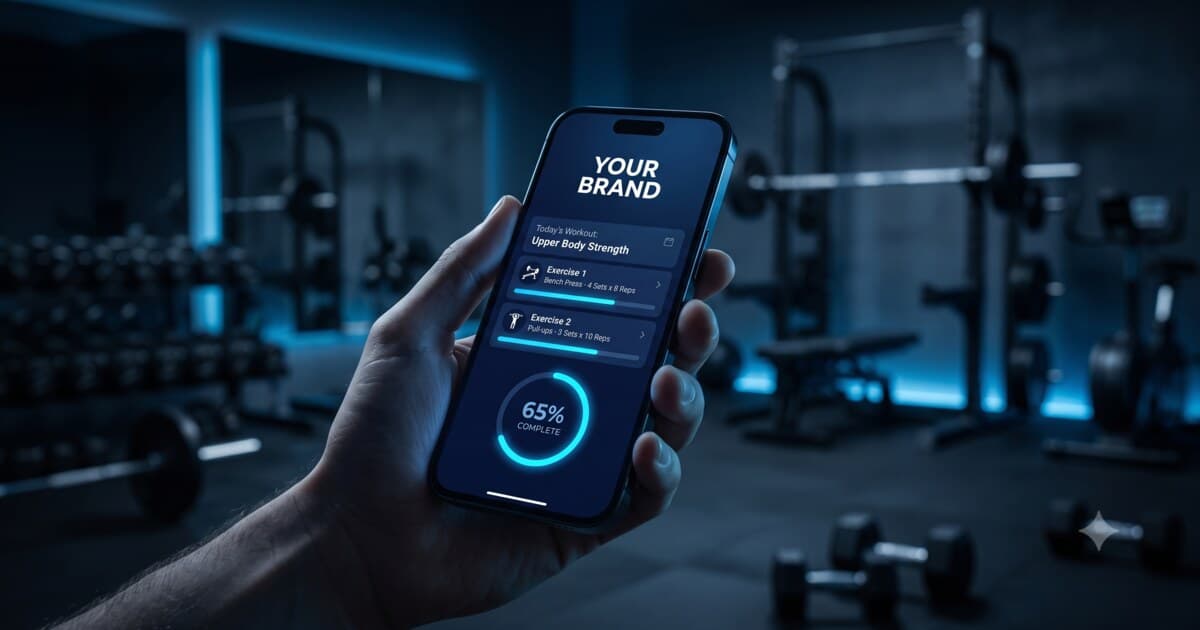
The fastest way to build your own branded fitness app with no code is to white-label a platform that already exists, rather than hiring developers to build one from scratch. With white-label software, the app, the coaching tools, the payments, and the tracking are already built. You add your logo, your colours, and your name, and it ships to the App Store and Google Play as your app, not the vendor's.
That single decision is the difference between launching in weeks for a predictable monthly fee and spending 6 to 12 months and tens of thousands of euros on custom development. For almost every personal trainer, coach, and gym, white-label is the right answer.
What "Branded Fitness App" Actually Means
A branded fitness app is an app your clients download that carries your identity end to end: your name in the App Store, your logo on the icon and splash screen, your colours in the interface, and ideally your own domain for the web version. Your clients never see the software vendor. As far as they are concerned, you built it.
Under that branded shell sits real functionality: workout plans, nutrition tracking, progress logging, messaging, and payments. The goal is that a client who trains with you experiences one seamless product with your name on it, instead of being sent to a generic third-party app that dilutes your brand.
Two Ways to Build One: Custom Dev vs White-Label
There are really only two paths, and they could not be more different.
Custom Development (Code It From Scratch)
You hire an agency or developers to design and build a native iOS and Android app plus a backend. You own the code, but you also own every cost: design, development, testing, App Store submission, servers, bug fixes, and every future feature. Realistic budgets start in the tens of thousands and run into six figures, and timelines of 6 to 12 months before launch are normal. Then maintenance never stops.
White-Label a Ready Platform (No Code)
You take a proven fitness platform and rebrand it. The vendor maintains the code, ships updates, keeps the app compliant with Apple and Google, and runs the infrastructure. You configure your branding and content and go live. There is no engineering team to hire and no codebase to maintain. This is the "no code" route, and it is how the overwhelming majority of branded fitness apps actually get made.
Why No-Code (White-Label) Wins for Most Trainers and Gyms
Building software is not your business. Coaching people is. White-labelling lets you put a professional app in front of clients without becoming a software company:
- Speed: launch in weeks instead of the better part of a year.
- Cost: a predictable subscription instead of an unpredictable build plus perpetual maintenance.
- No maintenance burden: updates, security, and OS changes are the vendor's job, not yours.
- Proven features: you inherit tools that have already been tested by thousands of real users.
- Focus: your energy goes into clients and content, not sprint planning and bug tickets.
The tradeoff is that you do not own the underlying code. For the vast majority of trainers and gyms, that is a price worth paying to launch this month instead of next year. If you are weighing the numbers, our breakdown of how much it costs to build a fitness app shows exactly where the money goes.
What Your Branded App Should Include
Before you pick a platform, know what a complete client experience needs. A serious branded fitness app should cover:
- Custom workout plans your clients follow, with sets, reps, and weights logged per session.
- Nutrition and meal plans plus a diet tracker for calories, macros, and water.
- Progress tracking for bodyweight, measurements, and progress photos.
- Exercise and meal libraries so you are not building content from zero.
- In-app messaging between you and your clients.
- Payments and subscriptions so clients pay you inside the app.
- Wearable integration to pull in steps, heart rate, and activity.
- Your branding across the app icon, colours, and, ideally, your own domain.
A platform like Trainera.fit ships with all of this already built, including large exercise and meal libraries, AI-generated training and nutrition plans, integrated payments, and wearable support, so your branded app is content-complete on day one.
Step-by-Step: Launch Your Branded App Without Code
1. Define Your Offer
Decide what clients get: one-to-one coaching, self-guided plans, group programs, or a mix. Your offer shapes which features matter most and how you will price it.
2. Choose a White-Label Platform
Pick a vendor that supports full branding (your name in the stores, your logo, your domain) and includes the features above. Confirm that white-label branding is part of the plan you are buying, since on most platforms, full branding sits on a premium or Enterprise tier.
3. Add Your Branding
Upload your logo, set your brand colours, and connect your domain for the web version. This is configuration, not coding. In an afternoon, the generic platform becomes recognisably yours.
4. Load Your Content
Bring in your workout and nutrition plans, or start from the platform's built-in libraries and adapt them. This is where your expertise makes the app feel bespoke.
5. Set Up Payments
Connect your payment details so clients subscribe or pay for coaching directly inside your app, and the money lands with you.
6. Invite Clients and Launch
Onboard your existing clients, then use your branded app as a selling point for new ones. A professional app under your name is a powerful differentiator against coaches still working out of spreadsheets and chat apps.
What It Costs and How Long It Takes
The two routes are worlds apart. Custom development typically means tens of thousands of euros and 6 to 12 months before a single client logs in, followed by ongoing maintenance costs forever. White-labelling a ready platform typically means a monthly or annual subscription and a launch measured in days or weeks, with maintenance handled for you.
For most trainers and gyms, the maths is decisive: the same money that buys a few months of custom development can run a fully branded white-label app for years, while you focus on clients instead of code. For the full picture on white-label fitness apps and how the branding works, see our dedicated guide.
Who Should Build a Branded App?
A branded app makes sense the moment your brand becomes an asset worth protecting and growing. That usually means personal trainers scaling past a handful of clients, online coaches who want to look as professional as the big names, and gyms and studios that want members engaging with their brand between visits. If you are still testing whether coaching is your business, start on a standard plan and upgrade to full branding when the brand is worth it.
Launch Your Brand, Not a Codebase
You do not need to become a software company to have a fitness app with your name on it. The no-code path is simple: white-label a platform that already has the features, the libraries, and the payments built in, add your branding, load your content, and launch. Weeks, not months. A subscription, not a six-figure build.
If you want to see what a fully branded app can look like under your own name, Trainera.fit offers white-label fitness apps on its Enterprise plan, with AI training and nutrition plans, integrated payments, wearables, and ready-made exercise and meal libraries, so you can put a professional, branded product in front of clients without writing a line of code.