Workout App vs Personal Trainer: Which Is Right for You?
A workout app is cheaper and always available, while a personal trainer offers hands-on feedback and real accountability. This guide breaks down the honest tradeoffs and shows why a hybrid setup often wins.
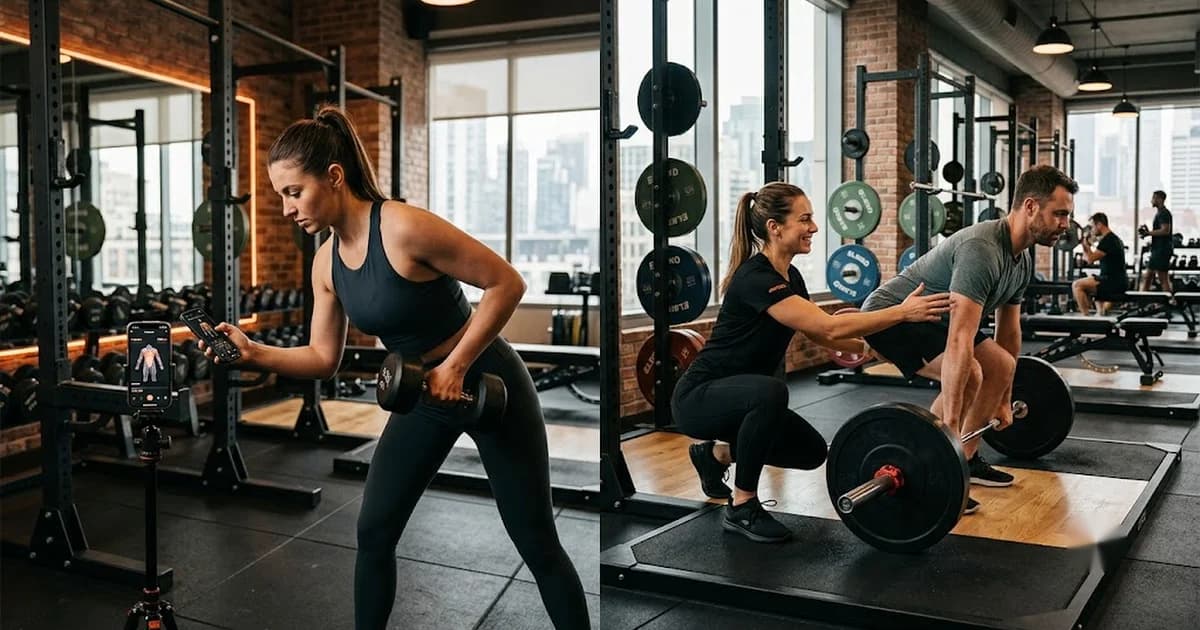
The real question is not which is better
Both a workout app and a personal trainer can get you fit. The honest question is which one fits your budget, your schedule, and the specific reason you keep falling off. The right answer depends less on features and more on what actually makes you show up and train hard. Below is a direct comparison across the five factors that matter, plus a third option most people overlook.
Before you compare them, get clear on your own situation. How much can you realistically spend each month? How consistent have you been on your own? Do you already know how to perform the basic lifts, or are you starting from zero? Your answers will point you toward one option long before any feature list does, so keep them in mind as you read.
Cost: the clearest difference
Cost is where these two options separate the fastest. A workout app is software, so the price is spread across everyone who uses it, and you pay a small recurring fee. A personal trainer sells time, and that time is expensive because there is only one of them and one of you in the room. A few sessions a week adds up to a serious monthly commitment.
This does not make trainers overpriced. You are buying attention, expertise, and someone whose job is to make you better. But if money is the reason you have not started, an app removes that barrier almost entirely. You can train seriously for the price of a couple of coffees a month, which is a big deal when the alternative is doing nothing.
There is also a hidden cost worth naming: the sessions you pay for but skip. With a trainer, a missed appointment is often money gone. An app carries no such penalty, so a bad week costs you nothing but lost time. If your life is unpredictable, that difference can matter as much as the sticker price.
Accountability: where most plans quietly die
Most fitness plans fail because life gets busy and no one notices when you skip. This is a trainer's biggest hidden advantage. When someone is waiting for you at a set time, and you have paid for it, you show up. That social pressure is real and it works for a lot of people who cannot self-motivate.
Apps fight this with streaks, reminders, progress charts, and adaptive plans that respond when you fall behind. For self-driven people this is plenty. But be honest with yourself here. If you have downloaded and abandoned three fitness apps already, the missing ingredient is probably human accountability, and that is worth paying for.
There is a middle ground too. Some people only need accountability at the start, until training becomes a habit, and then an app is enough to carry them. Others need it permanently. Knowing which type you are saves you from either overpaying for structure you do not need or quitting because you tried to go it alone too soon.
Personalization: general versus tailored
A good app personalizes through data. It asks about your goals, equipment, and experience, then builds a plan and adjusts weights, volume, and progression as you log workouts. Modern AI-driven apps do this well and update your program automatically as you get stronger.
A trainer personalizes through observation and conversation. They notice you slept badly, that your left knee is bothering you, or that you dread a certain exercise, and they adapt on the spot. That human read on your day and your mood is something software cannot fully replicate. For complex situations, injuries, or highly specific goals, that judgment is genuinely valuable.
For most everyday goals, though, the gap is smaller than it sounds. If you want to get stronger, lose fat, or build muscle with standard equipment, a well-designed app covers the fundamentals that drive almost all of your results. The trainer's edge shows up at the margins and in the unusual cases, not in the basic programming that most people actually need.
Form feedback: the safety factor
Form is where the gap is widest and most important. Apps teach technique with videos, cues, and tempo instructions, which is enough to learn most exercises safely. Once you know the movement, an app keeps you on track.
What software cannot do is watch a near-maximal squat in real time and stop you before a small breakdown becomes an injury. A trainer catches the rounded back, the caving knee, the shifted weight, in the moment. If you are lifting heavy, learning barbell movements, or working around a past injury, real-time human feedback is the safest choice, even occasionally.
A practical compromise is to film yourself. Recording a set and comparing it against a demonstration catches most obvious errors, and it costs nothing. It is not the same as a coach standing beside you, but for lighter loads and simpler movements it closes much of the gap and lets you use an app with more confidence.
Flexibility: training on your terms
An app wins on flexibility without contest. It is available at 5 a.m. or 11 p.m., at home, in a hotel, or in any gym, with no scheduling and no cancellation fees. You train when it suits you, and the plan travels with you.
A trainer works within set appointment times and a location, which is structure for some people and friction for others. If your schedule is unpredictable or you travel often, that rigidity can quietly kill your consistency. Flexibility is not just convenience, it is often the difference between training and not training at all.
Who each option is best for
Choose an app if you are self-motivated, budget-conscious, comfortable with the basics, and want to train on your own schedule. It is also ideal if you have a solid foundation and mainly need structure, tracking, and progression handled for you.
Choose a trainer if you are new and anxious about form, returning from injury, chasing a specific competitive goal, or you know you will not show up without someone expecting you. When accountability or safety is the real obstacle, the higher cost usually pays for itself in results you actually achieve.
The hybrid option most people miss
You do not have to pick one forever. The most cost-effective setup for many people is an app for daily programming, tracking, and structure, plus occasional coaching sessions for form checks and plan adjustments. You get software's low cost and flexibility with a human's eyes when it matters most.
A common rhythm is to lean on a coach heavily at the start, then taper to a check-in every few weeks once your technique is solid and your habit is set. The app handles the day-to-day while the coach handles the course corrections. Over a year this often costs a fraction of full-time training while keeping most of the benefit.
This is exactly why Trainera is built to do both. It works as an AI app for solo users, generating training and nutrition plans and tracking your workouts, macros, progress, and wearable data. And when you want a human, it connects you to real coaches, so you can start on your own and add accountability later without switching tools. If you are unsure which side you belong on, that flexibility is a low-risk way to find out.
How to decide this week
Be honest about your real blocker. If it is money, start with an app today. If it is form or safety, book a few trainer sessions and let them build your foundation. If it is accountability, get a human in the loop, whether full-time or occasional. The worst choice is endless deliberation while another week of training slips away, so pick the option that removes your specific obstacle and start now.
Frequently Asked Questions
Is a workout app as effective as a personal trainer?
How much cheaper is a workout app than a personal trainer?
Can a workout app correct my form?
What is the hybrid approach to fitness coaching?
Who should choose a personal trainer over an app?
Keep Reading
Run your coaching business on Trainera
Your own branded coaching app - clients, plans and payments in one place
Free up to 3 clients, no card. Web, iOS and Android under your brand - and we move your existing clients and plans across for free.
1000+ clients coached on Trainera