The Best At-Home Exercises for Visible Abs (And the Truth About Getting Them)
Everyone wants visible abs, but few know that crunches are only half the story. Here are the best at-home core exercises paired with the fat-loss reality that actually makes them show.
Get your free AI training and nutrition plan in 60 seconds
The Uncomfortable Truth: Abs Are Made in the Kitchen
Let's start with the point most fitness content skips: everyone already has abs. The rectus abdominis, the muscle that forms the classic six-pack, is present in every person. The reason you can't see yours is almost never a lack of ab exercises. It's a layer of body fat sitting on top of the muscle.
This is why the old saying holds true: abs are made in the kitchen, revealed in the gym. You can do a thousand crunches a day and still never see a line if your body fat stays high. Conversely, someone who rarely trains abs directly can have a visible midsection simply because they carry very little fat. Training builds and thickens the muscle so it looks better when uncovered, but diet is what does the uncovering.
Keep this in mind as you read the rest of this guide. The exercises below are genuinely effective for building a strong, dense core. But they are only half the equation. The other half is nutrition, which we'll cover near the end.
There's a comforting side to this truth as well. It means you don't need a gym membership, fancy machines, or hours of daily effort to make progress. Bodyweight movements done at home are more than enough to build the muscle. The variable you control most, and the one that changes everything, is what you eat. Once you accept that, the whole process becomes simpler and far less frustrating.
Why Train Your Abs at All?
If diet reveals abs, why bother training them? Because a well-trained core does more than look good. It stabilizes your spine, improves posture, transfers force between your upper and lower body, and reduces the risk of lower-back pain. A strong core makes nearly every other lift and daily movement more efficient.
There's also an aesthetic reason. A thicker, more developed rectus abdominis and set of obliques will look far more striking at the same body fat level than an untrained core. So training matters. It just isn't what makes abs visible in the first place.
Think of it as building a foundation now so that the reveal is worth it later. If you neglect the muscle entirely and only ever diet, you may end up lean but flat, with little definition to show for the effort. Training and dieting together produce a midsection that actually looks the way you pictured it.
Best Bodyweight Ab Exercises by Region
Your core is not one muscle. To develop it fully at home, target each region deliberately. Here are the most effective bodyweight options, grouped by the area they emphasize.
Upper Abs
- Crunches: the classic. Lift your shoulder blades off the floor without yanking your neck.
- Sit-ups: a fuller range of motion than crunches, hitting the abs through a longer path.
- Cable-free crunch holds: pause at the top of a crunch for two seconds to increase time under tension.
Lower Abs
- Leg raises: lying flat, raise straight legs to vertical and lower slowly without arching your back.
- Reverse crunches: curl your hips off the floor toward your ribcage, emphasizing the lower fibers.
- Flutter kicks: small, controlled alternating leg movements just above the floor.
- Mountain climbers: a dynamic option that also raises your heart rate.
Obliques
- Bicycle crunches: arguably the most complete oblique-and-upper-ab movement.
- Russian twists: rotate side to side with control, feet lifted for more difficulty.
- Side planks: hold a straight line on one forearm to train lateral stability.
- Heel taps: lying down, reach side to side to touch your heels.
Deep Core (Stability)
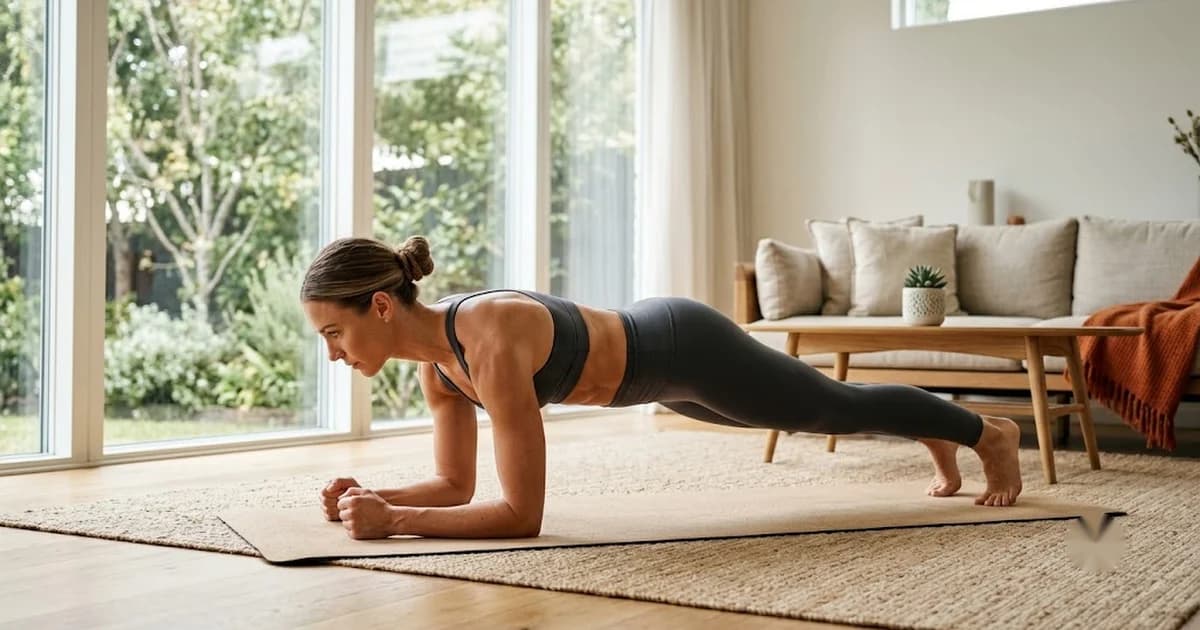
- Planks: the foundation of deep-core endurance; keep hips level and glutes tight.
- Dead bugs: extend opposite arm and leg while keeping your lower back pinned to the floor.
- Bird dogs: extend opposite arm and leg from all fours without rotating your hips.
- Hollow holds: a gymnastics staple that teaches full-body tension.
A Sample Home Ab Circuit
Here is a simple, equipment-free circuit that hits every region in about ten to twelve minutes. Perform each move for the time or reps listed, rest 15 to 20 seconds between them, then repeat the whole circuit two to three times.
- Bicycle crunches: 30 seconds
- Leg raises: 12 to 15 reps
- Plank: 40 to 60 seconds
- Russian twists: 30 seconds
- Reverse crunches: 12 to 15 reps
- Side plank: 30 seconds per side
- Dead bugs: 10 reps per side
Move with control rather than speed. Feeling the muscle work matters more than rushing through repetitions. If a movement becomes easy, slow it down or add a pause instead of just doing more reps.
How Often Should You Train Abs?
Your abs are muscles, and like any muscle they respond to training and need recovery. Two to four sessions per week is the sweet spot for most people. Daily ab marathons rarely produce better results and can leave the area chronically fatigued.
You can attach short core work to the end of your regular workouts or keep the circuit above as a standalone routine. What matters is consistency over weeks and months, not cramming everything into one heroic session. Progress by adding reps, slowing tempo, or increasing hold times gradually.
Fat Loss: The Part That Actually Reveals Your Abs
Now for the half that most people ignore. To see your abs, you need to lower the body fat covering them, and that comes down to a sustained calorie deficit: consistently eating slightly fewer calories than you burn. No single food burns belly fat, and spot reduction, the idea of losing fat from one area by training it, is a myth.
A few honest fundamentals:
- Prioritize protein. It keeps you full and protects muscle while you lose fat.
- Build meals around whole foods. Vegetables, lean proteins, fruit, and whole grains are filling for their calories.
- Watch liquid calories. Sugary drinks and alcohol add up fast without filling you.
- Stay patient. A gradual, sustainable deficit preserves muscle and is far easier to maintain than a crash diet.
Sleep and daily movement matter too. Poor sleep and a sedentary lifestyle make a deficit harder to sustain. There is no shortcut here, but the formula is genuinely simple even when it isn't easy.
One more honest note on expectations. Fat loss is rarely linear. Your weight will fluctuate day to day with water, sodium, and digestion, so judge progress over weeks rather than daily readings. Track the trend, not the noise, and keep your deficit modest enough that you can stick with it. Consistency over months is what pulls the fat off the muscle you've been building.
Bringing It Together
Visible abs come from two things working in tandem: a trained, developed core and a low enough body fat level to see it. Do the exercises in this guide two to four times a week, then let your nutrition do the reveal. That combination, repeated consistently, is what works. Anything promising faster results without addressing body fat is selling a fantasy.
If you'd rather not guess at the numbers, Trainera can build an AI-generated training plan and matching nutrition plan around your body fat goal, then track your progress and sync with your wearable so you can see whether you're actually in the deficit that reveals your abs. Treat it as a way to remove the guesswork and stay consistent. But even if you never sign up, the principles above are all you truly need: train your core, eat for a deficit, and be patient. The abs are already there.
Frequently Asked Questions
Can I get visible abs by training at home without equipment?
How often should I train my abs?
What body fat percentage do abs become visible at?
Are crunches enough to build a six-pack?
How long does it take to see abs?
Keep Reading
Put this into practice with Trainera
Get your free AI training and nutrition plan in 60 seconds
1800+ exercises, photo-AI food logging, wearables and progress tracking - free, no card needed. Train solo or with a certified coach.