Calf Raises: How to Do Them and Which Muscles They Work
Get your free AI training and nutrition plan in 60 seconds
Standing calf raises train the gastrocnemius; seated raises shift the work to the soleus. Here's the form, common mistakes, and a real progression path.
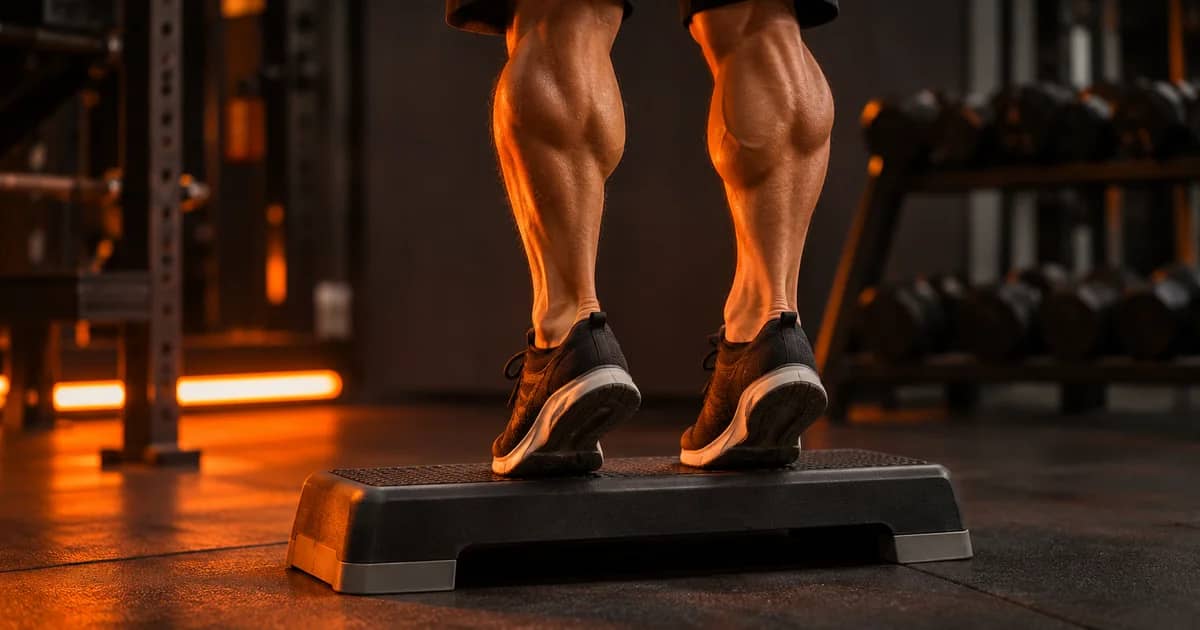
Standing calf raises target the gastrocnemius, seated calf raises target the soleus
The simplest way to remember the difference: when your knee is straight (standing calf raise), the two-headed gastrocnemius muscle is the main mover because it crosses both the knee and ankle joint. When your knee is bent to roughly 90 degrees (seated calf raise), the gastrocnemius is slackened and most of the work shifts to the soleus, the flatter muscle underneath it that only crosses the ankle joint. Both muscles plantarflex the ankle (push your toes down and heel up), but training them with the knee in different positions changes which one does more of the work.
This isn't a minor technicality. If you only ever do standing calf raises, the soleus is relatively undertrained, and vice versa. Most well-rounded lower-leg programs include both variations across a training week.
Get your free AI training and nutrition plan in 60 seconds
Gastrocnemius vs soleus: why the knee angle matters
- Gastrocnemius: originates above the knee on the femur, so it's a two-joint muscle. It's more active when the knee is extended, which is why standing calf raises (and straight-leg exercises like jump rope or sprinting) bias this muscle. It's the muscle that gives the calf its visible diamond shape.
- Soleus: originates below the knee on the tibia and fibula, so knee position doesn't change its leverage. It's a single-joint muscle that's heavily recruited any time the ankle plantarflexes with a bent knee, and it plays a large role in standing posture and walking endurance because it's packed with slow-twitch, fatigue-resistant fibers.
- Practical takeaway: standing raises (machine, barbell, or bodyweight on a step) emphasize gastrocnemius; seated raises (seated calf raise machine, or a dumbbell on your knee while seated on a bench) emphasize soleus.
- Why the soleus matters beyond aesthetics: because it's packed with slow-twitch fibers and sits deep against the leg's veins, the soleus plays a meaningful role in pumping blood back up toward the heart during standing and walking, which is one reason it's sometimes nicknamed the body's "second heart." Training it isn't just a muscle-building afterthought, it's a genuinely different physiological target than the gastrocnemius.
How to perform a calf raise with proper form
- Stand (or sit, for the seated version) with the balls of your feet on a raised edge or platform and your heels free to drop below it. A step, plate, or the machine's foot plate all work.
- Start with your heels dropped as low as comfortable to get a full stretch at the bottom. This is where most of the training benefit comes from. Don't skip it.
- Push through the balls of your feet and rise up onto your toes as high as you can, pausing briefly at the top.
- Lower under control back to the fully stretched bottom position. Avoid letting gravity do the work on the way down.
- Keep your knees roughly straight (standing) or at a fixed bend (seated) throughout. Don't let the knee angle drift during the set, since that changes which muscle you're actually training.
- Keep your weight centered over the balls of your feet rather than letting your ankles roll in or out; uneven pressure across the foot is a common way people feel the movement more in the ankle joint than in the calf muscle itself.
Common mistakes
- Bouncing out of the bottom position: using momentum to rebound off the stretched position shortcuts the muscle's time under tension and increases strain on the Achilles tendon without much training benefit.
- Partial range of motion: stopping a few inches above the bottom, or not rising all the way onto the toes at the top, trains a smaller slice of the muscle's full length. Calves respond well to full-range work, and cutting the range is one of the main reasons people stall on calf growth and strength.
- Rushing the tempo: calves are used to constant, repetitive loading from walking all day, so a slow, controlled tempo (roughly 2 seconds up, 2-3 seconds down) tends to produce better results than fast, bouncy reps.
- Ignoring the single-leg or seated variation entirely: training only one variation leaves one of the two calf muscles comparatively undertrained.
- Skipping a warm-up: the calves and Achilles tendon handle a lot of repetitive stress, and jumping straight into heavy loaded raises without a few light warm-up sets increases the chance of irritation, particularly for anyone who has had Achilles tightness or tendon issues before.
- Not paying attention to the mind-muscle connection: because calf raises are a small, repetitive movement, it's easy to go through the motions without actually squeezing at the top. Deliberately pausing and contracting at the top of each rep tends to improve results more than just moving the weight up and down.
Calf raise variations worth knowing
- Donkey calf raise: performed bent over at the hips (often with a partner or pad providing resistance across the lower back), which changes the angle of pull on the gastrocnemius slightly compared to a standing raise and allows for a strong stretch at the bottom.
- Leg press calf raise: pressing through just the balls of your feet on a leg press machine's platform, which lets you load the movement heavily while seated and semi-reclined, generally emphasizing the gastrocnemius similarly to a standing raise since the knee stays relatively extended.
- Single-leg calf raise: covered in more detail in the progression section below, but worth mentioning here because it also doubles as a useful way to spot and correct left-right strength imbalances that two-leg raises can hide.
How to progress calf raises over time
- Step 1, Bodyweight, two legs: master full range of motion standing on a flat floor, then progress to standing on a raised edge so the heel can drop below the toes.
- Step 2, Add load: hold a dumbbell, wear a loaded backpack, or use a calf raise machine/Smith machine to add resistance once bodyweight reps feel easy for your target rep range.
- Step 3, Single-leg raises: doing the movement on one leg at a time roughly doubles the load per leg and also challenges balance and ankle stability. This is a significant jump in difficulty, so build up reps on two legs first.
- Step 4, Combine both: once single-leg raises are solid, add external load to the single-leg version for continued progress.
- A common approach is training calves two to four times per week, since the muscle recovers relatively quickly compared to larger muscle groups, and tracking your reps and added weight over time makes it easy to see whether you're actually progressing or just repeating the same workout week after week.
Why calves can be slow to respond
Many people find their calves respond more slowly to training than other muscle groups, and there are a few plausible, well-accepted reasons: the calves are used to near-constant loading from standing and walking throughout the day, which means they're already somewhat conditioned to endure volume, and genetics play a real role in calf muscle shape and length of the muscle belly versus the Achilles tendon. None of that means training is pointless. It generally means consistent volume and full range of motion over months, not weeks, is what produces visible change, and tracking your sets and loads over that timeframe is far more useful than judging progress week to week.
Frequently Asked Questions
Do I need to do both standing and seated calf raises?
How many reps should I do for calf raises?
Why aren't my calves growing even though I train them?
Is it safe to do calf raises every day?
Should beginners start with single-leg calf raises?
Keep Reading
Get your free AI training and nutrition plan in 60 seconds
1,700+ exercises, wearables and progress tracking, free with no card needed. AI food scanning comes with Premium. Train solo or with a certified coach.