ChatGPT Workout Plans vs a Real AI Fitness App (With Prompts)
ChatGPT can write a solid first workout plan if you prompt it well. Here are 5 copy-paste prompts that actually work, and an honest look at where a chat window stops and a dedicated AI fitness app takes over.
Get your free AI training and nutrition plan in 60 seconds
TL;DR
ChatGPT can write a genuinely useful workout plan if you give it a specific prompt: your goal, your equipment, your training days, your experience level, and any injuries. Below are 5 copy-paste prompts that cover all of that.
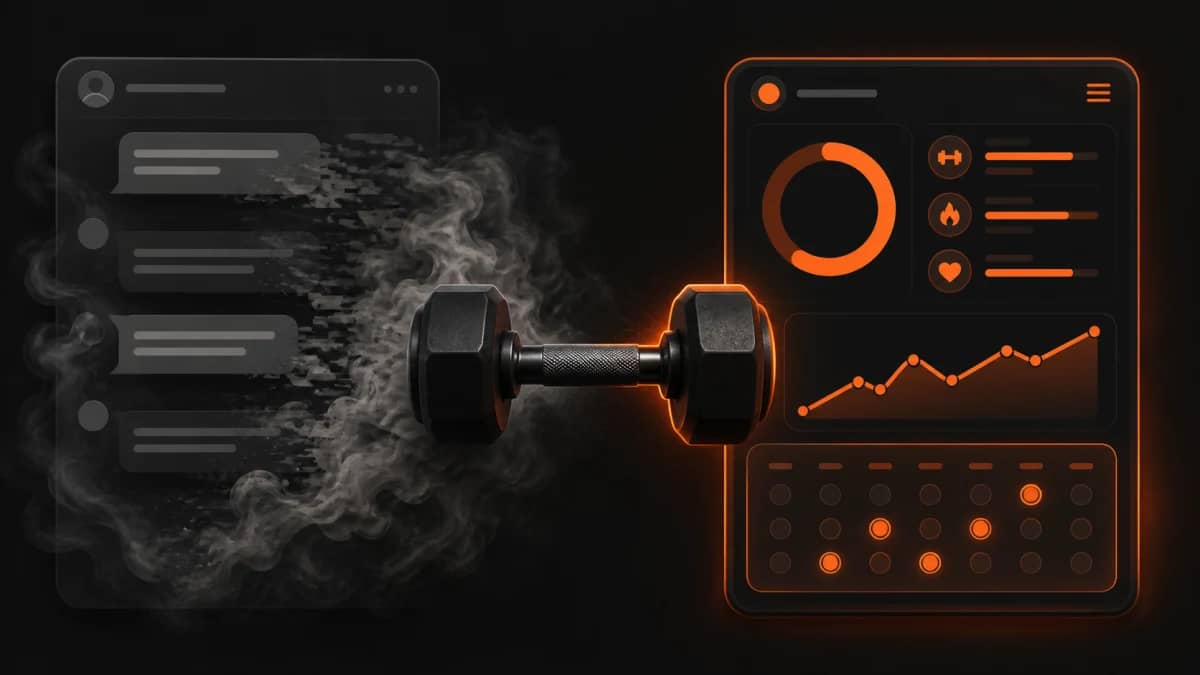
What ChatGPT can't do is remember what you actually lifted, adapt your plan when you stall or miss a week, show you how an exercise is performed, or keep your nutrition numbers consistent between chats. That's the difference between a plan and a system. A dedicated AI fitness app like Trainera's solo mode generates the plan the same way, then tracks your workouts, shows your last-session numbers, and handles meals in the same place. ChatGPT is a fine starting point. The app is the system you follow for months.
Yes, ChatGPT can write you a workout plan
Ask ChatGPT to "make me a workout plan" and you'll get the same generic 3-day full-body template it gives everyone. That's not a model problem, it's a prompt problem. The plan quality depends almost entirely on how much real information you feed it.
Five details change everything: your goal, your equipment, how many days you can train, your experience level, and any injuries or limitations. Every prompt below includes all five. Copy one, replace the bracketed parts with your own details, and you'll get something far closer to what a coach would write on day one.
5 copy-paste ChatGPT prompts for workout plans
1. The complete beginner prompt
"Act as a certified personal trainer. Build me a 4-week beginner workout plan. My goal is [general fitness and fat loss]. I can train [3] days per week for [45] minutes per session. My equipment: [a pair of adjustable dumbbells and a bench at home]. I have [no injuries]. Give me sets, reps, and rest times for every exercise, tell me how to warm up, and explain how to make week 2, 3, and 4 slightly harder. Format the plan as a table."
Why it works: it forces structure (sets, reps, rest), a time cap so the session actually fits your life, and a built-in progression so the plan isn't identical for four straight weeks.
2. The muscle-building prompt with progression
"Act as a strength coach. I'm an [intermediate] lifter with [2 years] of gym experience. Goal: build muscle, especially [chest and back]. I train [4] days per week in a [fully equipped commercial gym] and have [no injuries]. Write an upper/lower split with exercises, sets, reps, and RPE targets. Apply progressive overload: tell me exactly what to increase each week (weight, reps, or sets) and when to take a deload week."
Why it works: asking for RPE targets and explicit week-to-week increases makes ChatGPT commit to a progression model instead of handing you a static list of exercises.
3. The busy-schedule prompt
"I can realistically train [2] days per week for [30] minutes, no exceptions. Goal: [maintain strength and stay lean]. Equipment: [gym access]. Experience: [beginner-intermediate]. No injuries. Design the most efficient possible plan for that time budget. Prioritize compound movements, use supersets to save time, and tell me what I'm sacrificing by training this little so my expectations are realistic."
Why it works: the last sentence matters most. Asking ChatGPT to state the tradeoffs stops it from overpromising and gives you a plan built for the schedule you actually have, not the one you wish you had.
4. The injury-aware prompt
"Act as a personal trainer experienced with training around injuries. I have [a cranky right knee: squats below parallel and jumping hurt, leg press and hinging feel fine]. My physiotherapist has cleared me to train. Goal: [build lower-body strength without knee pain]. I train [3] days per week with [full gym access], experience [intermediate]. Build a plan that works around this, suggest substitutions for common knee-heavy exercises, and flag anything I should stop immediately if I feel pain."
Why it works: describing exactly what hurts and what doesn't gives ChatGPT real constraints to work with. One caution: ChatGPT is not a medical professional. If you haven't had the injury assessed, do that first, and treat its substitutions as suggestions to test carefully, not prescriptions.
5. The plan-review prompt
"Act as an experienced coach reviewing a client's program. Here is my current workout plan: [paste your plan]. My goal is [goal], I've been running it for [6 weeks], and my results so far: [what's progressing, what's stalled]. Critique it honestly: what's redundant, what's missing, where the volume is too high or too low, and what 2-3 changes would give the biggest improvement."
Why it works: review is arguably ChatGPT's strongest fitness use case. It's good at spotting imbalances (all pressing, no pulling; no direct hamstring work) in a plan you paste in front of it.
Small tweaks that improve any of these prompts
- Ask it to interview you first. Add "ask me any questions you need before writing the plan" and it will collect details you forgot to mention.
- List your exact equipment. "Home gym" means nothing. "Two 15 kg dumbbells, a pull-up bar, and a resistance band" produces a plan you can actually run.
- Demand a table format. Tables are easier to screenshot and follow in the gym than paragraphs.
- Set a hard session length. Without a time cap, ChatGPT loves writing 90-minute sessions.
- Ask for substitutions. "Give me one alternative for each exercise" saves you when a machine is taken.
Where ChatGPT workout plans fall apart
Everything above is real value, and it costs nothing. But run a ChatGPT plan for a month and the same problems show up for almost everyone.
No progress tracking
ChatGPT gives you a plan, then has no idea what you did with it. It doesn't know what weight you lifted Monday, whether you finished all your sets, or that your bench has been stuck at the same weight for three weeks. You end up tracking in a notes app or spreadsheet on the side, which is exactly the manual work you hoped AI would remove.
No adaptation week to week
A good coach changes the plan based on what happened: you missed two sessions, your squat stalled, your shoulder started clicking. ChatGPT only adapts if you re-paste your entire history and ask it to. Most people don't, so the "personalized" plan is frozen on day one while your body keeps changing.
No exercise videos
ChatGPT describes a Romanian deadlift in text. If you've never done one, a paragraph won't save your lower back. You end up searching each exercise separately anyway. A dedicated app shows the demonstration next to the exercise; Trainera's library covers 1,800+ exercises with video demonstrations.
You have to re-prompt everything
Long chats lose context, and new chats start from zero. Want week 5? Re-explain your goal, equipment, injuries, and results. Want a deload? Same again. The plan lives in a conversation, not in a structure, so every change is another round of copy-paste archaeology.
Nutrition drift
Ask ChatGPT for your calories and macros on three different days and you can get three different sets of numbers, because it re-estimates from scratch each time. And even a good meal plan is static: there's no food logging, so nothing tells you whether you're actually hitting your protein target or just owning a nice-looking list of meals. For a consistent baseline, run your numbers once through a proper macro calculator and hold ChatGPT to those targets.
What a dedicated AI fitness app adds
This is where an AI fitness app earns its place. In Trainera's solo mode, the same intake a good prompt covers (goal, equipment, days, experience, limitations) feeds an AI that builds both your training plan and your nutrition plan. The difference is everything that happens after day one.
- Plans that adapt from your logs. You log workouts in the app, so the AI sees what you actually did and adjusts the plan from real data instead of a static conversation.
- Exercise videos built in. Every exercise in the 1,800+ library comes with a video demonstration, right where you need it mid-session.
- Nutrition that closes the loop. AI-generated meal plans, food logging by photo with the AI food scanner, and an AI shopping list so the plan survives contact with the supermarket.
- An AI assistant with context. Ask questions inside the app and the answers relate to your plan, not a blank slate.
- One app, both modes. If you plateau or want accountability, you can add a real certified trainer from the marketplace later without switching platforms or losing your history.
- 26 languages. The whole experience works in 23 UI languages, which matters if English isn't your first language and most fitness apps assume it is.
To be fair to ChatGPT: it's more flexible for open-ended conversation, it's excellent for learning why a plan is built a certain way, and the free tier costs nothing. If you're the kind of person who happily maintains a training spreadsheet, ChatGPT plus discipline can work. Most people aren't that person by week four. For a wider look at how AI coaching compares to human coaching, see are AI personal trainers actually good.
ChatGPT vs an AI fitness app, side by side
| Capability | ChatGPT | AI fitness app (Trainera solo mode) |
|---|---|---|
| Initial workout plan | Good, with a detailed prompt | Good, from a structured intake |
| Progress tracking | None (you track separately) | Built-in workout logging |
| Week-to-week adaptation | Only if you re-prompt with your history | Built-in progression, last-session numbers shown, edit or regenerate anytime |
| Exercise demonstrations | Text descriptions only | 1,800+ exercises with videos |
| Nutrition | Static meal ideas, numbers drift between chats | AI meal plans, photo food logging, AI shopping list |
| Memory of your training | Lost between conversations | Full history in one place |
| Path to a human coach | None | Add a certified trainer from the marketplace anytime |
| Languages | Many, quality varies | 26 UI languages |
The verdict: prompt first, system second
Use ChatGPT for what it's genuinely good at: drafting a first plan with the prompts above, explaining training concepts, and reviewing a program you already run. If you're brand new and want to understand why your plan looks the way it does, it's a great free tutor.
But a workout plan isn't the hard part of getting results. Sticking to one, progressing it, and eating to match it for months is the hard part, and that requires tracking, adaptation, and having everything in one place. That's what a dedicated app is for. If you want the AI-built plan plus the system around it, Trainera's solo mode does both, and you can compare it against the wider field in our best AI fitness app roundup.
Related reading
Frequently Asked Questions
Can ChatGPT make a good workout plan?
What should I ask ChatGPT for a workout plan?
Is ChatGPT good for meal plans?
What is the difference between ChatGPT and an AI fitness app?
Does ChatGPT remember my workout progress?
Is an AI workout plan safe for beginners?
Keep Reading
Put this into practice with Trainera
Get your free AI training and nutrition plan in 60 seconds
1800+ exercises, wearables and progress tracking, free with no card needed. AI food scanning comes with Premium. Train solo or with a certified coach.