Gym Door Access Control Integration: What to Look For
What door access control integration actually means, the hardware types involved (turnstiles, speed gates, locks, readers), what to evaluate before you buy, and an honest look at where a general gym-management platform's built-in access control fits versus a dedicated hardware specialist.
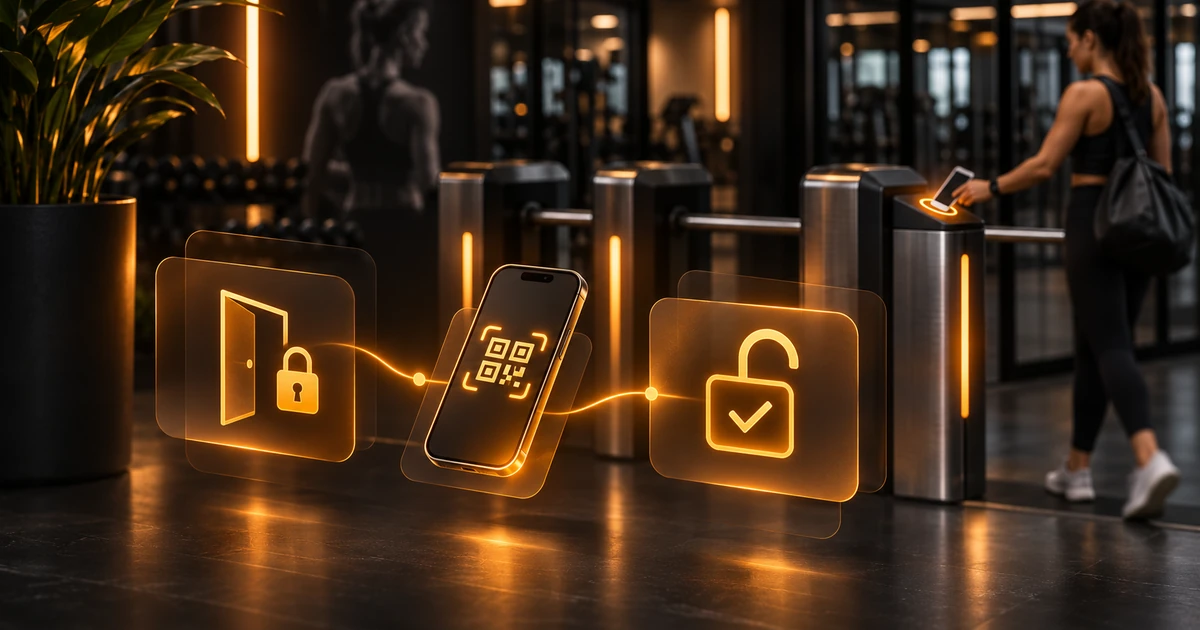
If your gym runs any hours without staff at the front desk — early mornings, late nights, or a full 24/7 model — door access control stops being a nice-to-have and becomes the system that decides whether a member can train at all. This guide covers what access control integration actually means, the hardware types involved, and how to evaluate a gym-management platform's access-control claims before you sign a contract.
What "door access control integration" actually means
At its core, it's the link between your gym-management software and the physical hardware that lets a member through a door. The software checks whether a membership is active and in good standing, then tells the hardware to unlock. Without that link, access control is just a lock with no idea who's on the other side of it.
Memberships, check-ins, staff and payments in one place
The hardware types you'll run into
- Turnstiles — one person at a time, common at larger unstaffed clubs.
- Speed gates — faster swing-style barriers for higher member throughput.
- Electronic locks — simple door strikes or mag-locks, often the cheapest entry point for a single door.
- Swing gates — a middle ground between a turnstile and a plain door.
- Credential readers — RFID cards, Bluetooth-based phone unlock, NFC fobs, or a QR code scanned from the member's app. QR check-in is the lowest-friction and cheapest option, since it needs no dedicated reader hardware beyond a phone or tablet at the door.
- Biometrics — fingerprint or facial recognition, less common, usually reserved for high-security or very high-volume sites.
Why this matters more for some gyms than others
A staffed gym with someone at the desk during all open hours can run perfectly well on simple QR check-in — the software confirms membership status, staff are there as a backstop if something goes wrong. An unstaffed or 24-hour gym doesn't have that backstop. If the access system misreads a credential, lets in someone with a lapsed membership, or fails to catch a second person slipping through behind a legitimate member (a problem known as tailgating), there's no one on site to catch it. That's exactly why access-control depth becomes a specialist category of its own for 24/7 operators, and why some gym-software vendors build an entire hardware ecosystem around it while others treat it as one feature among many.
What to actually evaluate
Is it included or a paid add-on? Some platforms bundle basic access control into their core plan; others sell it as a hardware package on top, often with an extra monthly fee per door.
Which hardware does it actually support? Ask for the specific list of compatible turnstiles, locks, and readers — a vague "compatible with most hardware" answer is a red flag.
How many doors or devices per site? Multi-entrance or multi-zone clubs need to know the device cap before they design their floor plan around it.
Does it catch tailgating? This is a genuine differentiator some specialist vendors offer and many general gym-management platforms don't.
Who installs and supports the hardware? Software-only vendors may leave you sourcing and maintaining the physical hardware yourself through a third party, which adds a second support relationship to manage when something breaks.
Where this leaves most gyms
If your core problem is genuinely "how do people get in safely with zero staff on site," a vendor that has built its business specifically around access-control hardware — proprietary readers, tailgating detection, a dedicated support line for the hardware itself — is worth the extra evaluation time, even if it costs more and locks you into their hardware ecosystem.
If you're a staffed gym, a boutique studio, or a hybrid operation where access control is one requirement among several (scheduling, billing, a branded member app, coaching tools), a general gym-management platform with solid, included door-hardware support is usually the better fit. Trainera's Core gym plan ($119/month flat, unlimited members) includes integration with turnstiles, speed gates, electronic locks and swing gates, up to 10 devices per site, alongside QR check-in as a no-hardware fallback. It's a genuinely useful level of access control for the large majority of single-location clubs and studios — it just isn't the same depth as a hardware specialist that has spent a decade on nothing but door security, and we won't pretend otherwise.
Run a gym or studio? Trainera brings memberships, QR check-in, a branded member app (on White Label) and payouts into one gym management software. Try it free for 7 days, no card needed.
Frequently Asked Questions
Keep Reading
Memberships, check-ins, staff and payments in one place
QR and turnstile check-in, membership packages, staff logins and a gym website, with no per-member fees. We move your members from your current software for free.