Child's Pose: How to Do It and Its Benefits
Get your free AI training and nutrition plan in 60 seconds
How to do child's pose correctly, what it stretches (lower back, hips, thighs), when to use it between sets or as a cooldown, and modifications for tight hips, knees, or pregnancy.
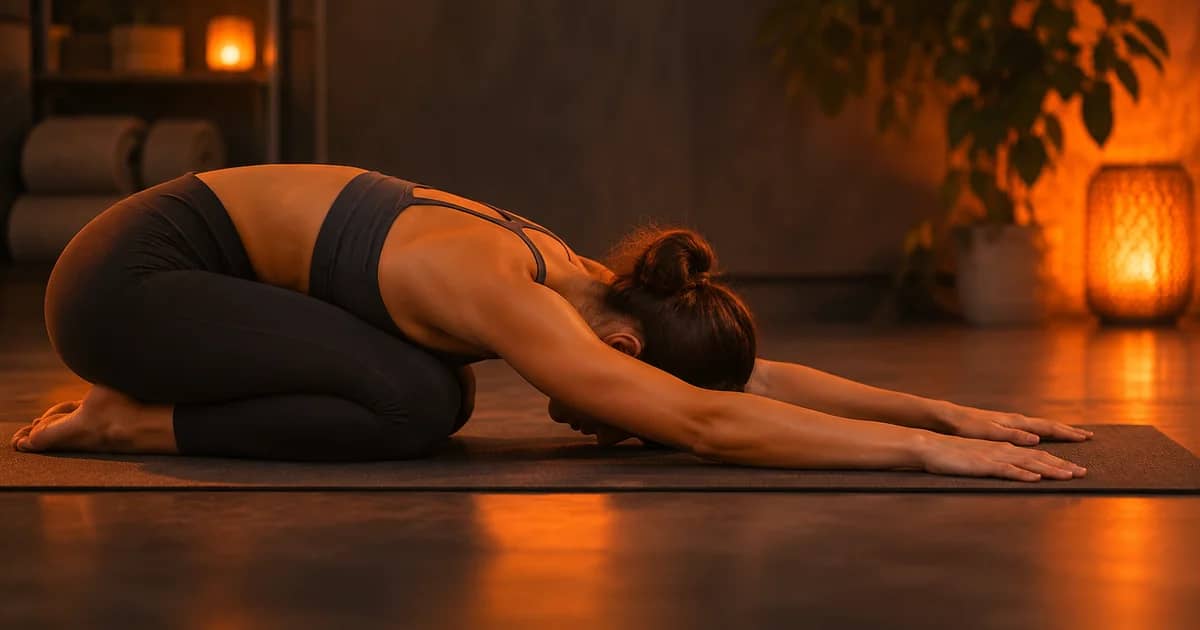
How Do You Do Child's Pose Correctly?
Child's pose is done by kneeling on the floor, sitting your hips back toward or onto your heels, and folding your torso forward until your forehead rests on the floor or a cushion, with your arms either extended forward or relaxed by your sides. It's a gentle, passive stretch used to release tension through the back, hips, and thighs, and is one of the most common rest positions in yoga and mobility practice, often used as a default "reset" pose between more demanding movements.
Despite looking simple, there's more than one correct way to set it up, and the small details, how wide the knees are, where the arms go, how far the hips sit back, change what the pose emphasizes and how comfortable it feels for different bodies.
Get your free AI training and nutrition plan in 60 seconds
What Does Child's Pose Stretch?
- Lower back: rounding the spine forward from a kneeling position gently stretches the muscles along the lower back that tighten from sitting for long periods or from heavy lifting earlier in a workout.
- Hips: sitting the hips back toward the heels puts a mild stretch through the hip extensors and the fronts of the hips, depending on how the knees are positioned and how far back the hips travel.
- Thighs and ankles: the quadriceps and the fronts of the ankles get a light stretch from the deep knee and ankle flexion involved in sitting back onto the heels, particularly in the close-knee variation.
- Shoulders and lats (arms-extended variation): reaching the arms forward while the hips stay back adds a stretch through the shoulders and the sides of the back as well, making this variation more of a full-body release than the arms-by-the-side version.
How to Do Child's Pose Step by Step
- Start on all fours, with knees and hands on the floor, wrists stacked under shoulders and knees under hips.
- Bring your knees either together or wide apart, depending on the variation (wide knees make more room for the torso and reduce pressure on the belly and chest, while knees together emphasizes the stretch through the outer hips and lower back more evenly).
- Sit your hips back toward your heels, moving only as far as feels comfortable. Your hips don't need to fully reach your heels for the pose to be effective.
- Fold your torso forward and down, letting your forehead rest on the floor or a cushion if the floor feels too far away.
- Extend your arms forward on the floor for more of a shoulder and back stretch, or bring them back alongside your body, palms up, for a more restful, passive hold that takes the shoulders out of the stretch entirely.
- Breathe slowly and evenly, letting each exhale sink you a little further into the position without forcing it.
- Stay in the position anywhere from 20 to 30 seconds up to a few minutes, depending on how you're using it: brief as a rest between sets, longer as a dedicated stretch.
When to Use Child's Pose
Child's pose works well in several different contexts, not just as a stand-alone stretch. It is commonly used as a rest position between sets of a more demanding yoga flow or a mobility circuit, letting the breathing settle and the back relax before continuing to the next movement. It also works well as part of a post-workout cooldown, especially after a session involving a lot of spinal loading, like deadlifts or squats, to gently decompress the lower back after being under load. And it's a simple piece of general mobility work on its own, done for a minute or two whenever the lower back or hips feel tight, without needing to be tied to a workout at all. Many people use it first thing in the morning or at the end of a long day sitting at a desk.
Modifications for Tight Hips, Knees, or Pregnancy
- Tight hips or knees: place a cushion or folded blanket between your calves and thighs so your hips don't need to sit as far back, or keep your knees wide apart to reduce the compression at the front of the hips and knees.
- Knee discomfort: add extra padding under the knees, or reduce how far you sit back toward your heels so less weight passes directly through the knee joint. A rolled towel behind the knees can also help some people.
- Pregnancy: widen the knees enough to make space for the belly, and rest the torso on a bolster, pillow, or yoga block stacked in front rather than folding all the way to the floor. Many people in later pregnancy find the wide-knee variation with support more comfortable than the traditional close-knee version. As with any stretch during pregnancy, check with your doctor or midwife about what's appropriate for your specific situation.
- Shoulder discomfort with arms extended: simply rest the arms alongside the body instead of reaching them forward, which removes the shoulder stretch while keeping the rest of the pose the same.
- Difficulty resting the forehead on the floor: stack a cushion, yoga block, or folded blanket under the forehead so the neck doesn't need to strain to reach the ground, which is a common and easy adjustment for people with limited hip or ankle flexibility.
Breathing in Child's Pose
Because child's pose is a passive, supported position, it's often used specifically as a place to practice slow, controlled breathing rather than just as a stretch. A simple approach is to inhale slowly through the nose, feeling the ribs expand into the lower back (which is easier to notice in this folded position than standing up), then exhale slowly and let the body settle slightly further into the stretch with each breath out. This pairing of a passive stretch with slow breathing is part of why the pose is so commonly used as a transition or rest point. It gives the nervous system a moment to downshift, not just the muscles a moment to lengthen.
Child's Pose Compared to Other Rest Positions
Child's pose is often used alongside or instead of other common rest and reset positions, such as downward-facing dog or a simple seated forward fold. Compared to downward dog, which actively loads the shoulders and calves while stretching the hamstrings, child's pose is more passive and restful, making it a better choice specifically when the goal is to slow down rather than keep working. Compared to a seated forward fold, child's pose distributes weight through the shins and tops of the feet rather than the sitting bones, which some people find more comfortable, particularly if prolonged sitting is already a source of discomfort.
Common Mistakes in Child's Pose
- Forcing the hips all the way to the heels: the hips don't need to fully touch the heels for the stretch to be effective; forcing the range before the hips and ankles are ready often causes unnecessary knee or ankle discomfort rather than a better stretch.
- Holding the breath or tensing through the shoulders: since this is meant to be a restful position, actively relaxing the shoulders and breathing slowly gets more benefit than holding tension throughout the hold.
- Skipping padding when the knees or ankles are sensitive: pushing through discomfort rather than adding a cushion or folded blanket tends to make the pose feel unpleasant enough that people avoid using it altogether, even though a small modification usually solves the issue.
Frequently Asked Questions
What muscles does child's pose stretch?
Is child's pose good for lower back pain?
Can I do child's pose during pregnancy?
How long should you hold child's pose?
Why do my knees hurt in child's pose?
Keep Reading
Get your free AI training and nutrition plan in 60 seconds
1,700+ exercises, wearables and progress tracking, free with no card needed. AI food scanning comes with Premium. Train solo or with a certified coach.