Home Workout Plan With No Equipment (Full Guide)
Get your free AI training and nutrition plan in 60 seconds
A complete no-equipment home workout plan covering form, progression and a weekly structure you can actually stick to, with no gym and no gear required.
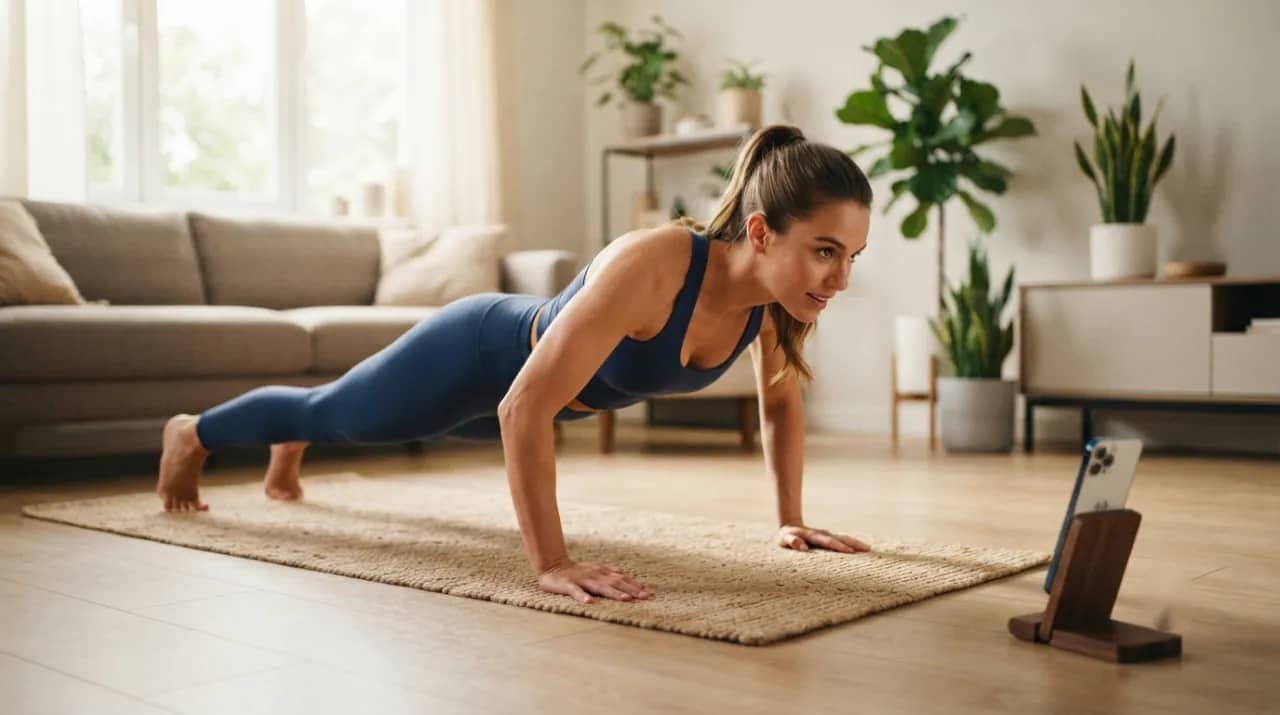
Can you really get fit at home with no equipment?
Yes. A home workout plan with no equipment can build real strength, add muscle mass and burn fat, using only bodyweight movements three to four times per week. You progress by changing reps, tempo and exercise difficulty instead of adding weight plates, and a few square feet of floor space is all the gear you need.
What separates the people who actually see results from the ones who quit after two weeks is not the workout itself. It is whether they follow a structured body workout with a clear starting position for every exercise, or just copy whatever video showed up on their feed that morning. Below is the full plan: the movements, the form, the weekly structure and how to keep progressing once the basics stop feeling hard.
Get your free AI training and nutrition plan in 60 seconds
You do not need a gym to get stronger
A gym is convenient, not required. Gravity, your own bodyweight and a clear patch of floor give you more resistance than most beginners can handle for the first few months of training. In practice, a lot of people make faster early progress at home than in a gym, simply because there is no commute, no waiting for a machine and no feeling watched while you figure out your form.
The shift that matters is thinking in terms of movement patterns instead of machines. Cover the handful of patterns your body is built to perform and you train every major muscle group, no barbell required.
The key bodyweight movement patterns
A complete home workout hits these patterns across the week. Learn these and you have a full program:
- Squats and lunges: Bodyweight squats, reverse lunges and split squats build your quads, glutes and hamstrings. These are the base of all lower-body strength training.
- Push ups and progressions: Start against a wall or sofa, move to knee push ups, then full push ups, then decline or archer push ups. This is your main chest, shoulder and triceps builder.
- Rows for your back: No pull-up bar? Lie under a sturdy table and pull your chest toward the edge, loop a towel around a door handle, or do reverse snow-angels on the floor for your upper back and rear shoulders.
- Hip hinges and glute bridges: Glute bridges, single-leg bridges and standing hinges hit the muscles along the back of your body that most desk-bound people barely use.
- Planks and core: Front planks, side planks, dead bugs and hollow holds build a stable midsection that protects your lower back during every other exercise.
- Cardio bursts: Jumping jacks, high knees, mountain climbers and burpees spike your heart rate between strength sets and build conditioning.
How to do the basics with good form
Most people do not need more exercises, they need better execution on the ones they already know. Here is how three of the most common ones should actually feel.
Bodyweight squat
Stand with feet shoulder-width apart, that is your starting position. Push your hips back and bend your knees as if sitting into a chair, keeping your chest up and your weight through your heels. Lower until your thighs are roughly parallel to the floor, then drive back up to the starting position and repeat. Watch that your knees track over your feet rather than caving inward.
Reverse lunge
From standing, step your right foot back and lower your right knee toward the floor while your left thigh stays close to parallel with the ground. Your right knee should stay soft, not slamming into the floor. Push back through your left foot to return to the starting position, then repeat on the other side so both legs get equal work.
Push up
Hands slightly wider than your shoulders, body in a straight line from head to heels, that is your starting position. Bend your elbows to lower your chest toward the floor, keeping your core braced so your hips do not sag. Press back up to the starting position and repeat for your full set. If a full push up is too hard right now, drop to your knees or elevate your hands on a sturdy surface and build from there.
How to progress without weights
This is where most people get stuck, so it is worth slowing down here. Muscles only grow when you keep challenging them, and without dumbbells you still have four real levers:
- More reps: If ten squats felt easy last week, do twelve or fifteen this week.
- Slower tempo: Lower yourself over three or four seconds. A slow push up is dramatically harder than a fast one and builds more control.
- Unilateral work: Train one limb at a time. A single-leg squat or a one-arm-focused row can nearly double the load on the working muscle.
- Harder variations: Graduate from knee push ups to full push ups to decline push ups, or from split squats to Bulgarian split squats. Each step up works like adding weight to a bar.
Use these levers consistently and strength training with no equipment will not plateau nearly as fast as people assume.
A simple weekly structure
Keep it simple and repeatable rather than clever. This template works regardless of your fitness level, you just adjust reps and rest to match where you are starting from:
- Day 1, lower body: squats, lunges, glute bridges, calf raises, plank.
- Day 2, upper body: push up progression, table rows, reverse snow-angels, side plank.
- Day 3, rest or a light walk.
- Day 4, full body workout and cardio: squats, push ups, mountain climbers, burpees, hollow hold.
- Optional day 5, core and mobility: planks, dead bugs, stretching.
Three to four training days with rest built in is the sweet spot for most people. Warm up for five minutes, work for twenty-five to forty, finish with a short stretch. Beginners can start with fewer sets per exercise and build from there over the first few weeks.
Mistakes that quietly stall progress
A few patterns show up again and again with people training at home. Skipping the warm up and going straight into push ups from a cold body is one, it raises injury risk and makes the first set feel worse than it needs to. Doing the exact same workout every week without changing reps, tempo or exercise difficulty is another, your body adapts fast and then has no reason to keep changing.
Rushing through reps is a third one. A fast, sloppy squat is doing less work than a controlled one even if the rep count looks the same on paper. Training daily at high intensity with no rest days is the last common trap, your muscles need a day of recovery between hard sessions on the same body part to actually grow back stronger.
Staying consistent is the real secret
The best plan is the one you actually repeat. Train at roughly the same time each day, keep your workout clothes within reach, and start with a session short enough that skipping it feels harder than doing it. Track every workout so you can see your reps climbing and your rest times dropping, that visible progress is what keeps most people coming back for month two and three.
Follow a structured plan instead of random videos
Random videos leave gaps. They repeat the same muscles, skip progression entirely, and never tell you what to do tomorrow. A structured plan removes that guesswork. This is exactly what Trainera.fit is built for, you can pick a real home workout program like 7-Day Home Kickstart to ease in, Home Hero for a full-body challenge, Living Room Gains to build muscle mass in tight spaces, or Bodyweight Only for a pure no-equipment path.
The app hands you the plan day by day, shows a short video for every exercise so your form stays clean, and lets you log each workout and track progress over time. If you want to know exactly how your logged workouts and data are handled, Trainera.fit's privacy policy spells that out in plain language before you ever sign up. If you are just getting started, our guide on how to start working out with a free beginner plan walks through the first steps, and you can spin up a personalized routine with the free AI workout plan generator.
Nutrition and recovery still decide the result
Training is only half of it. Whether your goal is building muscle or losing fat, what you eat decides how much of your effort actually shows up in the mirror. To build muscle mass, eat enough protein, roughly 1.6 to 2.2 grams per kilogram of bodyweight, with a small calorie surplus. To lose fat, keep the protein just as high and eat in a modest deficit so you hold onto muscle while the fat comes off. Either way, sleep 7 to 9 hours, your body repairs and grows during rest, not during the workout itself.
You do not need to track every gram. Building meals around a protein source, plenty of vegetables and some whole carbs covers most of it for most people. If you want the numbers in front of you, the diet tracker on Trainera.fit lets you log meals and see protein and calories at a glance, so your home training and your eating pull in the same direction instead of fighting each other.
Where to start your first session
You do not need money, machines or a gym membership to change how you look and move. You need a plan and a few square feet of floor. Trainera.fit is free to start and works on the web and on iOS and Android. Pick a home workout plan like Bodyweight Only or Living Room Gains, follow the video form cues, log each session, and watch your numbers climb week after week regardless of your current fitness level. When you want extra support, you can connect with a certified trainer right inside the app.
Open Trainera.fit and start your first home workout today. Everything from here is just repeating the plan and letting the small weekly changes add up.
Frequently Asked Questions
Can I really build muscle at home with no equipment?
How many days per week should I do a home workout with no equipment?
How do I make bodyweight exercises harder without weights?
Is a structured plan better than random YouTube workouts?
Keep Reading
Get your free AI training and nutrition plan in 60 seconds
1,970+ exercises, wearables and progress tracking, free with no card needed. AI food scanning comes with Premium. Train solo or with a certified coach.