Dumbbell-Only Full Body Workout at Home
Get your free AI training and nutrition plan in 60 seconds
A complete dumbbell-only full body workout for home training, with exact sets, reps, a 3-day schedule, a warmup, and ways to progress when your weights feel light.
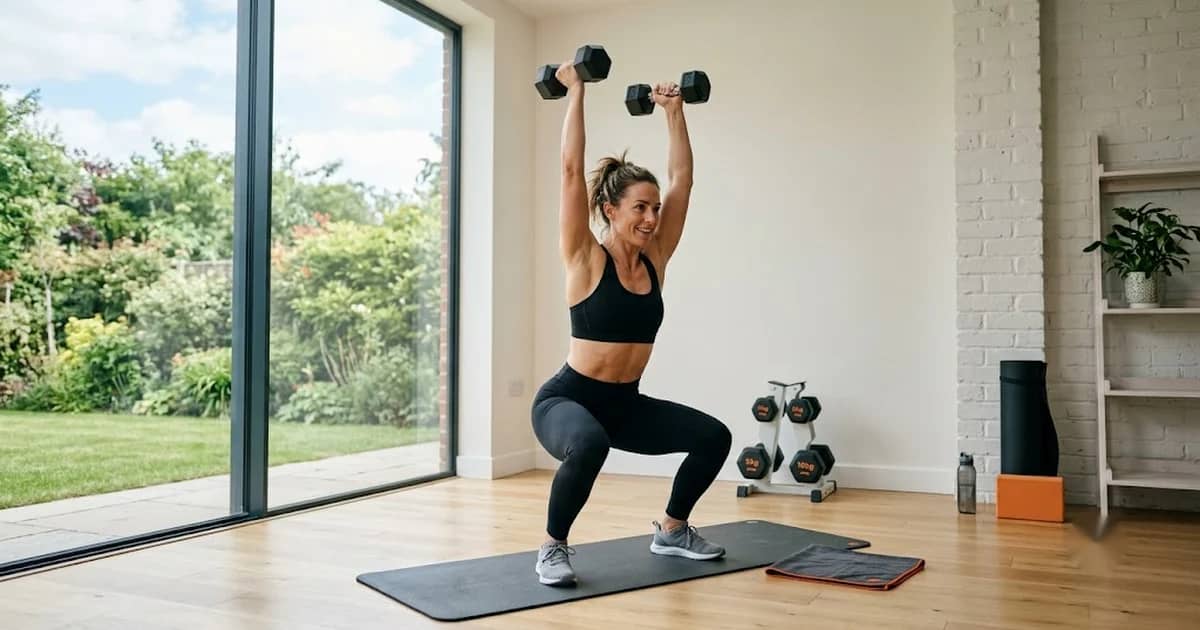
What a dumbbell-only full body workout at home actually looks like
A dumbbell-only full body workout at home means training your legs, chest, back, shoulders, arms, and core in one session, using a single pair of dumbbells for every exercise. Done three times a week with enough reps and sensible progression, it builds real muscle and strength without a gym membership or a room full of machines.
Most people overestimate how much equipment they need and underestimate how much a pair of dumbbells can do. A dumbbell can squat, press, row, hinge, carry, and curl, which covers every major movement pattern the body performs. What actually determines your results is not the brand of weight in your hand, it is whether you train hard enough and often enough, and whether you let yourself recover between sessions.
Get your free AI training and nutrition plan in 60 seconds
The full body dumbbell workout
This is the core session you will repeat three times a week. It trains your lower body, your upper body through both a push and a pull pattern, and your core, so no major muscle group gets left out. Rest sixty to ninety seconds between sets and aim to leave one or two reps in reserve, not grind every set to failure.
Lower body
- Dumbbell goblet squat: 3 sets of 10-12 reps. Hold one dumbbell vertically against your chest with both hands cupping the top end, and squat down between your heels. The front-loaded hold naturally keeps your torso upright.
- Dumbbell Romanian deadlift: 3 sets of 10-12 reps. Hold a dumbbell in each hand, hinge at the hips with a soft knee bend, and push your hips back until you feel the stretch in your hamstrings. Stand by driving your hips forward, not by rounding your lower back.
Upper body push
- Dumbbell floor press or bench press: 3 sets of 8-12 reps. Press the dumbbells up over your chest and control the lowering phase. The floor press version works well if you do not own a bench, since the floor limits the range at the bottom and protects your shoulders.
- Dumbbell shoulder press: 3 sets of 8-10 reps. Press overhead without arching your lower back. If you feel pinching in the shoulder at the top, press slightly in front of your ears instead of straight up.
Upper body pull
- Dumbbell bent-over row: 3 sets of 10-12 reps. Hinge forward with a flat back and pull the dumbbells to your ribs, squeezing your shoulder blades together at the top.
- Dumbbell curl: 2 sets of 12-15 reps. Control the lowering phase, no swinging the weight up with your hips or back.
Core
- Dumbbell suitcase carry: 3 sets of 30 seconds per side. Hold one dumbbell at your side and walk tall, resisting the urge to lean away from the weight. This trains the obliques and the muscles that keep your spine stable under load.
- Plank: 3 sets of 30-45 seconds. Squeeze your glutes, brace your abs, and keep a straight line from head to heels.
Logging your sets and reps for this session matters more than most people assume. Without a record, you are guessing at progress instead of managing it.
How to progress when your dumbbells feel too light
The most common worry for home lifters is running out of weight. In practice this is rarely the real ceiling, because adding load is only one of several ways to make an exercise harder, and the others are just as effective for building muscle.
Add reps. If you start at the bottom of a rep range, work toward the top over the following weeks. Going from 8 reps to 12 reps with the same dumbbell is genuine progress your muscles respond to, and it is often the easiest lever to pull first.
Slow the tempo. Lower the dumbbell over three or four seconds on every rep instead of dropping it down. This increases the time your muscle spends under tension and makes even a light weight feel demanding by the last few reps of a set.
Go unilateral. Training one limb at a time effectively doubles the load on the working side, and it also exposes strength imbalances between your left and right. A single-leg Romanian deadlift or a one-arm floor press turns a weight that felt easy with two limbs into a serious challenge.
Shorten rest. Cutting your rest from ninety seconds to forty-five forces the muscle to work while still fatigued from the previous set, which adds a metabolic demand that a light weight alone cannot provide.
Your 3-day weekly schedule
Because this is a full body plan, the same workout gets repeated three times a week on non-consecutive days. The rest days between sessions are not wasted time, they are when your body actually adapts and gets stronger from what you did in the gym or at home.
- Monday: Full body workout
- Tuesday: Rest or a light walk
- Wednesday: Full body workout
- Thursday: Rest or a light walk
- Friday: Full body workout
- Saturday and Sunday: Rest, walk, or gentle mobility work
To keep sessions from feeling stale, rotate small variations while keeping the structure identical. Swap the goblet squat for a reverse lunge on one day, or replace the floor press with an incline press if you have an adjustable bench. If you log your workouts in Trainera's workout tracker, you can see at a glance which exercises are due for a weight increase and which ones you rotated out last week.
Warm up before you lift
Do not jump straight into loaded sets from a cold start. A short warmup raises your body temperature, prepares your joints, and primes your nervous system so you lift with better form and more force. Spend two minutes on light cardio such as marching in place or jumping jacks, then run through a few movement drills.
- Bodyweight squats: 10 reps to open up the hips and knees.
- Arm circles: 10 forward and 10 backward for the shoulders.
- Hip hinges: 10 reps, without weight, to groove the deadlift pattern before you add a dumbbell.
- Light dumbbell presses: one easy set to wake up the pressing muscles before your working sets.
Common mistakes that stall home lifters
Most people who plateau at home are not held back by their equipment, they are held back by a handful of avoidable habits. The first is training without any record of what they did last session. If you cannot remember whether you pressed for eight or twelve reps last week, you cannot know whether you are actually progressing, and progression is the entire point of a strength training program.
The second mistake is chasing failure on every set. Grinding each set to a complete stop feels productive, but it drains your recovery and rarely adds much extra muscle compared to stopping a rep or two short. Leave a little in the tank so you have quality effort left for the exercises later in the session, not just the first two.
A third error is rushing the reps. Bouncing the dumbbells and using momentum shifts the work away from the target muscle and onto your joints. Control both the lifting and the lowering phase, actually feel the muscle doing the job, and a light dumbbell will suddenly feel heavier in the best possible way.
Choosing the right pair of dumbbells
If you are still deciding what to buy, an adjustable pair of dumbbells is the single best investment for a home lifter with limited space. One pair replaces an entire rack and lets you add weight as you get stronger, which solves the biggest long-term limitation of a fixed set. If you already own fixed dumbbells that feel light, the progression techniques above will carry you a surprisingly long way before the weight itself becomes the true ceiling.
Set up a small, dedicated space so nothing gets in the way of consistency. Keep the dumbbells visible instead of tucked away in a cupboard, and have your log and some water within reach. The less friction between you and the workout, the more likely you are to actually show up on the days that count.
Nutrition and recovery make the training work
Training is only half the equation. Muscle is built while you rest, using the protein and total calories you eat during the day. Prioritize a solid protein intake spread across your meals, get enough sleep, and stay consistent week to week. Even a well-designed workout will stall if recovery and food are treated as an afterthought instead of part of the plan.
Letting a plan adjust to you as you get stronger
A single template is a solid starting point, but the ideal program for you shifts as your strength improves, your equipment changes, or your goals move. Trainera is an AI fitness platform that builds personalized training and nutrition plans, tracks your sessions over time, and syncs with your wearable so your actual effort and recovery inform what comes next. If you would rather have your dumbbell sessions and your meals planned around your real progress instead of guessing week to week, that is exactly what Trainera is built to do, or you can connect with a trainer on the platform if you want a second set of eyes on your form and programming.
Start with the workout above this week. Grab your dumbbells, run through the warmup, and give yourself three honest sessions. Consistency, not the number on the dumbbell, is what turns a home routine into real results.
Frequently Asked Questions
Can I build muscle with just dumbbells at home?
How many dumbbells do I actually need for a full body workout?
Is 3 days a week of dumbbell training enough to build strength?
What if my dumbbells feel too light after a few weeks?
Keep Reading
Get your free AI training and nutrition plan in 60 seconds
1,700+ exercises, wearables and progress tracking, free with no card needed. AI food scanning comes with Premium. Train solo or with a certified coach.