Dumbbell Romanian Deadlift: How to Do It With Correct Form
Get your free AI training and nutrition plan in 60 seconds
How to do the dumbbell Romanian deadlift: hip-hinge setup, how far to lower the weights, common mistakes like rounding the back, and dumbbells vs. barbell.
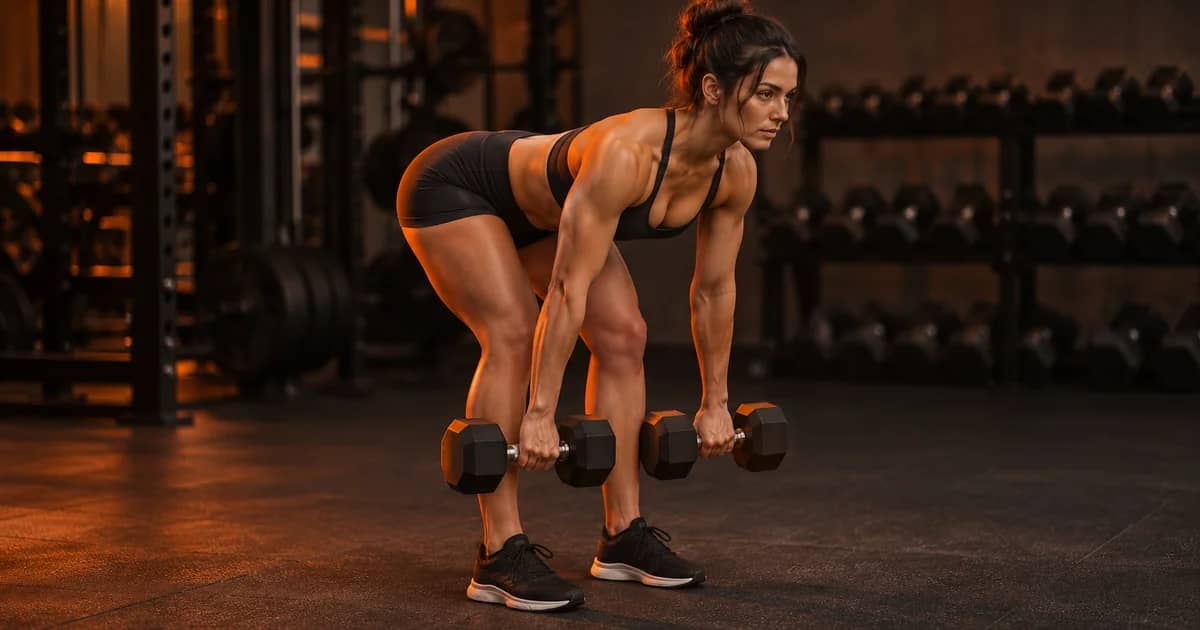
The dumbbell Romanian deadlift is a hip-hinge exercise that trains the hamstrings and glutes by lowering a pair of dumbbells along the front of the legs while keeping the knees only slightly bent and the spine neutral
Unlike a conventional deadlift, you don't start from the floor and you don't bend the knees much as you descend: the movement comes almost entirely from folding forward at the hips, which is what makes it such a direct hamstring and glute stretch-and-contract exercise.
Get your free AI training and nutrition plan in 60 seconds
How to set up and perform a dumbbell Romanian deadlift
- Stand with feet hip-width apart, holding a dumbbell in each hand in front of your thighs, palms facing your body.
- Soften your knees with a slight bend: not locked straight, but not bending into a squat either. This bend should stay roughly constant throughout the movement.
- Brace your core and start the movement by pushing your hips straight back, as if closing a car door with your glutes.
- Let the dumbbells travel down the front of your legs, staying close to your thighs and shins as you hinge forward.
- Keep your back flat from your hips to your shoulders. Your chest moves toward the floor as your hips move back, not by rounding the spine.
- Lower until you feel a firm stretch in your hamstrings, which for most people is somewhere between mid-shin and just below the knee. Range of motion depends on individual hamstring flexibility. Don't force the dumbbells to the floor if your hamstrings run out of stretch first and your lower back starts to round to compensate.
- Reverse the motion by driving your hips forward and squeezing your glutes to return to standing.
How far to lower the dumbbells
There's no fixed point everyone should hit. The right depth is wherever your hamstrings reach a solid stretch while your lower back stays flat: for some people that's around the knees, and for others with more hamstring flexibility it's lower on the shin. The moment your lower back starts to round to chase more range, you've gone past your current mobility limit for that rep.
It can help to think of the descent in two parts: the first portion is almost entirely hip movement with no real hamstring stretch yet, and the deeper portion, usually somewhere around knee height, is where the stretch actually becomes noticeable. Many beginners stop too early, before any real hamstring tension develops, simply because they associate "deadlift" with going low rather than feeling for the stretch itself.
Breathing and bracing
Take a breath and brace your core before initiating the hip hinge, holding that brace through the descent and the drive back up, then exhaling near the top. This is the same bracing approach used in conventional deadlifts and squats, and it helps keep the trunk rigid so the lower back isn't left to stabilize the spine on its own under load.
Common mistakes
- Rounding the lower back. This is the most common and the most important mistake to fix, since a loaded, rounded spine under hip-hinge tension is where back strain risk goes up. If you can't keep your back flat through the full range you're attempting, shorten the range until you can.
- Bending the knees too much, turning it into a squat. The RDL is a hip-dominant movement. If the knees travel forward and bend significantly during the descent, you're shifting load onto the quads and losing the deep hamstring stretch that makes the exercise valuable. Think "push the hips back," not "sit down."
- Letting the dumbbells drift away from the legs. Keeping the weights close to your thighs and shins keeps the load close to your center of gravity; letting them swing forward adds unnecessary strain on the lower back and makes the lift harder to control.
- Standing the hips up before the shoulders on the way up. This turns the top portion of the lift into a lower-back-dominant extension instead of a controlled glute-driven finish. Hips and shoulders should rise together.
- Looking straight up instead of keeping a neutral neck. Craning the neck upward tends to pull the whole spine out of its neutral position.
- Locking the knees out straight. A completely locked knee can shift strain onto the knee joint and makes it harder to maintain the slight, consistent bend needed to hinge properly: think of the knee position as fixed, not moving much in either direction once you've set it at the top.
Where it fits in a training week
The dumbbell RDL is typically used as either a primary hamstring/glute movement on a lower-body or pull-focused day, or as an accessory after a squat or deadlift variation. Because it demands precise hip-hinge control, it's generally better placed earlier in a session rather than at the very end, when fatigue from other lower-body work makes it harder to keep the back flat through a full range of motion.
Dumbbell vs. barbell Romanian deadlift: who should use which
The movement pattern is the same regardless of implement, but there are real practical differences:
- Dumbbells allow a slightly more natural hand and shoulder position since each arm can hang independently, which some lifters find more comfortable on the shoulders and wrists than a fixed barbell grip.
- Dumbbells are usually the better choice for beginners learning the hip-hinge pattern, since the load ramps up in smaller increments and there's less of a setup/technique barrier than loading and unracking a barbell.
- Dumbbells also suit home-gym training or anyone without a barbell and plates, and they're a reasonable way to keep training a hinge pattern while traveling.
- A barbell lets you load significantly heavier over time, since adding weight to a bar is far more practical than adding to dumbbells, and it tends to feel more stable once you're moving heavier loads because both hands share one fixed bar rather than two independently balanced weights.
For most people early in training, or anyone prioritizing control and feel over maximal loading, dumbbells are a perfectly good, often preferable, way to train the Romanian deadlift. Lifters chasing heavier hamstring/glute loading over time typically migrate to a barbell once their hip-hinge technique is solid.
| Factor | Dumbbell RDL | Barbell RDL |
|---|---|---|
| Learning curve | Lower, more forgiving setup | Higher, requires more hinge technique up front |
| Max loading over time | Lower (limited by dumbbell sizes/grip) | Higher (easy to add small plate increments) |
| Shoulder/wrist comfort | Often more comfortable, independent arms | Fixed grip, some prefer this for stability |
| Best suited for | Beginners, home gyms, accessory work | Progressive heavy loading over a training block |
Sensible rep ranges
Because the dumbbell RDL loads the hamstrings and glutes through a deep stretch, it's typically trained in a moderate rep range, commonly 8–12 reps for 3–4 sets, rather than very low reps, since control through the full range of motion matters more here than chasing a one-rep max. Lighter, higher-rep sets (12–15) are also a reasonable way to reinforce the hip-hinge pattern on a day focused more on technique than load.
As with the hip thrust, the dumbbell RDL is a reasonable movement to approach cautiously, or to check with a healthcare provider about first, if you have an existing lower-back condition: the loaded forward hinge, even performed correctly, puts the spine under more demand than many other exercises, and technique errors compound that demand quickly.
Frequently Asked Questions
Is the dumbbell Romanian deadlift the same as a stiff-leg deadlift?
Why do I feel the dumbbell RDL more in my lower back than my hamstrings?
How low should beginners go on a dumbbell RDL?
Do dumbbell Romanian deadlifts work the glutes or just the hamstrings?
Can I do Romanian deadlifts every leg day?
Keep Reading
Get your free AI training and nutrition plan in 60 seconds
1,700+ exercises, wearables and progress tracking, free with no card needed. AI food scanning comes with Premium. Train solo or with a certified coach.