Incline Dumbbell Press: Correct Bench Angle and Muscles Worked
Get your free AI training and nutrition plan in 60 seconds
The right incline dumbbell press bench angle is 15-30 degrees for upper chest emphasis. Setup, muscles worked, common mistakes, and training safely without a spotter.
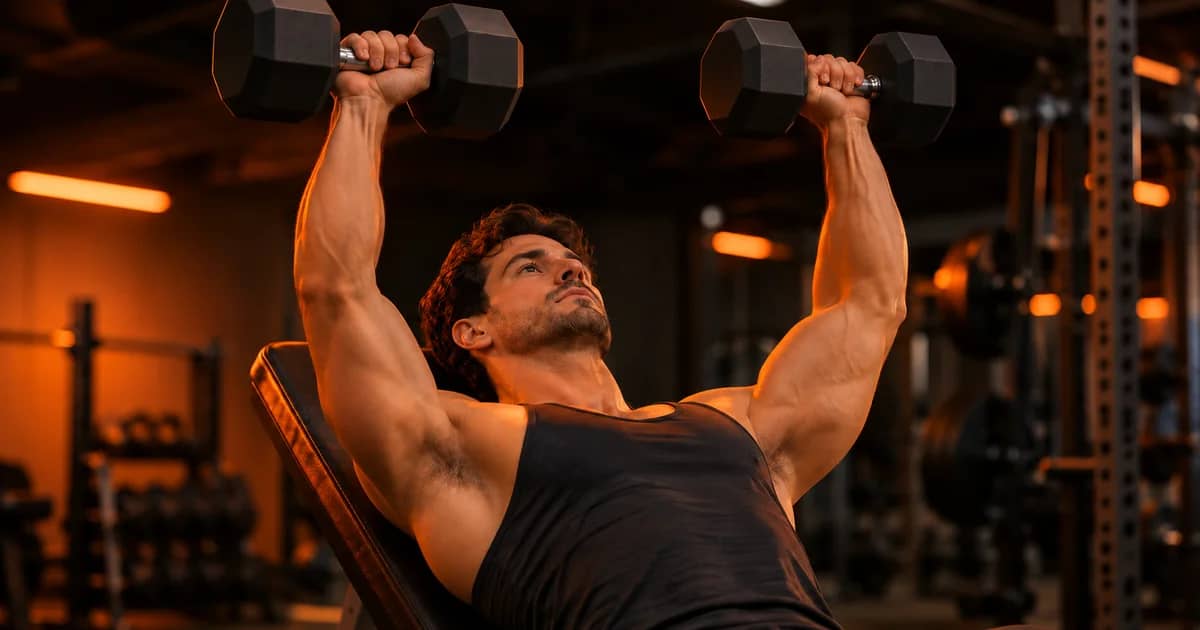
The incline dumbbell press targets the upper portion of the chest more than a flat press does, and the bench angle that keeps it a chest exercise rather than a shoulder exercise is roughly 15 to 30 degrees
Once the bench angle climbs much past 45 degrees, the pressing path starts to resemble an overhead shoulder press more than a chest press, shifting a large share of the work onto the front deltoids instead of the upper chest.
Get your free AI training and nutrition plan in 60 seconds
Choosing the right bench angle
- 15–30 degrees is the range most coaches recommend for a true incline chest press. It's enough of an angle to bias the upper chest (clavicular head of the pectoralis major) compared to a flat bench, without turning the movement into a pressing pattern dominated by the shoulders.
- 45 degrees and steeper moves the arm path closer to vertical, which increasingly recruits the anterior deltoid as the prime mover rather than the chest. At very steep angles (60+ degrees) you're effectively doing a seated shoulder press with chest assistance.
- If your gym bench only has fixed angle settings, pick the lowest incline option available rather than defaulting to the steepest. Most adjustable benches' "low" setting lands close to the ideal range.
How to set up and perform the incline dumbbell press
- Set the bench to 15–30 degrees and sit with your back flat against the pad.
- Pick up a dumbbell in each hand and rest them on your thighs, then use your knees to help kick them up to shoulder level as you lie back. This avoids straining your shoulders trying to hoist both weights into position from a dead stop.
- Position the dumbbells at the sides of your chest, roughly in line with your lower chest/upper ribcage, with your elbows bent and slightly flared, not tucked tight to your sides or flared out to 90 degrees.
- Plant your feet flat on the floor and keep your shoulder blades pulled back and down against the bench for a stable base.
- Press the dumbbells up and slightly inward until your arms are extended but not locked harshly, with the dumbbells ending roughly above your upper chest/shoulders.
- Lower with control back to the starting position, feeling a stretch across the upper chest at the bottom without letting the shoulders roll forward or the elbows drop below the bench line.
What the incline dumbbell press works
- Upper (clavicular) pectoralis major: the primary emphasis compared to a flat press.
- Anterior deltoids: contribute more here than in a flat press, increasing further as the bench angle gets steeper.
- Triceps: assist throughout the pressing motion, especially in the lockout portion.
- Serratus anterior and stabilizing shoulder muscles: work to control the dumbbells independently through the full range, more so than with a fixed barbell.
Compared to a flat dumbbell press, the incline version shifts emphasis upward on the chest and increases shoulder involvement somewhat; a flat press keeps slightly more emphasis on the mid/lower chest with a more even chest-to-shoulder work ratio.
| Bench angle | Primary emphasis | Notes |
|---|---|---|
| Flat (0°) | Mid/lower chest | Most even chest-to-shoulder ratio |
| 15–30° | Upper chest | Sweet spot for a true incline chest press |
| 45°+ | Front deltoid | Increasingly a shoulder press, less chest-specific |
| 60°+ (near-vertical) | Front deltoid | Functionally closer to a seated overhead press |
Grip, wrist position, and breathing
Hold the dumbbells with your wrists stacked directly over your elbows rather than tilted back, which reduces unnecessary wrist strain under load. A neutral-to-slightly-rotated grip (palms angled slightly toward each other rather than dead straight forward) is comfortable for most shoulders. As with other pressing movements, inhale and brace slightly on the way down and exhale through the effort of the press back up.
Sensible rep ranges
The incline dumbbell press is commonly trained in the 6–12 rep range as a primary upper-chest movement, with 3–4 sets being typical. Because stabilizing two independent dumbbells is more demanding than a fixed barbell, very heavy, low-rep singles or doubles are less common with this exercise. Most lifters get better results, and a lower injury risk, keeping it in a moderate rep range and saving maximal-effort low-rep work for barbell variations.
Common mistakes
- Setting the bench too steep, which was covered above but is worth repeating: this is the single biggest reason people feel incline pressing "in their shoulders" rather than their chest.
- Flaring the elbows out to a full 90 degrees from the torso. This increases shoulder joint stress. A moderate flare, roughly 45–60 degrees from the torso, is generally easier on the shoulders while still loading the chest well.
- Arching the lower back excessively off the bench to generate more leverage. Keeping the glutes and upper back in contact with the bench, with feet planted, gives a more stable and controlled pressing base.
- Not controlling the dumbbells at the bottom, letting them drop quickly into the stretched position. This adds unnecessary strain on the shoulder joint, especially at a loaded end range.
- Pressing the dumbbells straight up over the face/neck instead of over the upper chest, which changes the joint angles and reduces chest involvement.
- Bringing the dumbbells together with a loud clack at the top. This is mostly a sign of rushing the lockout, and it also means the last portion of the rep isn't under controlled muscular tension.
How to set up safely without a spotter
- Use the thigh-kick technique described above to get the dumbbells into the starting position without needing help, and reverse it (guide the dumbbells back to your thighs one at a time, using your knee to help lower the second one) to finish the set safely.
- Choose a weight you can fail safely with. Unlike a barbell, dumbbells can simply be dropped or tilted away from your body if a rep fails, which is actually one of the safety advantages of training incline presses with dumbbells rather than a barbell when training alone.
- Stay a rep or two short of total failure when training without a spotter, since the last rep of a true failure attempt is where control is hardest to maintain, especially mid-press.
- Keep your feet flat and your upper back pinned to the bench throughout the set for a stable base: an unstable base is a bigger injury risk than the weight itself for most lifters.
Warming up before heavier sets
Because the starting position requires lifting the dumbbells into place under your own control, it's worth doing a light warm-up set or two with a manageable weight before loading up. This doubles as a check that the bench angle, shoulder blade position, and elbow path all feel right before you commit to a heavier working set where correcting form mid-rep is harder.
Where it fits alongside other chest work
If upper-chest development is a specific priority, placing the incline dumbbell press earlier in a chest-focused session, while you're freshest, lets you lift more load and get more out of the upper-chest emphasis than doing it after a flat bench press has already fatigued the same pressing muscles. If overall chest size is the main goal rather than upper-chest emphasis specifically, the order matters less, and either a flat or incline press can lead depending on preference.
Frequently Asked Questions
What's the best bench angle for incline dumbbell press?
Why do my shoulders hurt more than my chest during incline press?
Should I do incline or flat dumbbell press first?
How do I get heavy dumbbells into position without a spotter?
Is the incline dumbbell press better than the barbell incline press?
Keep Reading
Get your free AI training and nutrition plan in 60 seconds
1,700+ exercises, wearables and progress tracking, free with no card needed. AI food scanning comes with Premium. Train solo or with a certified coach.