Hip Thrusts: Proper Form, Muscles Worked, and Common Mistakes
Get your free AI training and nutrition plan in 60 seconds
How to do barbell and bodyweight hip thrusts correctly: bench and shoulder position, glute squeeze at the top, common mistakes, and how it compares to a glute bridge.
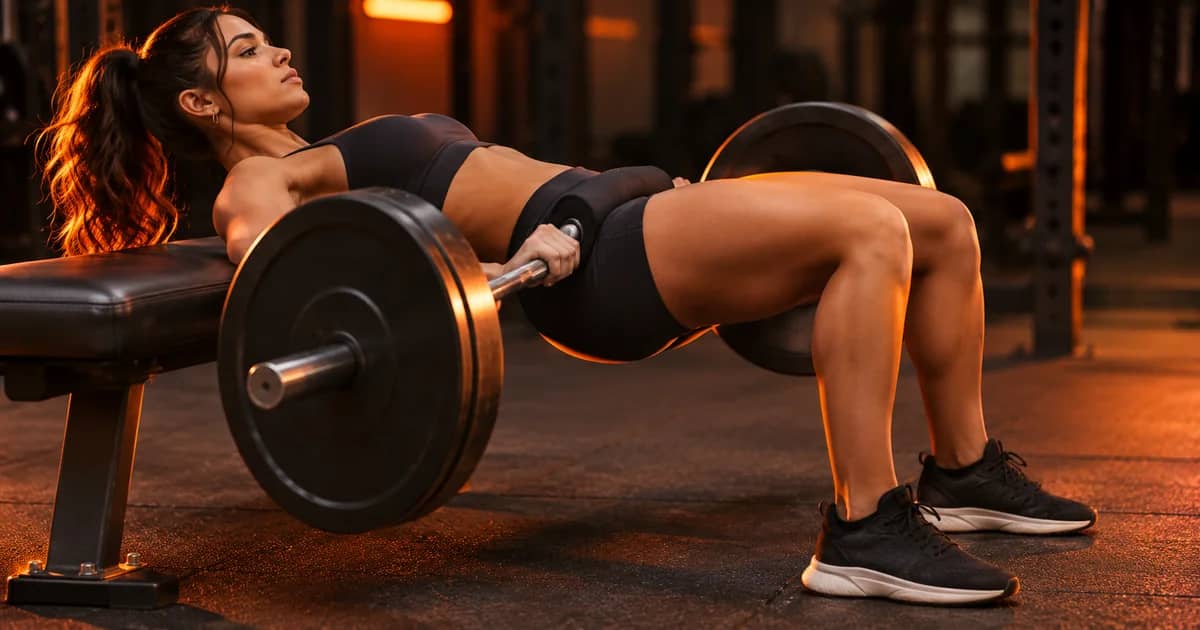
The hip thrust is a hip-hinge exercise that primarily targets the glutes, with the hamstrings working as a secondary mover, performed by driving the hips upward with your upper back braced against a bench
It isolates hip extension more directly than a squat or deadlift because the knees stay in a relatively fixed position throughout the movement, which shifts a larger share of the work onto the glutes rather than spreading it across the quads and lower back.
Get your free AI training and nutrition plan in 60 seconds
How to set up a barbell hip thrust
- Sit on the floor with your upper back against the edge of a bench, knees bent, feet flat on the floor about hip-width apart.
- Roll a loaded barbell over your hips, using a thick pad or folded towel/mat across the bar to protect your hip bones.
- Position your shoulder blades on the bench so the bottom edge sits roughly at or just below the shoulder blades, not higher up on your neck.
- Tuck your chin slightly and keep your gaze forward-down rather than up at the ceiling. This helps keep the lower back from over-extending at the top.
- Drive through your heels and push your hips up until your torso is roughly parallel to the floor and your knees are bent close to 90 degrees.
- Squeeze your glutes hard at the top for a brief pause, without pushing the hips so high that your lower back arches excessively.
- Lower under control until your hips are just short of touching the floor, then repeat.
Bodyweight and beginner setup
The same positioning applies without a barbell: upper back on the bench, feet flat, drive the hips up and squeeze. Bodyweight hip thrusts are a reasonable way to learn the movement pattern and build initial glute strength before adding load, and they remain useful as a high-rep finisher even once you're thrusting heavier weight. Holding a single dumbbell or kettlebell across the hips with both hands is a natural progression once bodyweight reps feel easy, before moving on to a barbell setup.
A short warm-up set or two with no load, focusing purely on the hip-hinge pattern and the top-position glute squeeze, is worth doing even for experienced lifters before adding the working weight. It's an easy way to confirm bench height and foot placement feel right before a heavier bar is loaded across the hips.
What hip thrusts work
- Glutes (maximus primarily, with the medius and minimus assisting): the main driver of hip extension in this exercise.
- Hamstrings: assist with hip extension, especially as the hips approach full lockout.
- Core and erector spinae: work isometrically to keep the torso from collapsing or over-arching under load.
- Quadriceps: play a minor stabilizing role at the knee but aren't a primary target the way they are in a squat.
Common mistakes
- Hyperextending the lower back at the top instead of squeezing the glutes. If you feel the movement in your lower back rather than your glutes, you're likely pushing the hips too high and arching the spine to get there. Stop the ascent once the torso is roughly parallel to the floor and the glutes are fully contracted.
- Wrong bench height for your shoulder blade position. If the bench edge sits too low on your back, you'll lose range of motion; too high and it digs into your neck.
- Feet too close or too far from the hips. Feet placed too far away increases hamstring involvement and can make it harder to reach full hip extension; feet too close shifts load onto the knees and quads. Shins roughly vertical at the top of the movement is a good general target.
- Looking up at the ceiling throughout the lift. This tends to pull the chin and neck into extension and encourages the lower back to arch along with it. Keeping a slight chin tuck helps keep the ribcage and pelvis better aligned.
- Not pausing or squeezing at the top. Bouncing through reps without a controlled pause reduces how much tension the glutes actually get under at peak contraction.
- Letting the bar roll or shift during the set. An unpadded or loosely controlled bar can migrate up toward the stomach or down toward the hip crease as you move, which is both uncomfortable and a sign the setup needs a thicker pad or a tighter starting position.
Breathing and bracing
Brace your core and take a breath before initiating the drive upward, holding tension through your midsection as the hips rise rather than letting your stomach go soft. This helps transmit force efficiently from your lower body up through a stable trunk, and it reduces the tendency to compensate for a loose core by overextending the lower back at the top.
Hip thrust vs. glute bridge
The glute bridge is performed flat on the floor instead of with the upper back elevated on a bench. The two exercises work the same muscles, but:
- Range of motion is shorter in a glute bridge because the floor stops the hips from dropping as low as they can in a hip thrust, and the torso never reaches the same parallel-to-floor top position.
- The hip thrust allows heavier external loading over time since the longer range and more upright torso angle let you progressively add weight more comfortably.
- The glute bridge is a reasonable regression for beginners, for anyone without access to a bench, or as a lower-back-friendly option when the hip thrust setup isn't available.
Many lifters use the glute bridge to learn the hip-hinge pattern and build initial glute activation, then progress to the barbell hip thrust once the technique and bracing feel solid.
| Exercise | Range of motion | Loading potential | Best used for |
|---|---|---|---|
| Glute bridge | Short (floor-limited) | Lower | Learning the pattern, warm-ups, no-bench settings |
| Hip thrust | Full (torso parallel at top) | Higher | Progressive glute strength/hypertrophy work |
Programming hip thrusts
Hip thrusts respond well to a moderate rep range given how directly they isolate hip extension. Many lifters use something in the 8–15 rep range across 2–4 sets, progressing load gradually over weeks once the top-position squeeze and lockout feel consistent. Because the exercise doesn't tax balance or coordination as much as a squat or deadlift, it's also commonly used with slightly higher reps (15–20) as a glute-focused finisher at the end of a lower-body session.
Who should be cautious
Anyone with existing lower-back pain should pay particular attention to keeping the lumbar spine neutral rather than extending at the top, since that's the most common way this exercise aggravates the back. Starting with bodyweight or light-dumbbell hip thrusts and focusing on the glute squeeze rather than the height of the hips is the safer way to learn it.
Anyone with hip or groin discomfort from a prior injury should also pay attention to foot placement and avoid pushing for an overly wide stance, since a stance that stresses the hip joint uncomfortably is a sign to narrow it rather than push through. As with most compound lower-body movements, learning the pattern with light or no load first, and progressing weight gradually once the form feels consistent across every rep, is the lowest-risk way to build up to heavier hip thrusts over time.
Pregnant lifters and anyone recovering from a recent hip, pelvic, or abdominal surgery should check with a qualified healthcare provider before adding loaded hip thrusts back into a routine, since the loaded hip-extension pattern and the pressure of a bar across the hips may not be appropriate in every stage of recovery.
Frequently Asked Questions
How high should I push my hips in a hip thrust?
Is the hip thrust better than squats for glute growth?
What pad should I use for barbell hip thrusts?
Why do my hip flexors cramp during hip thrusts?
Can I do hip thrusts without a bench?
Keep Reading
Get your free AI training and nutrition plan in 60 seconds
1,700+ exercises, wearables and progress tracking, free with no card needed. AI food scanning comes with Premium. Train solo or with a certified coach.