Gym Machines Explained: A Beginner's Guide to Common Equipment
Get your free AI training and nutrition plan in 60 seconds
A plain-English guide to the gym machines beginners see most: leg press, lat pulldown, chest press, pec deck, cable machine, Smith machine, and others.
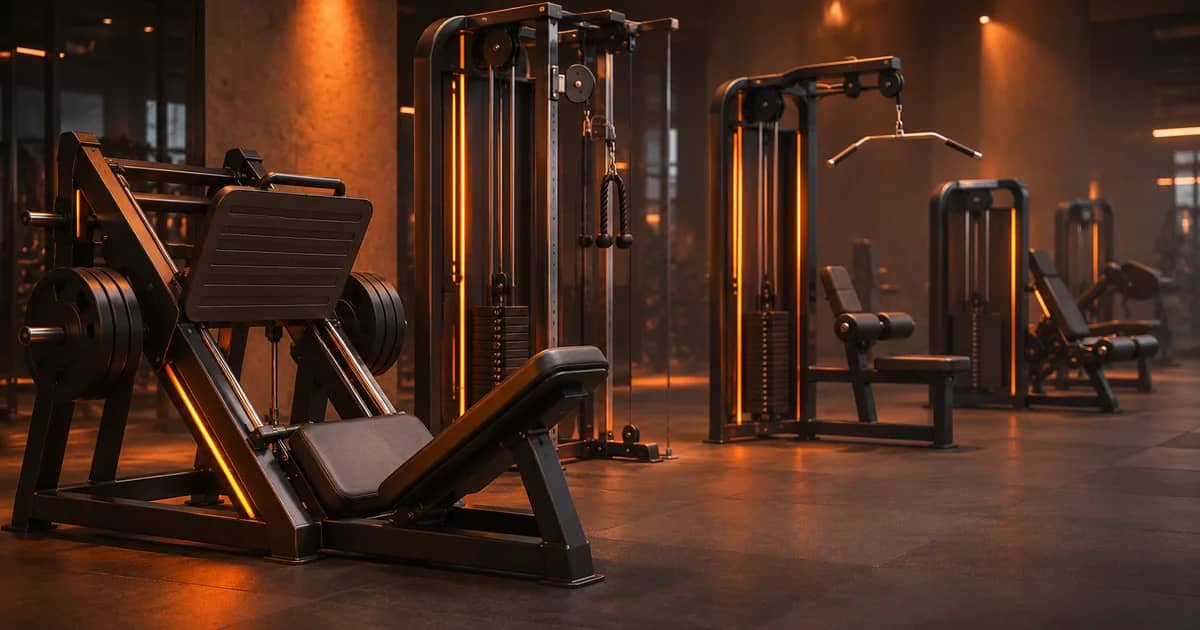
Here's what the most common gym machines do and how to use each one
Walking into a gym for the first time, the machine floor can feel like a wall of unfamiliar equipment. The good news is that most gyms use a similar core set of machines, and each one is built around a specific, learnable movement pattern. Below is a practical rundown of the machines you'll see most often, what each one trains, and the basics of how to use it.
Get your free AI training and nutrition plan in 60 seconds
Leg press
The leg press trains the quadriceps, glutes, and hamstrings by having you push a weighted platform away from your body while seated or reclined, rather than standing and squatting under a bar. Sit in the seat with your feet shoulder-width apart on the platform, unlock the safety handles, and lower the platform by bending your knees toward your chest until your knees reach roughly a 90-degree angle, then press back up through your heels without locking your knees out hard at the top. It's a useful alternative to squats for people who want to train the legs with less demand on balance and trunk stabilization.
Lat pulldown
The lat pulldown trains the latissimus dorsi (the large back muscles) along with the biceps and rear shoulders, and is often used as a substitute for pull-ups for people who aren't yet strong enough to do a full bodyweight pull-up. Sit facing the machine with your thighs secured under the pad, grip the bar wider than shoulder-width, and pull it down toward your upper chest by driving your elbows down and back, then let it rise back up under control without letting your shoulders shrug up toward your ears.
Chest press machine
The chest press machine trains the pectoralis major (chest), front shoulders, and triceps through a pushing motion similar to a bench press, but guided along a fixed or semi-fixed path. Sit with your back flat against the pad and the handles roughly at chest height, then press the handles forward until your arms are extended (without fully locking the elbows), and return slowly to the starting position. It's a good entry point for people still building comfort and strength with pressing movements before moving to free weights.
Pec deck
The pec deck is a chest isolation machine that works the pectoralis major through a hugging motion, bringing your arms together in front of your chest from an open position. Set the seat so the handles line up with chest height, keep a slight bend in your elbows, and squeeze your arms together in front of you before returning slowly to the stretched starting position. Because it isolates the chest without much help from the shoulders or triceps, it's commonly used toward the end of a chest workout.
Cable machine
The cable machine is one of the most versatile pieces of equipment in the gym because the pulley height and attachment can be changed to train nearly any muscle group: rows, triceps pushdowns, face pulls, cable flys, and more. The constant tension provided by the cable (unlike free weights, which lose tension at certain points in a range of motion) makes it useful for isolation work. Start with the pulley at the height needed for your chosen exercise, select an appropriate attachment (handle, bar, or rope), and keep your movement controlled rather than letting the weight stack yank your arm back between reps.
Smith machine
The Smith machine is a barbell fixed within vertical rails, so it only moves up and down along a set path rather than requiring you to balance it freely like a regular barbell. This makes it useful for squats, bench presses, and shoulder presses when you want extra stability or are training alone without a spotter, since most Smith machines let you lock the bar at any point along the rail. The tradeoff is that because the path is fixed, it doesn't train the small stabilizing muscles the same way a free-weight version of the same lift would.
Leg extension and leg curl
The leg extension isolates the quadriceps by having you extend your knees against resistance while seated, with a pad resting against your shins. The leg curl isolates the hamstrings by doing essentially the opposite movement: bending the knee against resistance, either lying face down, seated, or standing depending on the machine. Both are set up by adjusting the pad to sit comfortably against your shins (extension) or just above your heels/ankles (curl), and both should be performed through a controlled range of motion rather than using momentum to swing the weight.
Seated row
The seated row trains the muscles of the mid-back (rhomboids, middle trapezius) and latissimus dorsi, along with the biceps, through a horizontal pulling motion. Sit with your feet braced on the footplate and a slight bend in your knees, grip the handle, and pull it toward your torso by driving your elbows back and squeezing your shoulder blades together, then extend your arms back out under control without rounding your back forward at the start of each rep.
Assisted pull-up/dip machine
This machine uses a counterweighted platform or band system that you kneel or stand on, offsetting a portion of your bodyweight so you can practice pull-ups or dips before you're strong enough to do the full bodyweight version unassisted. More weight selected on the machine generally means more assistance (making the exercise easier), which can feel counterintuitive compared to other machines where more weight means more resistance. It's a practical stepping stone for building toward unassisted pull-ups and dips.
Hip abductor/adductor machine
These machines isolate the muscles on the outer hip (abductors, which move the leg away from the body) and inner thigh (adductors, which move the leg toward the body). Sitting with your legs against the pads, you either push the pads outward (abduction) or squeeze them inward (adduction) through a controlled range of motion. They're commonly used as accessory exercises for hip stability and inner/outer thigh strength rather than as a primary lower-body exercise.
General tips for using gym machines
- Read the diagram on the machine: most machines have a printed illustration showing proper seat adjustment and the intended range of motion, which is a quick way to get the basic setup right before your first set.
- Start with lighter weight than you think you need: machines can feel deceptively easy to load heavily since they guide the path for you; starting light lets you learn the movement and the adjustment points before adding significant weight.
- Adjust the seat every time: the previous person's settings are rarely correct for your body, and a quick seat or pad adjustment takes seconds but makes a real difference in how well the exercise targets the intended muscle.
- Use a controlled tempo: machines make it easy to move weight quickly using momentum; slowing down the lowering (eccentric) portion of each rep generally improves the training effect regardless of which machine you're using.
Putting it together
None of these machines are mandatory, and no single piece of equipment is "better" than all the others in some universal sense. They each train specific muscle groups through specific movement patterns, and a well-rounded routine typically mixes a few of them with free-weight or bodyweight exercises. If you're new to the gym, a practical starting point is picking one machine per major muscle group (legs, back, chest) and learning the basic form before adding complexity. Keeping a simple log of what machine, weight, and reps you used each session makes it much easier to see whether you're actually progressing over time rather than guessing from memory.
Frequently Asked Questions
What's the difference between a Smith machine and a cable machine?
Which gym machine should a beginner start with?
Is the leg press as good as squats?
What does the lat pulldown machine work?
Do I need to use every machine in the gym?
Keep Reading
Get your free AI training and nutrition plan in 60 seconds
1,700+ exercises, wearables and progress tracking, free with no card needed. AI food scanning comes with Premium. Train solo or with a certified coach.