Single-Arm Cable Row: How to Do It, Muscles Worked, and Common Mistakes
Get your free AI training and nutrition plan in 60 seconds
The single-arm cable row works your lats, rhomboids, and rear delts while forcing your core to resist rotation. Setup, form cues, mistakes, and how it compares to a two-arm row.
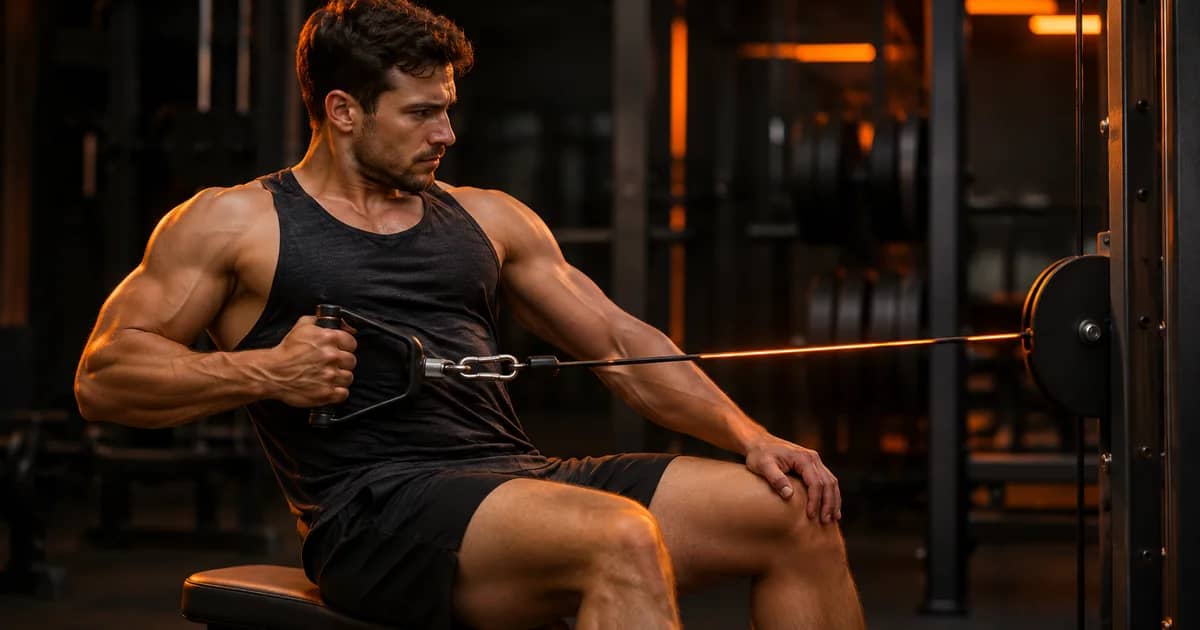
The single-arm cable row trains your lats, rhomboids, and rear delts one side at a time, while your core works to resist the rotation created by the one-sided load
Because you're pulling with only one arm against a fixed cable, your trunk has to actively resist being twisted toward the working side. That anti-rotation demand is the main thing that separates this exercise from a standard two-arm row, and it's why coaches program it as much for core control as for back size.
Get your free AI training and nutrition plan in 60 seconds
How to set up and perform a single-arm cable row
- Attach a single D-handle to a low cable pulley.
- Stand facing the machine in a staggered stance (one foot forward, one back) or a square stance with feet about hip-width apart, knees slightly bent.
- Grip the handle with the working arm and step back far enough that there's tension on the cable at full arm extension.
- Brace your core as if you were about to take a light punch to the stomach, and hinge your torso forward slightly from the hips, keeping your spine neutral.
- Pull the handle back by driving your elbow toward your hip, keeping it close to your body. Squeeze your shoulder blade toward your spine at the end of the movement.
- Control the return to full arm extension without letting the weight stack slam or your shoulder round forward.
- Complete all reps on one side before switching arms, or alternate sides if you're supersetting for time.
A free hand can rest on your knee (in a staggered stance) or grip a stable upright on the machine for extra balance, but avoid pushing off it to help generate the pull: its only job is stability, not assistance. Grip orientation (palm facing in, palm facing down, or a neutral handle) is mostly a matter of comfort and wrist position; a neutral or palm-in grip tends to feel easiest on the shoulder for most people.
What the single-arm cable row works
- Latissimus dorsi – the primary mover, pulling the arm back and down.
- Rhomboids and middle trapezius – responsible for retracting the shoulder blade at the end of the pull.
- Rear deltoids – assist in pulling the arm backward, especially if the elbow drifts slightly wider.
- Biceps and forearms – work isometrically and concentrically to maintain the grip and help flex the elbow.
- Obliques and deep core stabilizers – fire hard on the non-working side to prevent the torso from rotating toward the cable.
That last point is what makes the single-arm version worth including even if you already do two-arm rows: a bilateral row doesn't challenge rotational core stability nearly as much, because the load is balanced on both sides of the body at once.
Common mistakes
- Rotating the torso toward the working arm. This is the most common fault. If your shoulders twist to help the handle travel further back, you're letting the core do less work and often shortening the effective range of motion for the lat. Keep your hips and shoulders square to the machine throughout.
- Using momentum from the legs or lower back. Jerking the torso backward to heave the weight turns the exercise into a standing cable deadlift-row hybrid. The pull should come from the shoulder and shoulder blade, not from rocking.
- Letting the shoulder shrug up toward the ear. This shifts emphasis onto the upper trapezius instead of the mid-back muscles the exercise is meant to target.
- Too much weight, too little range. If you can't straighten the arm fully at the start without your torso rotating to compensate, the load is too heavy for the stance you're using.
- Rushing the eccentric (return) phase. Letting the cable yank your arm back to full extension skips the controlled lengthening portion of the movement, which is a meaningful part of the muscle-building stimulus and also the point in the rep where a rounded or twisted shoulder is most likely to get pulled into a bad position.
Breathing and bracing
Take a breath and brace your core before starting the pull, holding that brace through the full rep rather than letting your midsection go soft halfway through. A loose core is one of the quickest ways to lose the anti-rotation benefit of this exercise, since the trunk needs continuous tension to resist the cable's pull toward the working side. Exhale as the handle reaches your hip, then re-brace before the next rep.
Single-arm cable row vs. two-arm row
A two-arm row (barbell row, seated cable row, chest-supported row) generally allows you to move more total weight and is efficient when your main goal is loading the back muscles as heavily as possible. The single-arm cable row trades some of that loading capacity for:
- Independent work per side, which can help even out strength or muscle imbalances between left and right.
- Anti-rotation core demand that a bilateral row doesn't provide.
- A longer, often smoother range of motion at the end position, since the free arm and trunk can rotate slightly to help the shoulder blade retract fully (within reason: not as a substitute for control).
Neither version replaces the other. Many programs use a heavier bilateral row as a primary back movement and the single-arm cable row as an accessory later in the session, when a bit of core and stability challenge is welcome rather than a hindrance to lifting heavy.
| Factor | Single-arm cable row | Two-arm row |
|---|---|---|
| Loading capacity | Lower per arm (limited by stability) | Higher total load |
| Core demand | High (anti-rotation) | Lower (balanced load) |
| Per-side correction | Yes. Each arm trained independently | No, stronger side can compensate |
| Typical role | Accessory / secondary movement | Primary back movement |
Where it fits in a training week
The single-arm cable row is typically programmed on a back or pull-focused training day, after one or two heavier bilateral movements. Because the stance demands balance and core control, it's best performed while you're not already fatigued to the point of losing form: doing it as the very last exercise of a long session, when your core is already taxed from other work, tends to produce sloppier reps than placing it in the first half of the workout.
Sensible rep ranges
Because the single-arm cable row is usually an accessory or secondary pulling movement rather than a maximal-strength lift, it responds well to moderate-to-higher rep work:
- 8–12 reps per arm for general hypertrophy, using a weight where the last 1–2 reps are genuinely hard without the torso needing to rotate to finish them.
- 12–15 reps per arm if you're using it as a finisher or pairing it with a heavier compound row earlier in the workout.
- 2–4 sets is typical for most training splits.
If you track your training, logging the weight and reps per arm separately is worth doing here specifically. It's one of the few exercises where a left-right discrepancy tends to show up clearly over a few weeks.
Who benefits most from this exercise
Anyone who has noticed one side of their back feels weaker, less engaged, or harder to "feel" during bilateral rows is a good candidate for working more single-arm cable rows into their routine, since the unilateral setup makes it much harder for a dominant side to quietly take over the work. It's also a sensible choice for anyone returning from a minor shoulder or elbow issue on one side, since the load and range can be adjusted independently per arm rather than being dictated by whichever side is less capable that day.
Frequently Asked Questions
Should I do single-arm cable rows before or after barbell rows?
Can I do single-arm cable rows if I don't have a cable machine?
Why does my torso want to rotate during the exercise?
Is the single-arm cable row good for beginners?
What's a good cable height for this exercise?
Keep Reading
Get your free AI training and nutrition plan in 60 seconds
1,700+ exercises, wearables and progress tracking, free with no card needed. AI food scanning comes with Premium. Train solo or with a certified coach.