Gym Management Software in Australia: 2026 Buyer Guide
What Australian gym owners need from software: BECS direct debit or card billing, GST, Privacy Act duties for health data, state membership rules and 24/7 check-in, with options and published prices.
What does gym management software need to handle in Australia?
In Australia, gym software has to fit local rules as well as run classes and memberships. That means recurring billing that matches how members pay (card or BECS direct debit), GST at 10% once your GST turnover reaches A$75,000, Privacy Act duties that apply to gyms collecting health information even below the A$3m small business threshold, and membership terms that hold up under the Australian Consumer Law. If you run a 24/7 club, check-in and access records matter as much as the timetable.
This guide is for independent gyms, boutique studios and small multi-site operators. It covers the Australian parts generic lists skip, options with published pricing, and where Trainera fits. It is general information, not legal or tax advice.
The Australian rules your software has to work with
Packages, a class planner and a member app are the same everywhere. The Australian part is tax, payments, privacy and consumer law.
| Area | What applies | What it means for your software |
|---|---|---|
| GST | 10% on most goods and services; registration required at A$75,000 GST turnover (A$150,000 for non-profits), within 21 days | Prices, invoices and reports need to show GST correctly once you are registered |
| GST on fitness | Personal training and gym memberships are taxable, not GST-free | Do not set up memberships or PT packs as GST-free by default |
| Recurring payments | BECS direct debit via a Direct Debit Request (DDR) and service agreement, or card on file | Your billing provider must handle mandates, notices and failed payments |
| Privacy | Privacy Act 1988 and the 13 Australian Privacy Principles; gyms collecting health information are covered whatever their turnover | Consent for health questions, access control on member records, a privacy policy |
| Contracts | Australian Consumer Law unfair contract terms regime, plus state rules (QLD code, NSW pre-paid fees) | Membership terms, cooling-off and cancellation flows need to match your state |
| Coming in 2027 | Unfair Trading Practices Act (Act No. 64 of 2026), in force 1 July 2027 | Subscription information and easy cancellation, so plan your sign-up and exit flow now |
Sources: ATO GST registration, ATO GST and other health services, OAIC small business guidance and Parliament of Australia bill page.
GST: why fitness is taxable
The ATO lists GST-free health services, and personal training is not on the list. Its own example is exercise physiology, which is GST-free only on a doctor referral where a Medicare benefit is payable. Standard PT sessions and gym memberships are therefore taxable once you are registered. If you also run allied health services from the same premises, the treatment can differ, so check with your accountant.
In practice, ask for a sample report that splits GST for your BAS before you sign.
BECS direct debit vs card: how Australian members pay
Australian gyms bill members by BECS direct debit from a bank account, by card on file, or both. We found no reliable figure for the split, so decide based on your own members.
BECS is run under rules administered by the Australian Payments Network (AusPayNet). The member signs a Direct Debit Request and a DDR Service Agreement. Notice periods come from that agreement and the scheme rules, not from a statute.
| Point | BECS direct debit (Stripe AU) | Card on file |
|---|---|---|
| Who can pay | Members with an Australian bank account, AUD only; only Australian Stripe accounts can collect | Any member with a card |
| Confirmation | Success confirmed at T+2 | Usually at the time of payment |
| Disputes | Up to 7 years, "no questions asked", and final | Card scheme chargeback rules |
| Refunds | Must be issued within 90 days | Card refund rules |
| Pre-debit notice | Scheme guidelines suggest 14 calendar days (not mandatory); Stripe's default email goes the day before | Depends on your terms |
| Changing arrangements | Stripe's DDR agreement: at least 30 days' written notice of changes; members asked to give 7 business days to stop a drawing | Depends on your terms |
| New-user limits | A$10,000 per transaction and per week | Depends on provider |
Sources: Stripe BECS Direct Debit docs and Stripe BECS DDR Service Agreement.
The 7-year dispute window is the line owners tend to miss: a member who disputes a debit years later gets the money back, and you cannot contest it.
For a wider comparison of BECS, UK Bacs and Canadian PAD, see our sibling guide on gym direct debit in the UK, Australia and Canada, and for fees and payout models see gym payment software.
Privacy Act: the small business exemption does not cover most gyms
A business with annual turnover of A$3m or less is generally exempt from the Privacy Act. Health service providers are an exception, and the OAIC names gyms directly: "A gym or a weight loss clinic is a health service provider in situations where they collect your health information" (OAIC).
If your sign-up includes a pre-exercise screening, injury questions or body measurements, assume the Privacy Act applies to you. Health information is "sensitive information" and needs consent to collect, among other conditions (OAIC key concepts).
What to look for in software, as good practice rather than a compliance stamp:
- Health questions collected in a form with a clear consent step, not in free-text notes or a group chat.
- Staff roles, so a casual front-desk worker does not see every injury note.
- A way to export or delete a member's data when they ask.
Two dates to watch. The 2024 amendment act is law, and privacy policies must disclose automated decision-making by 10 December 2026. A second tranche was released as an exposure draft on 31 August 2026, and law firm summaries report it does not remove the small business exemption yet (LK Law, September 2026). You remain the controller of your member data, so check your own obligations with a privacy adviser.
Membership contracts: ACL, state rules and the 2027 changes
Since 9 November 2023 it has been unlawful to include or rely on unfair terms in standard-form consumer contracts, and a membership agreement is usually exactly that. Maximum penalties for a corporation are the greatest of A$50m, three times the benefit, or 30% of adjusted turnover during the breach period (ACCC).
| Rule | Where | Key points | Status |
|---|---|---|---|
| Fitness Industry Code of Practice | Queensland | 48-hour cooling-off, cancellation in writing; refund within 14 days less services used and a capped admin fee; cancel for permanent sickness or injury with a medical certificate | In force |
| Fitness Services (Pre-paid Fees) Act 2000 | New South Wales | No pre-paid fees covering more than 12 months; refund if service does not start within 3 months; cooling-off only if in the contract | In force |
| Unfair contract terms | National (ACL) | Unfair terms in standard-form contracts are unlawful, with large penalties | In force since 9 Nov 2023 |
| Unfair Trading Practices Act (No. 64 of 2026) | National | Pre-contract and ongoing subscription information, easy cancellation, drip pricing | Passed (assent 6 Jul 2026), in force 1 July 2027 |
Sources: Queensland Government and NSW Government. We have not checked fitness-specific rules in Victoria, WA, SA or the other states, so look those up for your location.
NSW Fair Trading notes that gyms often require 30 days' written notice to stop direct debits. Whether that still works under the 2027 subscription rules is a question for your lawyer; meanwhile, log every cancellation request with a date.
24/7 gyms and check-in
If you run a 24/7 or partly staffed club, check-in is not a nice extra.
Questions to ask every vendor:
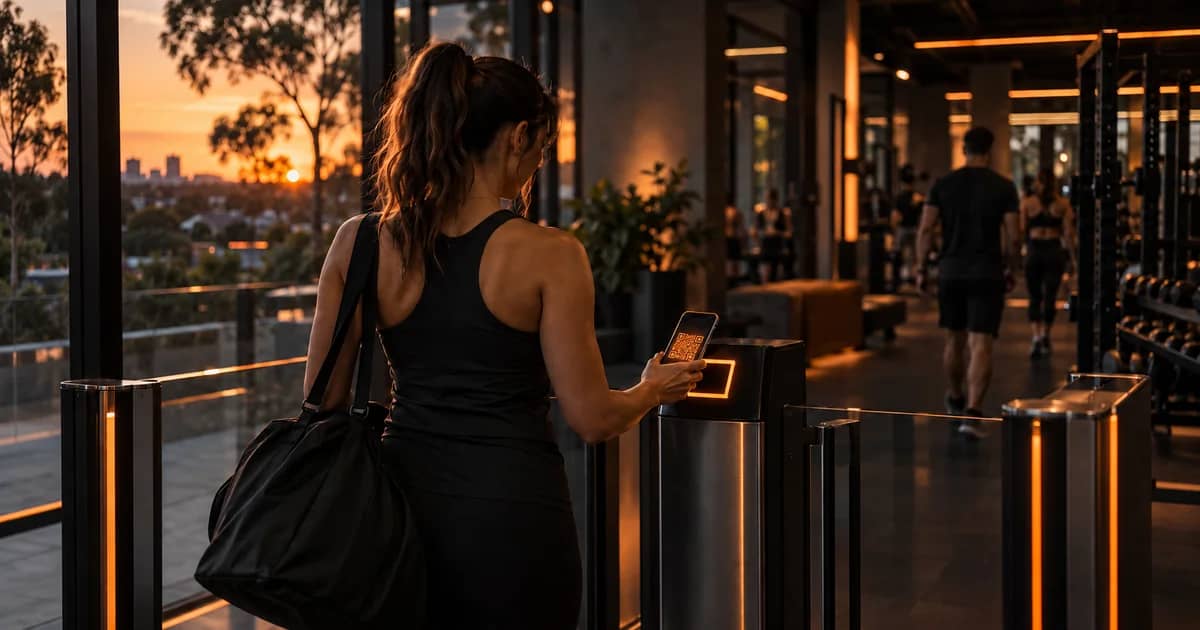
- Which check-in methods do you offer (app QR code, manual check-in at the desk, door or turnstile), and does each one record its source?
- Which door and turnstile hardware is integrated today, in Australia, with a reference customer you can call?
- Does access stop automatically when a payment fails or a membership ends?
For the hardware side, see how to run a 24/7 unstaffed gym and gym check-in and access control software.
Gym management software options used in Australia
Prices below are what each vendor publishes, checked on 7 October 2026. Several vendor pages change currency depending on where you visit from, so we show the currency the page displayed and do not convert. "Quote only" means no public price.
| Software | Headquarters | Main focus | Published starting price |
|---|---|---|---|
| Hapana | Sydney, Australia | Gyms, studios, franchises | Quote only (per-location Basic, Premium, Pro) |
| Clubware (Xplor) | Auckland, New Zealand | Gyms in Australia and NZ since 2001 | Quote only, no public price found |
| PerfectGym | Warsaw, Poland (Melbourne office) | Clubs and chains | Studio from €179 per club per month, plus an onboarding fee |
| Mindbody | San Luis Obispo, US | Studios, spas | Quote required outside North America and Asia |
| Glofox (ABC Fitness) | Dublin, Ireland | Boutique studios | Quote only |
| Gymdesk | Austin, US | Small gyms, martial arts | 75 to 100 US dollars a month up to 50 members (USD shown) |
| TeamUp (DaySmart) | London, UK | Studios, PT businesses | AUD pricing offered, figure not confirmed |
| Trainera | Online platform | Gyms, studios, PTs and online coaches | Core A$179 a month |
Sources: Hapana pricing, Clubware, PerfectGym pricing, Mindbody pricing, Glofox pricing, Gymdesk pricing, TeamUp pricing. For what a full setup tends to cost once payments and add-ons are counted, see how much gym management software costs.
A local head office matters most for Australian payment integrations, on-site hardware support or a franchise rollout.
How to choose for a small or boutique gym
What I see with smaller owners is that they buy for the gym they hope to have in five years and then pay for features nobody uses. Start with the next 12 months.
- Payments first. Decide card, BECS or both, then cut every vendor whose billing does not match. Ask who holds the merchant account.
- Your state's contract rules. If you are in Queensland or NSW, check the sign-up and cancellation flow against the rules above before the demo ends.
- Health data. Look at where screening answers live and who can see them.
- Access. For 24/7, hardware integration decides the shortlist. For staffed hours, app QR plus manual check-in may be enough.
- Trainers. If PTs work in your gym, check whether they can program clients in the same app. Trainers may be registered with AUSactive, which needs a Certificate IV in Fitness for PT registration, so you can ask for proof of registration and insurance at onboarding.
For a wider feature checklist that is not country-specific, our gym management software guide covers the rest.
Where Trainera fits for an Australian gym
Trainera is one platform for gyms, studios, personal trainers and their members. Here is exactly how it works in Australia, including the parts that may rule it out.
- Plan pricing is in Australian dollars. Core is A$179 a month (self-serve, card), White Label A$329 and Studio A$389 (both by call, invoiced). The first 3 trainers are included and each extra trainer is A$22 a month. Prices are set for Australia on trainera.fit/pricing.
- Memberships in AUD. You create packages with your own price, currency and billing cycle, including AUD, and sell them online by card through your own Stripe account. Trainera takes a 0% platform fee; Stripe bills its processing fee to you directly.
- Card only online. Trainera's online checkout takes cards. It does not collect BECS direct debit. If you want BECS, run it through your own payment provider or bank and record the membership in Trainera, or take payment at the desk and record it there.
- Check-in. Members get a digital member card with QR check-in in the app, and staff can check members in manually from the gym overview. Each check-in is recorded with its source. Ask us about your specific door hardware before you plan around it.
- Core features. Web dashboard, Leads CRM with a 7-stage pipeline and follow-up reminders, class planner with recurring series and rosters, gym website builder with your own domain, a members-only community feed, and TRAI, an AI assistant for your gym data (200 requests a month).
- Your own app. On White Label and Studio you get branded iOS and Android apps, with store submission handled by Trainera and push notifications under your brand.
Trainera fits a studio or independent gym that is happy with card billing in AUD and app-based check-in. If you depend on BECS inside the gym software or on a specific turnstile integration, a local specialist above may suit you better.
If you also run gyms elsewhere, see the sibling guide for gym management software in the UK. For the trainers you work with, there is running a PT business in Australia.
Your shortlist checklist for an Australian gym
- Write down how members will pay: card, BECS, desk, or a mix.
- Confirm GST settings and a BAS-friendly report with each vendor.
- Treat health screening data as covered by the Privacy Act, whatever your turnover.
- Check sign-up, cooling-off and cancellation against your state's rules, and plan for 1 July 2027.
- For 24/7 access, get the hardware integration and a reference in writing, plus contract length, setup fees and export terms.
Want to see AUD membership packages, QR check-in and the class planner in a live account? Look at Trainera for gyms.
Frequently Asked Questions
What is the best gym management software in Australia?
Do gyms in Australia have to charge GST on memberships?
Does the Privacy Act apply to small gyms in Australia?
Can gym software take BECS direct debit in Australia?
How much does gym software cost in Australia?
Keep Reading
Run your gym on Trainera
Memberships, check-ins, staff and payments in one place
QR and turnstile check-in, membership packages, staff logins and a gym website, with no per-member fees. We move your members from your current software for free.