Gym Payments in Switzerland: TWINT, QR-Bill and LSV+
LSV+ direct debit ends in Switzerland, with the last CHF debit on 30 September 2028 and EUR on 31 August 2027. How gyms collect memberships with cards, TWINT, QR-bill and eBill instead, what each method fits, and a step-by-step plan for the switch.
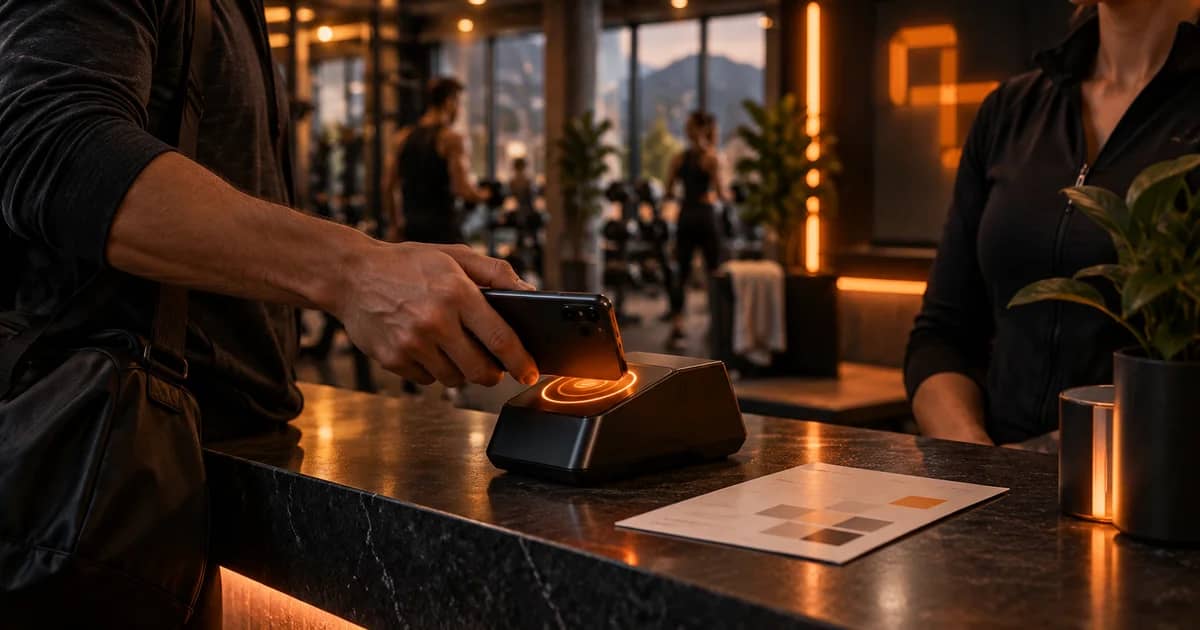
How do Swiss gyms collect membership fees in 2026?
Most Swiss gyms sell a 12-month contract (76.2% of members in 2025, swiss active Eckdatenstudie 2026) and collect it by card, TWINT, QR-bill or LSV+ direct debit. The big deadline is LSV+/BDD: SIX ends it, with the last CHF debit on 30 September 2028 and the last EUR debit on 31 August 2027 (SIX). A gym that still runs LSV+ needs a new collection method before then.
The rest of this post goes method by method: who pays that way, what it costs you in admin, and what replaces direct debit. Status as of October 2026.
Which payment methods Swiss members actually use
Swiss people still split their payments between cards, cash and apps, and online they lean on apps and banking.
The Swiss National Bank payment methods survey 2025 (autumn 2025, about 2,000 people) gives these shares of transactions:
| Payment method | At the point of sale | Remote (online, app, invoices) |
|---|---|---|
| Debit card | 37% | 16% |
| Cash | 30% | 3% |
| Payment apps (such as TWINT) | 17% | 32% |
| Credit card | 13% | 19% |
| Online banking | 0% | 17% |
Source: SNB, survey 2025. The SNB also notes that people prefer to pay invoices through online or mobile banking, and only 2% want cash abolished.
For a gym this means two things. At reception you still need card and cash. For the annual fee, our reading of the remote-payment shares is that many members will prefer an invoice paid from their banking app, or TWINT, to typing card details into a website.
Gym payment options in Switzerland compared
Each method fits a different part of the membership: sign-up, the annual fee, monthly billing or the desk.
| Method | Recurring? | Who starts the payment | Typical gym use | Status 2026 |
|---|---|---|---|---|
| Debit or credit card | Depends on the provider setup | Member at checkout, gym for later charges | Online sign-up, prepaid packages, desk | Standard |
| TWINT | On Stripe: recurring payments and subscriptions supported, CHF only | Member confirms in the app | Online sign-up, day passes, desk | Over 6 million active users (watson.ch, 2026) |
| QR-bill | No, one invoice per payment | Member pays from e-banking | Annual fee, instalments | Only structured addresses since 22 Nov 2025 |
| eBill | eBill Direct Debit since summer 2025 | Member approves in e-banking | Annual fee, invoice series | Over 4 million users (June 2026) |
| LSV+ / BDD direct debit | Yes | Gym, with a debit authorization | Monthly or annual debits | Ending: last CHF debit 30 Sep 2028 |
| Cash or standing order | Standing order: yes, set by the member | Member | Desk, members who prefer their bank | Standard |
Sources: Stripe TWINT docs, SIX QR-bill, SIX eBill media release, August 2026, SIX LSV+ page linked above.
LSV+ and BDD are ending: the dates gyms need
SIX is shutting down LSV+ and Business Direct Debit, and has stopped taking on new participants.
| Date | What happens |
|---|---|
| Summer 2025 | eBill Direct Debit launched as the successor |
| 31 Dec 2025 | Last date for new financial institutions to join; no new LSV IDs after that |
| Mid-2027 | Further eBill functions planned, including Business Direct Debit and a migration supported by SIX |
| 31 Aug 2027 | Last LSV+/BDD debit in EUR |
| 31 Dec 2027 | euroSIC ends |
| 30 Sep 2028 | Last LSV+/BDD debit in CHF |
Sources: SIX, LSV decommissioning; SIX blog on the discontinuation; mid-2027 functions: SIX eBill release. SIX also notes that a bank can end its LSV+ service earlier than 30 September 2028, so ask yours for its own date.
SIX recommends eBill, QR-bill, standing orders or single payments as alternatives, and asks billers to plan the move with their bank before September 2028. If you invoice some members in euros (cross-border members from Germany or France, for example), your deadline is a year earlier.
What I would not do is wait for summer 2028. Every LSV+ member has to act once, whether that means signing up for eBill, setting a standing order or paying a QR-bill. Members on holiday, members who ignore post, members who change bank: the earlier you start, the fewer gaps you chase later.
TWINT for gyms: what it covers and what it does not
TWINT reaches a large share of Swiss members through an app they already use, which makes it a strong option for sign-ups and one-off purchases.
According to a watson.ch report (17 Feb 2026), TWINT has over 6 million active users, processed 901 million transactions in the previous year and is accepted in 81% of physical shops and 86% of online shops. The same report says TWINT is introducing its own direct debit as an LSV+ replacement; treat that as a media report and check the details with TWINT or your bank.
If you accept TWINT through Stripe, the Stripe documentation lists these conditions:
- customers in Switzerland only, prices in CHF;
- recurring payments and subscriptions are supported;
- maximum CHF 5,000 per payment, refunds possible for up to 180 days;
- your website must show your company name, legal form, address and contact details, and prices must be in CHF by checkout at the latest.
Stripe's German price page listed TWINT at 2.6% + EUR 0.25 per transaction when our researchers checked it on 7 October 2026 (Stripe pricing). Check your own Stripe account for the rate that applies to you.
The CHF 5,000 cap does not matter for a gym membership, since the average annual fee was CHF 997 in 2025 (swiss active). The CHF-only rule matters if you have members paying in euros.
QR-bill and eBill: invoices for the annual fee
For a 12-month contract, an invoice with a QR-bill is a common way to collect the fee, and the QR-bill is the standard Swiss payment slip since the old slips were retired.
The QR-bill has been in use since 30 June 2020, and the old orange and red payment slips stopped working on 30 September 2022. Since 22 November 2025 only structured addresses are allowed (Implementation Guidelines 2.3), with more umlauts and special characters permitted. A QR reference needs a QR-IBAN, which only exists for Swiss and Liechtenstein accounts; the alternative is a creditor reference (SCOR) with a normal IBAN (SIX QR-bill).
In practice, check two things in whatever produces your invoices: that member addresses are stored as street, number, postcode and town in separate fields, and that the reference matches your account type. Old member records with the whole address in one line are where structured-address errors come from.
eBill goes a step further. The invoice lands directly in the member's e-banking, and they approve it there. SIX reported over 4 million registered users at the end of June 2026, about 93 million transactions in 2025 and 110 participating financial institutions. SIX introduced eBill Direct Debit in summer 2025 as a successor solution to LSV+ and BDD (SIX, August 2026). To issue eBills, you go through your bank or an invoicing provider connected to eBill.
A practical setup for a Swiss gym
Most gyms end up with a mix: card or TWINT online, invoice for the annual fee, and card and cash at the desk.
- List your current flows. How many members pay by LSV+, by invoice, by card, at the desk? The LSV+ group is your migration project.
- Talk to your bank about eBill. Ask what eBill Direct Debit costs, when Business Direct Debit and the SIX-supported migration are available in 2027, and how existing LSV+ authorizations move over.
- Clean up member addresses so QR-bills validate with structured addresses.
- Decide on online sign-up. Card checkout works for prepaid packages; TWINT through a provider such as Stripe adds the method many Swiss members prefer.
- Write the payment method into the contract. Which methods you accept, when the fee is due and what happens on late payment belong in your terms. Our post on Swiss gym membership contract rules covers the clauses to check.
- Tell members early, with one clear message per group: what changes, what they need to do, by which date.
This is general information as of October 2026, not legal or tax advice. Check bank fees and contract wording with your bank, your fiduciary (Treuhänder) or a lawyer.
Where Trainera fits
Trainera handles the online card part and the records; TWINT, QR-bill, eBill and LSV+ run outside it.
- Online sales by card. A gym creates membership packages with its own price in CHF and sells them online by card through its own Stripe account, with 0% Trainera platform fee. Stripe bills its processing fee to the gym directly.
- One-off payment per package. An online package purchase is a single card payment, not a card subscription that renews by itself. Trainera does not charge members automatically every month.
- No TWINT, QR-bill, eBill or LSV+ in Trainera. If you invoice by QR-bill or eBill, or collect by LSV+ until 2028, you do that through your bank or payment provider and record the payment in Trainera.
- Desk payments. Cash or bank transfer taken at reception is recorded in Trainera, so the member's status is right even when the money arrived outside the app.
- Members get a digital member card with QR check-in in the free app for iOS, Android and web.
| Trainera gym plan (Switzerland) | Monthly price | Notes |
|---|---|---|
| Core | CHF 129 | Self-serve, card |
| White Label | CHF 239 | Your own branded iOS and Android apps |
| Studio | CHF 279 | White Label plus Community Plus and Automations |
| Extra trainer (after 3 included) | CHF 16 | Per trainer per month |
Prices from trainera.fit/pricing for Switzerland, October 2026; yearly billing is 10 times the monthly price. For the wider picture of how a Swiss gym chooses software (VAT, data protection, languages), see gym software in Switzerland. For how your own Stripe account and desk payments work in general, read gym payment software and gym front desk software. If you also have members in Germany or Austria, SEPA Direct Debit for gyms covers the euro side.
Your LSV+ to 2028 checklist
Use these dates and steps to plan the switch in the order the deadlines arrive.
- EUR members on LSV+/BDD: move them before 31 August 2027.
- CHF members on LSV+: move them before 30 September 2028, ideally once your bank offers the 2027 eBill migration.
- QR-bills: structured addresses only, since 22 November 2025.
- TWINT online: CHF only, company details and CHF prices visible on your site.
- Contract terms: payment methods and due dates written down.
Want online package sales by card and clean member records next to your bank invoicing? See how Trainera works for gyms.
Frequently Asked Questions
When does LSV+ end in Switzerland?
What replaces LSV+ for gym memberships?
Can a gym take TWINT for recurring membership payments?
What changed with the QR-bill in November 2025?
Does Trainera support TWINT or QR-bill?
Keep Reading
Run your gym on Trainera
Memberships, check-ins, staff and payments in one place
QR and turnstile check-in, membership packages, staff logins and a gym website, with no per-member fees. We move your members from your current software for free.