Workout for Women Over 50 and 60: Strength, Bone and Balance Plan
A practical workout for women over 50 and 60: how to lift for muscle and bone, train balance safely, eat enough protein and follow a sample week, even if you have never lifted before.
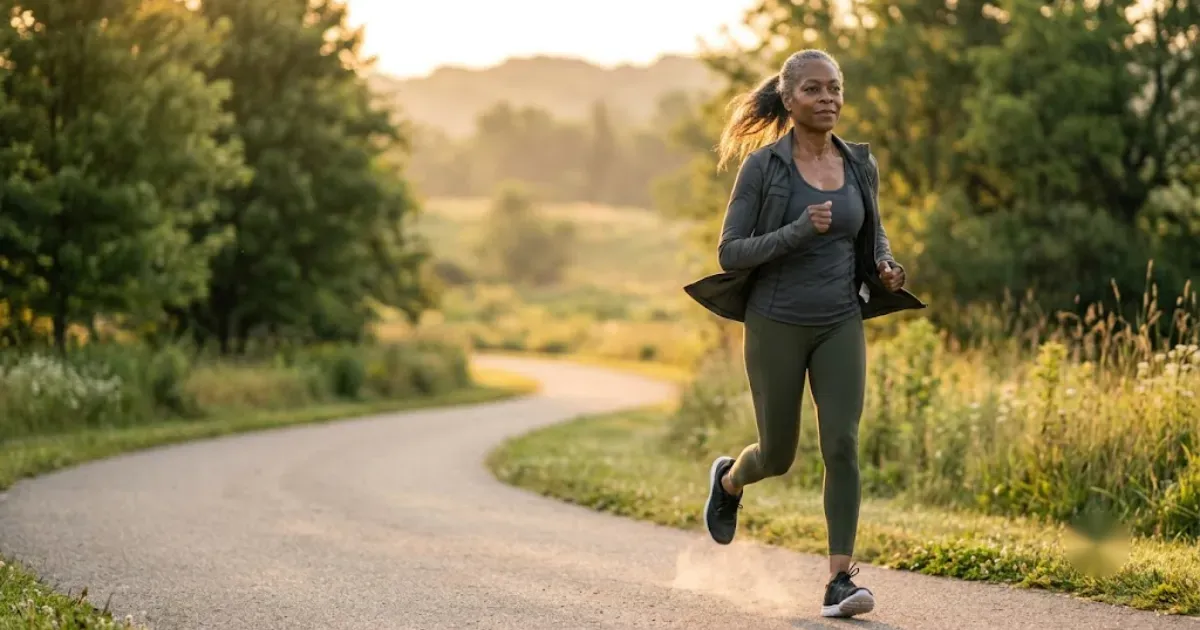
The best workout for women over 50 combines strength training 2 to 3 days a week, balance practice, some impact work for bone and about 150 minutes of moderate cardio weekly. Lift loads that make the last two reps hard and progress in small steps. The same plan works after 60, with extra attention on balance.
This guide is for women who mostly train on their own, at home or in a regular gym: a sample week, exact sets and reps, bone-safe progressions and a clear way to start if you have never lifted.
What workout is best for women over 50?
A full-body strength program done two or three times a week, backed by walking or other cardio and a few minutes of balance work, covers almost everything you need. Strength is the part most women skip, and it is the part that protects muscle, bone and independence.
The WHO physical activity guidelines recommend that adults do 150 to 300 minutes of moderate aerobic activity (or 75 to 150 minutes of vigorous activity) a week, plus muscle-strengthening work for all major muscle groups on 2 or more days. From 65, the WHO adds varied multicomponent activity that emphasises functional balance and strength on 3 or more days a week to prevent falls.
In practice, a good workout for women over 50 has five parts:
- Strength: squats, hinges, pushes, pulls and carries, 2 to 3 times a week.
- Impact: small jumps, stomps or brisk stair climbing, if your bones allow it.
- Balance: single-leg and narrow-stance work, a few minutes most days.
- Cardio: brisk walking, cycling, swimming or dancing.
- Mobility: enough to move comfortably through each lift, not hours of stretching.
For a deeper look at the lifting side, read our guide to strength training after 50.
Get your free AI training and nutrition plan in 60 seconds
How does training change after menopause?
The goal shifts from burning calories to protecting bone and muscle. Falling estrogen speeds up bone loss in the years around and after menopause, and muscle strength drops faster when it gets no stimulus, so well-progressed strength training matters more than it did at 35.
- Load beats endless reps. Bones respond to meaningful load and to impact, not to 30 reps with a tiny dumbbell.
- Recovery may take longer. Poor sleep and joint aches are common, so leave at least one day between hard sessions for the same muscles.
- You do not need to train to failure. Stopping one to three reps short builds strength with less fatigue and lower injury risk.
Heavy lifting used to be discouraged for women with low bone mass. The LIFTMOR randomised trial challenged that: 101 postmenopausal women with low bone mass (average age 65) did either 8 months of twice-weekly, 30-minute supervised high-intensity resistance and impact training (5 sets of 5 reps above 85% of their one-rep max) or a low-intensity home program. Lumbar spine bone density rose 2.9% in the lifting group and fell 1.2% in the home group, femoral neck density changed by +0.3% versus -1.9%, and all functional tests improved more. Only one minor adverse event, a lower back spasm, was reported. The women were screened, closely supervised and built up gradually, so treat it as a destination, not a day-one starting point.
How can women build muscle after 50 and after 60?
The same way anyone builds muscle: progressive overload, enough protein and enough recovery. Progress is slower than at 25, but women in their 60s, 70s and beyond still gain measurable strength and muscle with consistent training.
The training part
- Frequency: 2 to 3 full-body sessions a week.
- Volume: 2 to 3 sets per exercise, 6 to 12 reps.
- Effort: finish each set with 1 to 3 reps left in the tank.
- Progression: once you hit the top of the rep range on every set with good form, add the smallest weight increase available.
- Speed: once the movement is solid, lift with intent (stand up from a squat briskly, lower under control). Power fades faster with age than strength, and it is what catches you when you trip.
The protein part
The PROT-AGE study group recommends that people over 65 eat at least 1.0 to 1.2 g of protein per kg of body weight a day, and 1.2 g/kg or more if they exercise. For a 70 kg woman who lifts, that is roughly 85 g a day, easiest to reach as 25 to 30 g at each of three meals. Some easy sources:
- 100 g cooked chicken breast: about 30 g protein
- 200 g plain Greek yogurt: about 18 to 20 g
- 2 large eggs: about 12 g
- 100 g canned tuna, drained: about 25 g
- 150 g cooked lentils: about 13 g
If you have severe kidney disease, talk to your doctor before raising protein.
So, how to build muscle after 60 specifically? Same rules, with a longer warm-up, a slightly slower start and balance work built into every session. Age changes the speed of progress, not the method.
What should a workout for women over 60 include each week?
Two or three strength sessions, balance practice on at least three days, around 150 minutes of moderate activity and, if your bone health allows, a little impact. This sample week fits all of that into about 3 to 4 hours.
| Day | Session | Time |
|---|---|---|
| Monday | Strength A + 5 minutes balance | 40 to 45 min |
| Tuesday | Brisk walk + heel drops or low stomps | 30 to 40 min |
| Wednesday | Strength B + 5 minutes balance | 40 to 45 min |
| Thursday | Cycling, swimming or dancing + mobility | 30 to 40 min |
| Friday | Strength A (lighter if tired) + 5 minutes balance | 35 to 45 min |
| Saturday | Longer walk or hike | 45 to 60 min |
| Sunday | Rest or gentle stretching | Optional |
Strength A
- Goblet squat or sit-to-stand from a chair: 3 x 8 to 12
- Dumbbell Romanian deadlift: 3 x 8 to 10
- Incline push-up (hands on a bench or counter): 3 x 6 to 12
- One-arm dumbbell row: 3 x 10 each side
- Farmer carry: 3 x 30 to 40 metres
- Prone back extension (lying face down, lift your chest slightly): 2 x 10
Strength B
- Step-up onto a low box or stair: 3 x 8 each leg
- Glute bridge or hip thrust: 3 x 10 to 12
- Seated dumbbell shoulder press: 3 x 8 to 10
- Lat pulldown or band pulldown: 3 x 10 to 12
- Supported split squat (hand on a wall): 2 x 8 each leg
- Pallof press with a band: 2 x 10 each side
If shaping your lower body is a priority, borrow ideas from our glutes and curves workout plan and swap them into Strength B.
How do you train for bone density and balance safely?
Bone responds to load and impact, and balance improves when you practise it at the edge of your ability. Do both, progress gradually, and choose your starting level based on whether you have osteoporosis or a fracture history.
The UK consensus statement Strong, steady and straight recommends that people with osteoporosis do resistance and impact exercise for bone strength, strength and balance work to reduce falls, and spinal extension exercise for posture. For safety it advises avoiding postures with a high degree of spinal flexion, such as repeated sit-ups or loaded toe touches. People with a vertebral fracture or multiple low-trauma fractures should usually keep impact to the level of brisk walking, and anyone at risk of falls should start with strength and balance training first.
Impact progression (move on only when the current step feels easy):
- Heel drops: rise onto your toes, drop down firmly, 10 to 20 times
- Marching stomps on the spot
- Small two-footed jumps or skipping
- Low hops or step-downs from a stair
Balance progression (always next to a counter or wall):
- Feet together, then heel to toe, 30 seconds each
- Single-leg stand, 20 to 30 seconds per leg
- Single-leg stand while turning your head or reaching
- Walking heel to toe along a line, then slow step-ups and lunges
See your doctor before starting if you have a diagnosed spinal fracture, have fallen recently, get chest pain, dizziness or unusual breathlessness on exertion, or have had a joint replaced in the last few months. A physiotherapist can then set safe limits for you to build on.
Is an online personal trainer worth it for older women?
For many women, yes. An online personal trainer gives you a plan built around your joints, bone status and schedule, plus video form checks and accountability, usually for less than regular in-person sessions. If you are already consistent and confident with technique, you may not need one.
When you look for an online personal trainer for women over 50, check that they:
- ask about your health history, menopause symptoms, bone density results and past injuries before writing anything;
- review your exercise videos and give specific technique feedback;
- progress loads gradually and include balance and impact work;
- adjust the plan when life gets in the way.
Prices vary widely by country and service level, so read how much an online personal trainer costs before you compare offers.
How do you start if you have never lifted weights?
Start with two short full-body sessions a week using your body weight and light dumbbells, learn the basic movement patterns, and add load in small steps every week or two. The first two months are about technique and habit, not about how heavy you lift.
- Weeks 1 to 2: two sessions of Strength A, 2 sets of 10 to 12 reps at an easy effort. Walk on other days.
- Weeks 3 to 4: add a third set and start the balance progression on three days.
- Weeks 5 to 6: alternate Strength A and B, and add weight whenever all sets feel comfortable.
- Weeks 7 to 8: move to three sessions a week if recovery is good, and try the first step of the impact progression.
Log every session: exercise, weight, sets and reps. Mild muscle soreness for a day or two is normal. Sharp joint pain is not, so swap the exercise and mention it to your doctor or a physiotherapist if it persists.
How to turn this into your own plan
A written plan only works if you track it and adjust it. Trainera has a free forever plan, no card needed, with workout logging, a diet tracker, basic analytics and one AI training plan and one AI nutrition plan a month. Its AI coach, TRAI, builds a workout plan from more than 1,800 real exercises (over 1,700 with video) and answers your questions in your own language, which helps when you want the sample week above adapted to your equipment and schedule. If you would rather work with a person, the trainers marketplace lets you find a personal trainer by specialty and location.
Frequently Asked Questions
Keep Reading
Get your free AI training and nutrition plan in 60 seconds
1,800+ exercises, wearables and progress tracking, free with no card needed. AI food scanning comes with Premium. Train solo or with a certified coach.