Tricep Extension Variations: Overhead, Skull Crusher, and Pushdown Compared
Get your free AI training and nutrition plan in 60 seconds
Overhead extension, skull crusher, and cable pushdown compared: how elbow and shoulder position change long-head emphasis, common mistakes, and which to pick.
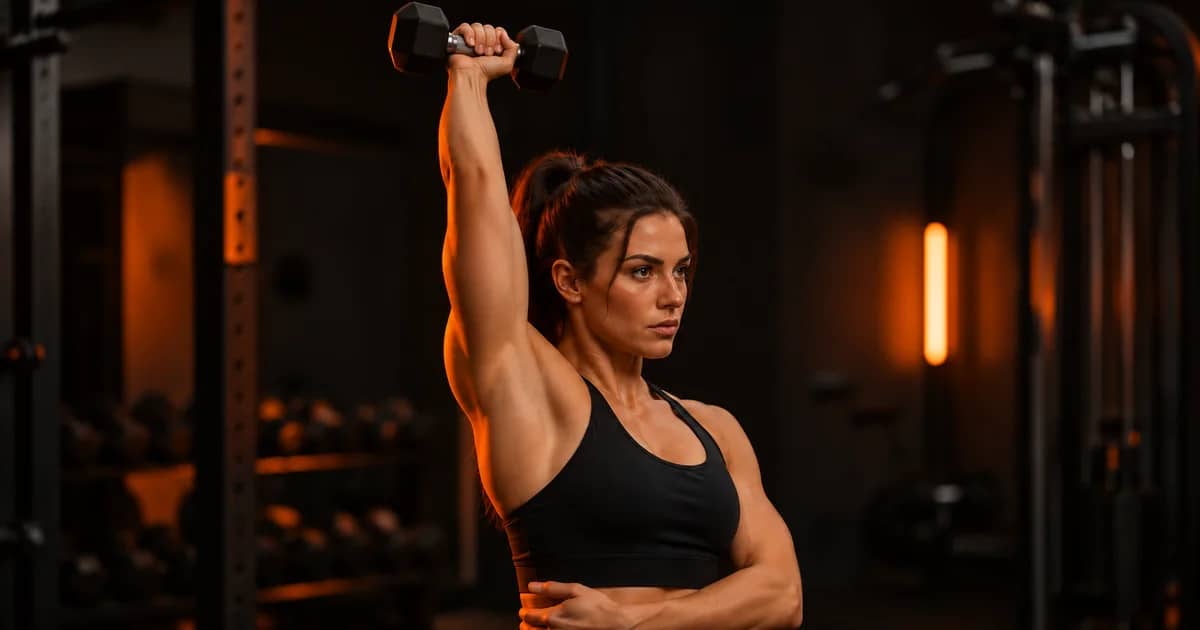
The tricep extension has three main variations, overhead extension, lying extension (skull crusher), and cable pushdown, and they differ mainly in elbow/shoulder position, which changes how much they stretch and load the long head of the triceps
All three train the triceps through elbow extension, but the position of the upper arm relative to the torso at the start of each movement changes which of the triceps' three heads gets the most emphasis, particularly the long head.
Get your free AI training and nutrition plan in 60 seconds
Why elbow and shoulder position matters: the long head
The triceps has three heads: lateral, medial, and long. The long head is the only one that crosses both the shoulder and elbow joints, meaning its length (and therefore how much stretch it experiences) depends on shoulder position as well as elbow angle. When the arm is raised overhead, the long head is placed in a lengthened position at the shoulder, which puts it under more stretch during the exercise. Exercises performed with the upper arm down at the sides (like a pushdown) don't lengthen the long head at the shoulder, so the long head gets comparatively less stretch-related stimulus in that position, even though the lateral and medial heads are still worked well.
Overhead dumbbell or cable extension
Performed with the arm raised overhead (holding a dumbbell behind the head, or using a cable from a low pulley), this position lengthens the long head at the shoulder throughout the movement. Because of that extended stretch, it's generally considered one of the better variations specifically for the long head.
- Setup: raise the upper arm overhead, keep the elbow pointed forward and relatively still, and lower the weight behind the head by bending at the elbow only.
- Key cue: avoid letting the elbow flare out to the side or drift forward and back. It should stay roughly fixed next to your head throughout the set.
Skull crusher / lying tricep extension
Performed lying on a bench with the upper arms pointed up toward the ceiling (not overhead past the head), a barbell, EZ-bar, or dumbbells are lowered toward or just past the forehead by bending only at the elbow.
- Setup: lie on a flat bench, start with the upper arms vertical, and lower the weight toward your forehead or just behind it, keeping the upper arms still throughout.
- Key cue: keep the elbows pointed at the ceiling and relatively fixed in place, if they drift backward (toward your head) or flare outward, you lose tension on the triceps and can strain the elbow joint.
- This variation puts some stretch on the long head, though generally less than a fully overhead position, since the upper arm is vertical relative to the torso rather than raised past it.
Cable pushdown
Performed standing at a cable stack with the upper arms pinned to the sides of the torso, pressing the attachment (bar, rope, or single handle) down until the arms are extended.
- Setup: stand facing the cable, elbows tucked close to your ribs, and push the attachment down without letting the elbows drift forward away from the torso.
- Key cue: keep the upper arm still and let only the forearm move. Many people unintentionally lean into the movement with their shoulders or let their elbows rise, which reduces triceps isolation.
- Because the upper arm stays down at the side, the long head isn't placed under the same lengthened stretch as the overhead variations, which is why pushdowns are often considered better for overall triceps work and the lateral/medial heads than specifically for long-head emphasis.
| Variation | Upper arm position | Long head stretch | Equipment |
|---|---|---|---|
| Overhead extension | Raised overhead | High | Dumbbell, cable, EZ-bar |
| Skull crusher / lying extension | Vertical (upper arm pointed up) | Moderate | Barbell, EZ-bar, dumbbells |
| Cable pushdown | Down at the sides | Low | Cable stack |
Sensible rep ranges
All three variations tend to work well in a moderate rep range, roughly 8–15 reps for 2–4 sets, since the triceps, and the elbow joint specifically, generally respond better to controlled moderate loading than to very heavy, low-rep isolation work. Pushdowns in particular are easy to load with momentum at low reps, so keeping the rep range a bit higher helps enforce the strict elbow-only motion that makes the exercise effective in the first place.
Common mistakes across all variations
- Letting the upper arm move instead of isolating the elbow. In every variation, the upper arm should stay relatively fixed in place while only the forearm swings through the range: moving the shoulder turns the exercise into more of a press and reduces triceps isolation.
- Flaring the elbows out to the sides in pushdowns and skull crushers, which reduces tension on the triceps and increases strain elsewhere.
- Using too much weight and shortening the range of motion to compensate, especially common in pushdowns where it's easy to lean on the cable stack rather than control the movement.
- Going too heavy on skull crushers, which is one of the more elbow-joint-sensitive variations: a controlled tempo and a conservative weight matter more here than in most other triceps exercises.
- Stopping the overhead extension short of a real stretch by not lowering the weight far enough behind the head, which undercuts the main advantage of choosing that variation in the first place.
Single-arm variations
Both overhead extensions and pushdowns can be performed one arm at a time: a single-arm overhead dumbbell extension, or a single-arm cable pushdown/overhead extension. Training one arm at a time makes it easier to notice and correct left-right strength differences, and it can also let you focus more closely on keeping the upper arm still, since there's less overall load to stabilize compared to a two-arm version.
Choosing a variation based on your equipment
- Only have dumbbells: overhead dumbbell extension is a solid default, and it directly targets the long head.
- Have a cable machine: both overhead cable extensions and pushdowns are available, alternating between them across a training block, or doing one of each in the same session, covers both the long-head-emphasis and general-triceps-isolation benefits.
- Have a barbell/EZ-bar and a bench: skull crushers are a good compound-adjacent option that can typically handle more total load than single-arm or cable variations.
- Training at home with minimal equipment: a single dumbbell is enough to perform overhead extensions effectively, making it one of the more accessible options.
There's no single "best" variation for everyone. Most well-rounded triceps programs include at least one overhead-position movement (for long-head stretch) alongside a pushdown-style or skull-crusher movement (for the other two heads), rather than relying on only one pattern indefinitely.
A note on elbow discomfort
The triceps' tendon attachment at the elbow can be sensitive to high-volume isolation work, particularly with heavier skull crushers or aggressive pushdown loading. Mild muscular fatigue in the belly of the triceps is expected from training; a sharp, localized pain at the elbow joint itself is not, and is a reason to reduce the load, check elbow positioning, or swap to a different variation for a while rather than training through it.
Rotating between variations over the course of a training block, rather than doing the exact same tricep extension week after week, is also a practical way to spread the loading stress across slightly different joint angles and tendon attachment points, which may help manage the cumulative stress any single variation places on the elbow over time.
Frequently Asked Questions
Which tricep extension variation builds the triceps long head best?
Are skull crushers bad for the elbows?
Is a cable pushdown as effective as an overhead extension?
Can I do tricep extensions with just dumbbells at home?
Should I do tricep extensions before or after pressing exercises?
Keep Reading
Get your free AI training and nutrition plan in 60 seconds
1,700+ exercises, wearables and progress tracking, free with no card needed. AI food scanning comes with Premium. Train solo or with a certified coach.