Which Tricep Head Makes Arms Look Bigger?
The triceps has three heads, and one contributes far more to arm size than the others. Learn which head to prioritize, which tricep exercises to use, and how to build genuinely bigger arms.
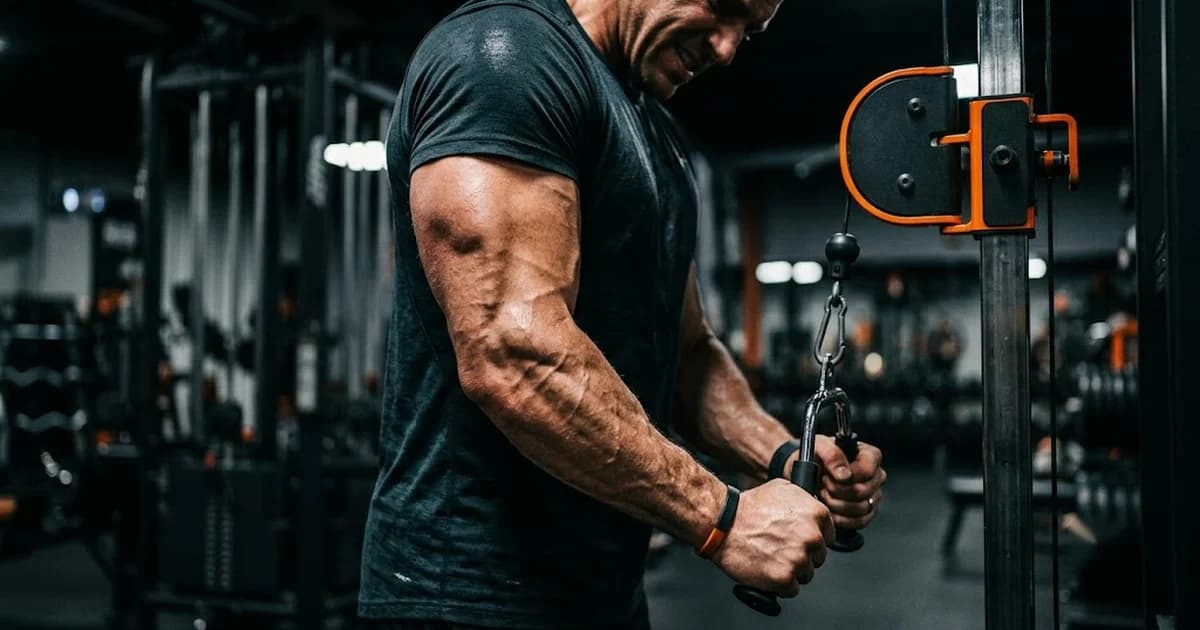
Get your free AI training and nutrition plan in 60 seconds
The Triceps Muscle Decides How Big Your Arms Look
The long head of the triceps is the single most important head for building bigger arms - it is the largest of the three and sits along the entire back of the upper arm, so developing it adds more raw mass than training any other part of the muscle. If your goal is arms that look bigger in a shirt or fill out a sleeve from every angle, understanding the triceps muscle and how each of its three heads works is the fastest shortcut available to you.
Most people chasing bigger arms focus almost entirely on biceps curls. The problem is that the triceps muscle makes up roughly two thirds of your upper arm. The biceps gets all the attention, but the triceps does most of the size work. If you want the tape measure to move, you need to understand not just how hard to train the triceps, but which part of it to emphasize and which tricep exercises actually reach the heads that matter most.
The Three Heads of the Triceps Muscle
The word triceps literally means three heads. Each head of the triceps muscle originates at a slightly different point on the arm and shoulder, and each responds differently to arm position and exercise selection. All three converge at a single tendon near the elbow and all three extend the arm at that joint, but they do not contribute equally to how your arm looks from different angles. Understanding the lateral, medial, and long head separately is what lets you choose exercises with a purpose rather than just picking whatever feels natural.
The Long Head
The long head is the largest portion of the triceps muscle and runs along the inner back of the upper arm. It is the only head that crosses the shoulder joint, which means arm position - specifically how far overhead your arm is - directly controls how much it gets loaded. When someone has genuinely big, thick arms viewed from behind or from the side, a well-developed long head is almost always the reason. Neglect it and your arms will look smaller than the effort you are putting in, regardless of how many pushdowns you do.
The Lateral Head
The lateral head sits on the outside of the upper arm. It is what creates the sharp horseshoe outline when you flex or even when your arm simply hangs at your side in a relaxed position. A strong lateral head gives arms their hard, defined appearance and makes the muscle look three-dimensional rather than round and flat. The lateral head responds best to exercises where your upper arm stays close to your torso and you drive the elbow to full extension against resistance.
The Medial Head
The medial head sits deeper and lower on the arm, closest to the elbow. It is smaller than the other two and is recruited in virtually every tricep exercise you will ever do, so it rarely needs direct targeting. It contributes to elbow joint stability and fills out the lower portion of the arm, particularly during higher-rep work. If you train the long head and lateral head properly, the medial head comes along for the ride automatically.
Which Tricep Head Actually Makes Arms Look Bigger?
For raw, overall arm size, the long head wins without question. It is the largest muscle belly of the three and sits in a position that adds visible thickness from every angle. When you see someone with arms that look big whether they are flexing or not, a developed long head is doing most of that work. Training programs that ignore overhead movements and only include pushdowns consistently undertrain this head, and the result is arms that plateau well short of their potential.
For visible shape and that sharp definition from the side, the lateral head matters most. A big long head without a developed lateral head can look round but undefined, while a strong lateral head sharpens the entire arm and makes the horseshoe pop even at moderate body fat levels. The two heads complement each other: the long head gives you the mass to create, and the lateral head gives you the lines that make that mass look impressive.
The honest answer is that you want both. A smart program does not pick a favorite - it uses overhead-biased tricep exercises to develop the long head and pushdown-style movements to develop the lateral head, hitting both in the same week. The good news is that covering both takes only two or three well-chosen exercises, not a huge rotation of movements.
The Best Tricep Exercises for the Long Head
Because the long head crosses the shoulder joint, it is stretched most aggressively when your arm is raised overhead. Loading a muscle in a lengthened position is one of the most reliable drivers of hypertrophy, and the long head is one of the clearest examples of this principle in practice. Any exercise where your upper arm finishes beside or behind your ear puts the long head under a deep, loaded stretch.
- Overhead cable extension: A cable set at low height keeps constant tension on the long head throughout the full range of motion. This is one of the most effective single exercises for bigger triceps when done with a controlled eccentric.
- Overhead dumbbell extension (single or double arm): Simple to set up and easy to feel. Let the elbow travel well behind the head on each rep to maximize the stretch on the long head.
- Incline lying dumbbell extension: Performing extensions on an incline bench with the arms angled back behind your torso places the long head in a lengthened position without the shoulder discomfort some lifters get with strict overhead work.
- EZ-bar or straight-bar skull crushers performed on a slight decline: Angling the bench slightly downward increases the range of motion and shifts more load onto the long head compared to a flat bench version.
On all of these movements, control the lowering phase deliberately. A slow, full descent into the stretch is where the long head does its best work, and cutting the range short to handle more weight largely defeats the purpose. A lighter load taken through a complete range beats a heavier one bounced through half of it every single time.
The Best Tricep Exercises for the Lateral Head
The lateral head is most active when your arm is down at your side and you drive the elbow to full extension against resistance. Pushdown-style movements are the clearest expression of this, and they belong in almost every arm session. A hard squeeze at the fully extended position is where the lateral head contracts most forcefully, so pause at the bottom of each rep before allowing the weight to return.
- Rope pushdown: The rope allows your hands to flare slightly at the bottom, which emphasizes the lateral head and medial head simultaneously through full elbow extension.
- Straight bar or V-bar pushdown: A stiffer path than the rope and useful for adding load more easily as you get stronger. Keep elbows pinned to your sides throughout.
- Close-grip bench press: A compound movement that builds overall triceps size and pressing strength. The close hand position shifts emphasis onto the lateral head and provides a strength base that supports all your isolation work.
- Upright dips: Keeping your torso fairly vertical during dips shifts more work to the triceps and away from the chest. This exercise trains the lateral and medial heads hard and allows significant loading once bodyweight becomes too easy.
How to Build a Complete Tricep Session
You do not need six exercises to build bigger triceps. You need one movement that genuinely loads the long head, one that drives the lateral head, and enough quality sets per week to create a progressive stimulus. Here is a simple, complete session that covers both heads efficiently:
- Overhead cable or dumbbell extension: 3-4 sets of 10-12 reps. Slow on the descent, full range, long head focused.
- Rope pushdown: 3 sets of 12-15 reps. Hard squeeze at the bottom, elbows fixed, lateral head focused.
- Close-grip press or dip: 3 sets of 8-10 reps. Overall triceps strength and mass builder.
- Optional finisher: 2 sets of overhead extensions taken close to failure if the long head needs extra volume that week.
Run this structure once or twice per week. If you train triceps twice, consider leading with overhead movements one day and pushdowns the next so neither the long head nor the lateral head gets shortchanged across the week. Add a small amount of weight or one extra rep per session when the current load feels manageable - that incremental progression, not perfect exercise selection, is what actually creates bigger triceps over months of consistent training.
Common Mistakes That Keep Arms Small
Knowing which exercises to use matters less than avoiding the habits that quietly kill your progress. These are the most frequent mistakes lifters make when trying to build bigger triceps muscles:
- Only doing pushdowns: Pushdowns are excellent, but they cannot fully load the long head because the arm never goes overhead. Limiting your training to pushdowns means your biggest head stays undertrained indefinitely.
- Cutting the range of motion short: On overhead extensions especially, a partial range of motion removes most of the stretch on the long head, which is exactly where the growth stimulus lives.
- Letting elbows flare on pushdowns: Flaring elbows during a pushdown shifts load off the lateral head and onto the shoulders. Keep the upper arm fixed and drive purely from the elbow joint.
- Never progressing the load: Doing the same weight for the same reps every session for months is the most reliable way to build nothing. Track your sets and push for improvement consistently.
- Ignoring compound pressing: Close-grip bench press and weighted dips build the structural strength that makes every isolation exercise more productive. Removing them from your program limits how strong your triceps can get overall.
Using Structure to Stay Consistent
The heads do not grow because you understand their anatomy. They grow because you train them in the right positions, with enough effort, and push a little harder over time. That consistency is where structure pays off. On Trainera.fit, AI-generated training plans automatically balance overhead tricep work with pushdown movements across your weekly schedule, so you are not relying on memory or guesswork to make sure both heads get enough volume. The platform also tracks your sets and weights over time, which makes progressive overload concrete rather than approximate.
If your arm training has felt random or your results have stalled, letting a structured plan handle the programming frees you to focus entirely on execution. Trainera.fit builds that plan around your goals and adjusts it as you progress, so your tricep sessions always have a clear purpose rather than just filling time in the gym.
The Takeaway
The long head is the largest part of the triceps muscle and the primary driver of arm mass - it needs overhead exercises that load it in a stretched position. The lateral head sculpts the horseshoe definition from the side and responds to pushdowns and close-grip pressing with elbows fixed. The medial head develops automatically when you train the other two properly. Prioritize the long head to create size, develop the lateral head to build shape, progress your loads consistently, and your arms will look bigger from every angle - not just one.
Frequently Asked Questions
Which tricep head is the biggest and most important for arm size?
Which tricep head creates the horseshoe shape?
Do I need overhead exercises to build bigger triceps?
How often should I train triceps to build bigger arms?
Keep Reading
Put this into practice with Trainera
Get your free AI training and nutrition plan in 60 seconds
1800+ exercises, photo-AI food logging, wearables and progress tracking - free, no card needed. Train solo or with a certified coach.