Low HRV: What It Means, What Causes It and Whether to Train Today
A low HRV morning is usually down to sleep, alcohol, illness, hard training or stress, and one reading on its own means little. Here is how to judge the drop against your own baseline and decide whether to train as planned, go lighter or rest.
Get your free AI training and nutrition plan in 60 secondsCreate your free plan
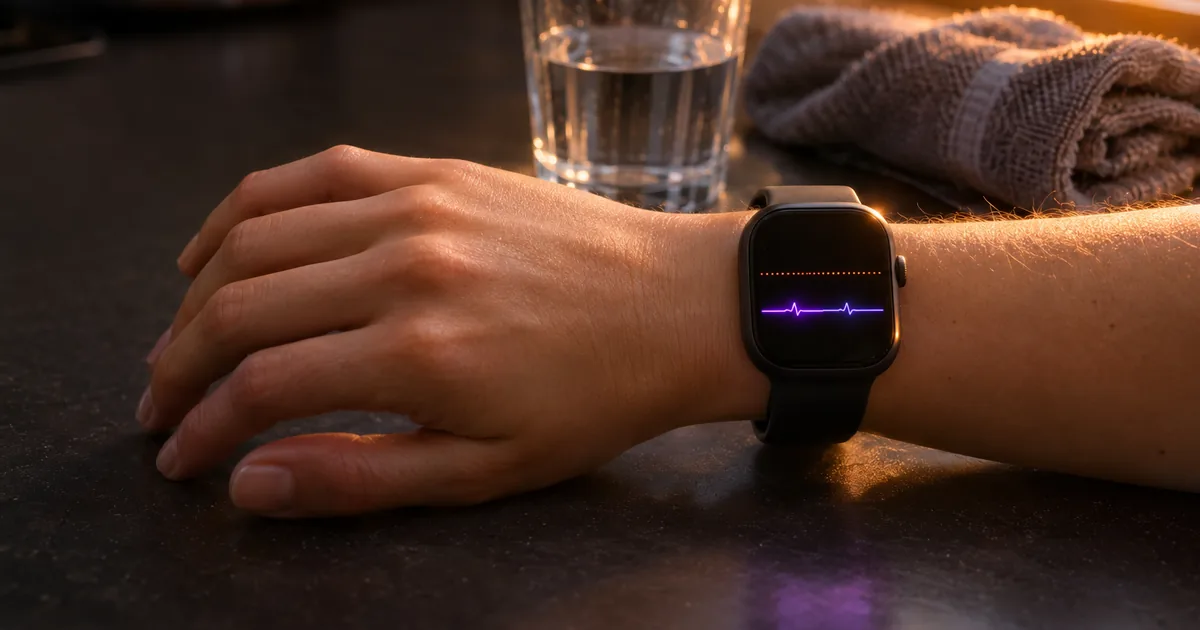
A low HRV reading means your heart rhythm varied less between beats than it usually does for you. The most common reasons are short sleep, alcohol, illness, hard training and stress. One low morning is rarely a reason to worry or to skip training. What matters is how far below your own baseline it is and whether it stays there.
What does low HRV mean?
Low HRV means your nervous system is busier than usual and less in recovery mode right now. It is a signal worth checking, not a diagnosis.
Your heart does not beat like a metronome. Even at 60 beats a minute, one gap between beats might be 0.95 seconds, the next 1.05 and the one after that 0.98. Heart rate variability (HRV) is the size of those small swings, measured in milliseconds. When you are well rested, the "rest and digest" side of your nervous system is in charge and the swings are bigger. When your body is handling a load such as a hard session, a virus, a few drinks or a stressful week, the swings get smaller and HRV drops.
So "low" only means something compared with your usual. A reading of 35 ms can be normal for one person and a clear dip for someone who usually sits at 70 ms. If you want to see how your number compares with others your age, read What Is a Good HRV? Averages by Age and Why Your Own Baseline Matters More, and keep in mind that your own baseline still tells you more.
Why your watch and your friend's ring show different numbers
Devices calculate HRV with different formulas and at different times of day, so you can't compare their numbers. Only compare a device with itself.
- Apple Watch saves HRV to Apple Health as SDNN (the data type is called heartRateVariabilitySDNN). SDNN is the standard deviation of the gaps between beats over a measuring window.
- Many other wearables report RMSSD, which looks at how much each gap differs from the next. It responds more to short-term recovery, and its values do not line up with SDNN.
- Timing matters. Oura says it measures HRV only during sleep, in five-minute samples through the night. A reading taken in the daytime, after coffee and a commute, will not match a night-time one.
Get your free AI training and nutrition plan in 60 seconds
What causes a sudden drop in HRV?
A sudden drop in HRV usually comes from something in the last 24 to 48 hours: a short or broken night, alcohol, an illness starting, a hard workout, stress, a late heavy meal, heat or travel. Most of these sort themselves out within a day or two.
- Short sleep. The American Academy of Sleep Medicine recommends that adults sleep 7 or more hours a night on a regular basis. A single 5-hour night often shows up the next morning.
- Low HRV after drinking. Alcohol is one of the most reliable causes. Studies of overnight wearable data link drinking to lower HRV and a higher resting heart rate, and the effect gets bigger with more drinks. Even a couple of drinks with dinner can pull the next morning's reading down.
- Low HRV when sick. HRV can drop before you feel properly ill, often along with a higher resting heart rate.
- Hard training. A heavy leg day, a long run or a type of session you are not used to can lower HRV for a night or two. That is a normal response to hard work, not a warning sign.
- Stress. Deadlines, arguments and worry load the same system that training does.
- Late meals. A big meal close to bedtime keeps your body digesting overnight. If you train in the evening, what you eat around a night workout can make a visible difference.
- Heat and travel. A hot bedroom, not drinking enough, a long flight, a new time zone or an unfamiliar bed can all lower readings for a few nights.
Low HRV but I feel fine: should I worry?
No. If you feel fine and nothing else looks off, one low reading is most likely normal night-to-night variation or a short-lived effect of the night before. Watch the trend over the next few days before you change anything.
HRV moves around a lot from night to night, which is why trackers smooth it out. Garmin's HRV Status needs three weeks of consistent sleep data before it shows a status, and then it compares your seven-day average with your baseline range. Apple's Vitals app learns a typical range for your overnight readings and, by default, only notifies you when at least two of them fall outside it. Both are built on the same idea: one number on one morning tells you very little.
On a low morning, ask yourself three things:
- Is there an obvious reason, such as a drink, a late night or yesterday's session?
- Is anything else off, such as a higher resting heart rate, short sleep, a sore throat or unusual tiredness?
- Has it been low for more than two or three days in a row?
If the answer to all three is no, train as planned.
How big a drop in HRV matters?
Measure the drop as a percentage of your own usual value, not against a chart. As a rough coaching rule, a dip of about 10% is everyday noise for many people. A reading at or below about 80% of your usual is worth acting on, and one at or below about 65% is a clear sign to go easier.
To find your usual value, wear your device to bed most nights for at least two to three weeks, then use the average your app shows. After that, think in percentages. If your usual is 52 ms, a reading of 47 ms is about 90% of it and means little. 41 ms is about 80% and deserves a closer look at your sleep and how you feel. 33 ms is about 65% and is a real dip.
HRV dropping steadily over a week tells you more than one sharp dip. Check it alongside resting heart rate. If your resting pulse is also several beats higher than normal, recovery is more likely to be the problem. Resting Heart Rate Higher Than Usual: Should You Train or Rest? covers that side of it.
Should I work out if my HRV is low?
Usually yes, but scale the session to the size of the drop and the other signs. A small dip with normal sleep means train as planned. A big dip, or a dip together with short sleep or a higher resting heart rate, means a lighter session. Signs of illness mean rest.
| What you see this morning | What it usually means | What to do today |
|---|---|---|
| HRV within about 10% of your usual, normal sleep, you feel fine | Normal variation | Train as planned |
| HRV 10 to 20% below usual, nothing else off | Probably a one-off from last night or yesterday's session | Train as planned, warm up well and see how the first sets feel |
| HRV at or below about 80% of usual, or a night under 6 hours | Recovery is a bit low | Keep the session but trim it: one set fewer per exercise, drop the hardest interval or top set |
| HRV at or below about 65% of usual, or low HRV plus short sleep plus a clearly higher resting heart rate | Recovery is low | Go lighter: about 10% less weight, fewer intervals and shorter cardio, or a walk and mobility instead |
| Any of the above with fever, body aches, chest congestion or feeling unwell | Your body is fighting something | Rest until the symptoms settle, then build back up gradually |
| Chest pain, fainting, severe breathlessness or a racing heartbeat that will not settle | Not a training question | Stop and get urgent medical help |
For tired, sore or slightly off days that your watch does not explain, Should I Work Out Today? A Decision Guide for Tired, Sore and Sick Days goes through more situations.
Is low HRV dangerous?
A low reading on your watch is not dangerous in itself. It shows how your body is coping with recent load, and in healthy people it usually recovers within days.
In research, HRV that stays low over the long term, measured with medical equipment, is linked to poorer heart health and lower fitness. That pattern comes from studying large groups, and a consumer wearable cannot diagnose it in you. If your HRV stays low and you also have symptoms, see a doctor about the symptoms rather than trying to work it out from the number.
Low HRV for a week or more: what should you change?
If your HRV has been clearly below your usual for a week or longer, your total load is probably more than you are recovering from. Sort out sleep and alcohol first, then cut your training volume for a week. See a doctor if it does not recover or you have other symptoms.
- Protect your sleep. Aim for 7 hours or more of actual sleep, with a consistent bedtime and a cool, dark room.
- Stop drinking alcohol for a week and see what the trend does. It is the quickest test you can run.
- Take a lighter week. Keep the same workouts, cut sets by roughly a third to a half and keep the intensity moderate. Low-impact options from cross training fit well here.
- Eat enough. Hard training on a big calorie deficit often pushes HRV down. Make sure you get a proper meal after training.
- Count the rest of your life. Work stress, a new baby, shift work or a family illness all add to your load.
When to see a doctor
- Your resting heart rate stays clearly above your usual for more than a week with no obvious reason, or you keep feeling unwell or exhausted even after resting.
- You have a fever or illness that is not getting better, especially before going back to hard training.
- You get palpitations that keep coming back or last longer than a few minutes. The NHS advises seeing a GP if this happens.
- You have chest pain or shortness of breath, or you feel faint or have fainted. The NHS says to call 999 or go to A&E for these. Outside the UK, call your local emergency number.
How should you use wearable data to balance training and recovery?
Treat wearable data as one input alongside how you feel and how you perform. Watch trends against your own baseline, act when several signs agree, and change one session at a time rather than the whole plan.
This is the core of HRV training, also called HRV-guided training. Research on it, mostly in endurance athletes, suggests that adjusting each day's intensity to HRV works at least as well as following a fixed plan. The gains in performance are modest. In practice:
- Measure the same way every night: same device, worn to bed.
- Read HRV, resting heart rate and sleep together. One sign on its own is a hint. Two or three together are worth acting on.
- Change the size of today's session, not the overall direction of your training.
- If the data and your body disagree for days, go by your symptoms and get professional advice if you need it.
For a wider look at steps, sleep and heart data, see How to Use Wearable Data to Improve Your Training.
How Trainera's daily readiness uses HRV
Trainera's daily readiness compares you only with yourself. If you train on your own in Trainera on a Pro, Premium or Platinum plan, it reads last night's sleep, HRV and resting heart rate from Apple Health on iPhone (so an Apple Watch worn at night) or from Health Connect on Android. Your usual HRV and resting heart rate are worked out from the last 21 days. HRV counts as a sign when it is at or below 80% of your usual, and counts more at 65%. A resting heart rate at least 7 beats and 10% above your usual only counts alongside another sign.
Every morning, "Today's readiness" tells you in one line whether things look normal, a bit low or low, and gives the reasons in plain numbers, for example "Your heart rate variability is 38 ms, below your usual 52 ms". There is no 0 to 100 score. On a low day, TRAI, the AI coach, suggests a lighter version of today's workout with the same exercises in the same order, and you choose "Use lighter session" or "Keep original". Your health values are not sent to an AI model. It is wellness guidance, not a diagnosis. It is not part of the Free plan or available to clients of a trainer or gym, it does not connect to WHOOP or Oura, and Garmin data is not used by its AI features.
Frequently Asked Questions
Keep Reading
Get your free AI training and nutrition plan in 60 seconds
1,800+ exercises, wearables and progress tracking, free with no card needed. AI food scanning comes with Premium. Train solo or with a certified coach.