What Is a Good HRV? Averages by Age and Why Your Baseline Matters
A good HRV is one that sits in your own normal range, not one that beats a chart. Here are honest HRV averages by age and sex, why devices disagree, and how to build a personal baseline in two to three weeks.
Get your free AI training and nutrition plan in 60 secondsCreate your free plan
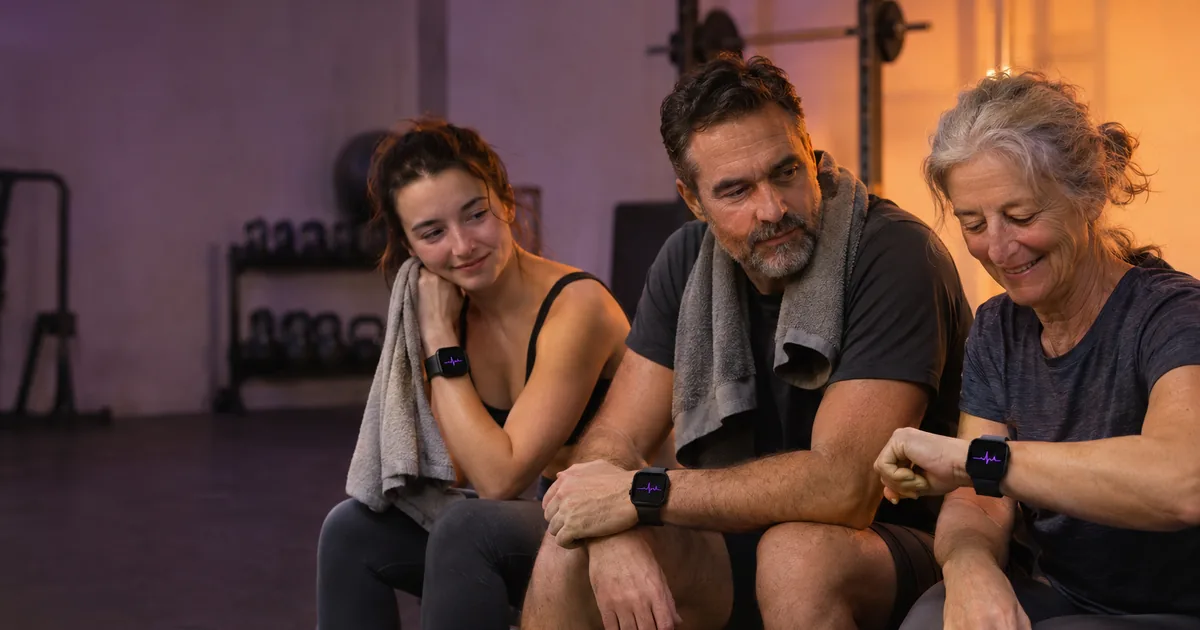
What is a good HRV? There is no single good number. In a study of about 8 million Fitbit users, the typical early-morning HRV (RMSSD) was roughly 48 to 54 ms at age 25, about 37 to 38 ms at 40 and about 27 to 28 ms at 60, with a very wide spread. A good HRV is one that sits inside your own normal range.
That is the short answer. The rest of this article gives you one honest table with its source, explains why your watch and your friend's ring can't be compared, and shows you how to use your own numbers instead.
What is a good HRV for my age?
A good HRV for your age is anything in the broad middle of people your age, and more importantly a value that is normal for you. HRV falls steadily with age, so a 25-year-old and a 55-year-old should not expect the same number.
A 2025 systematic review of 58 studies concluded that there are still no generally accepted HRV normal values, because studies use different devices, recording lengths and metrics (Brozat, Böckelmann and Sammito, J Cardiovasc Dev Dis 2025). So treat any chart, including the one below, as context rather than a grade.
HRV chart by age and gender
The largest wearable dataset with published age and sex tables comes from Fitbit researchers, who analyzed about 8 million users (Natarajan et al., preprint 2019, later published in The Lancet Digital Health). The values below are from their supplementary Table S2: wrist sensor, 5-minute windows, measured between 6 and 7 am, when most people are still asleep. "Middle half" means the 25th to 75th percentile.
| Age | Women, RMSSD median (middle half) | Men, RMSSD median (middle half) | Women, SDRR median | Men, SDRR median |
|---|---|---|---|---|
| 20 | 56 ms (37-85) | 66 ms (45-96) | 76 ms | 88 ms |
| 25 | 48 ms (32-73) | 54 ms (35-79) | 68 ms | 79 ms |
| 30 | 45 ms (31-67) | 49 ms (34-71) | 65 ms | 75 ms |
| 35 | 41 ms (29-60) | 43 ms (31-62) | 61 ms | 70 ms |
| 40 | 37 ms (26-52) | 38 ms (27-54) | 56 ms | 65 ms |
| 45 | 33 ms (24-46) | 34 ms (25-48) | 51 ms | 61 ms |
| 50 | 31 ms (22-42) | 31 ms (23-42) | 49 ms | 56 ms |
| 55 | 29 ms (22-40) | 29 ms (21-39) | 47 ms | 52 ms |
| 60 | 28 ms (21-38) | 27 ms (20-37) | 44 ms | 49 ms |
SDRR is the study's name for what most people call SDNN. Two things jump out: the middle half is wide at every age, and the same people measured between 6 and 7 pm had much lower values. A healthy HRV number is a range, not a target.
HRV for women by age
In this data, women under about 45 had a slightly lower median RMSSD than men of the same age, and the gap closed by around 50. Women's HRV also tends to shift across the menstrual cycle, so a dip in the days before a period is common and not a sign that something is wrong. Comparing the same phase month to month tells you more than comparing yourself with men or with a chart.
HRV for a 40 year old male
For a 40-year-old man, the median early-morning RMSSD in the Fitbit data was 38 ms, with the middle half between 27 and 54 ms. Anywhere in that band is typical. A trained endurance athlete may sit well above it, and that is fine too.
Is an HRV of 40 good?
Usually, yes. On an overnight RMSSD measurement, 40 ms is close to the median for people in their late 30s and early 40s and above the median from the mid-40s on. What matters more is whether 40 is normal for you: if you usually sit at 60, a 40 is worth noticing, and if you usually sit at 35, it is a good night.
Get your free AI training and nutrition plan in 60 seconds
Why is my HRV lower on Apple Watch than on other devices?
Because Apple Watch and overnight wearables measure different things at different times. Apple Health's standard HRV value is SDNN from readings taken whenever you're still, including during the day, while rings and many watches report a sleep average, when HRV is naturally at its highest.
- Different formula. Apple Health has long stored HRV as SDNN (the HealthKit data type is named heartRateVariabilitySDNN), the standard deviation of the gaps between beats. RMSSD looks at the difference between each beat and the next, which tracks the fast, breathing-linked changes. The same heartbeats give two different numbers.
- Different time of day. Apple says HRV is sampled while you're still, so the number of readings depends on your activity (Apple Support). In the Fitbit data, RMSSD peaked between about 5 and 8 am and was lowest around 7 to 8 pm. For 40-year-old men the median was 38 ms at 6 am but 26 ms at 6 pm.
- Different window length. Short recordings tend to give smaller values than long ones; the Fitbit authors note that 24-hour time-domain values run larger than 5-minute ones.
- Different sensors and filtering. Every brand cleans the raw signal its own way.
Apple Watch Series 12 and Ultra 4 add overnight HRV and daytime HRV in the Vitals app, and Apple asks you to wear the watch to sleep for 7 days to set your typical range (Apple Support: Vitals). Those models also show a Recovery HRV in the Heart Rate app. Apple's support pages don't say which formula it uses, so keep it as its own series and don't mix it with older Health data.
| Device | When HRV is measured (official help page) | Compare it with |
|---|---|---|
| Apple Watch | Sampled while you're still; overnight HRV in Vitals on Series 12 and Ultra 4 | Your own Apple history, same metric |
| Oura | Only during sleep, as the mean of five-minute samples through the night (Oura Help) | Your own trends; Oura says not to compare with others |
| Garmin | Wrist readings while sleeping; a seven-day average checked against your baseline range (Garmin manual) | Your baseline range |
Oura notes that typical HRV values run from under 20 to over 200 ms. That spread alone is the reason to compare a device only with itself.
What moves HRV up or down from day to day?
HRV during sleep reflects how relaxed your nervous system is, so anything that adds load or stress pulls it down for a night or two. The usual suspects:
- Short or broken sleep, especially several nights in a row.
- Alcohol, even a couple of drinks, typically lowers overnight HRV and raises resting heart rate.
- A big or late dinner; see how late meals affect recovery.
- A hard or unusually long session the day before, particularly late in the evening.
- Illness, often a day or two before you feel symptoms.
- Psychological stress, travel, heat and dehydration.
- Measurement timing: a reading taken later in the day will be lower.
A single low night with an obvious cause is not a problem. For what to do on those mornings, read low HRV: what it means and whether to train today.
How do I find my own HRV baseline?
Wear the same device every night for two to three weeks, then use the average and the range you saw as your baseline. Apple uses 7 nights to set a typical range, and Garmin needs three weeks of consistent sleep data before it shows an HRV status.
- Wear it every night, snug and charged. Gaps make the average less reliable.
- Look at one metric only: the overnight value if your device has one.
- Note obvious disruptors such as alcohol, illness or a very late session.
- After 14 to 21 nights, write down your average and your usual low and high.
- From then on, watch the 7-day average against that baseline more than any single night.
- Refresh it every few months, because fitness, age and seasons shift it.
What counts as a meaningful HRV change?
One low night rarely means much; a big drop, or several low mornings in a row, does. Use this as a coach's rule of thumb, not a medical rule:
| What you see | Likely meaning | What to do today |
|---|---|---|
| HRV inside your usual range | Normal day-to-day noise | Train as planned |
| One night below your usual low, clear cause | Short-term stress (drink, late meal, hard session) | Train as planned, keep hard efforts in check |
| HRV at or below about 80% of your usual, or low three mornings running | Recovery lagging | Lighter session: fewer sets, less load, easy cardio |
| Low HRV plus resting heart rate clearly up and short sleep | Body dealing with something bigger | Walk or rest; skip training if you feel ill |
| Below baseline for two weeks or more, no clear reason | Accumulated fatigue, ongoing stress or a health issue | Cut training volume for a week; talk to a doctor if it persists or you have symptoms |
Resting heart rate is the best partner signal. If it is also climbing, read resting heart rate higher than usual: should you train or rest?
How can I raise my HRV over months?
You raise HRV slowly, through the basics: consistent sleep, aerobic fitness, less alcohol and better stress control. Expect weeks to months, not days.
- Sleep 7 hours or more on a regular schedule, the amount adult sleep guidelines recommend. More on that in how sleep affects your fitness results.
- Build an aerobic base. In the Fitbit data, people who took more daily steps had higher HRV in every age group, although the effect was smaller in older users. Add easy cardio such as brisk walks, cycling or zone 2 runs.
- Cut back on alcohol, especially within a few hours of bed.
- Manage stress: slow breathing, time outside and fewer late screens all help some people.
- Progress training gradually and plan easier weeks, so load doesn't outrun recovery.
How can wearable data help me build a better recovery routine?
Wearable data helps when you compare each morning with your own baseline and act on trends: lighter days when several signals drop together, normal training when they don't. It is less useful when you chase a single number or compare yourself with others.
Pick two or three signals (sleep duration, overnight HRV, resting heart rate), check them at the same time each morning, and decide in advance what you'll change on a low day. How to use wearable data to improve your training goes deeper, and readiness scores explained shows what Garmin, Oura, WHOOP and Fitbit combine into their scores.
How Trainera's daily readiness uses your own usual HRV
Trainera's daily readiness works on the same idea as this article: it compares you only with yourself, never with a population chart. Each morning it reads last night's sleep, HRV and resting heart rate from Apple Health on iPhone (so an Apple Watch worn at night) or Health Connect on Android. It checks them against your usual night over the last 14 days and your usual HRV and resting heart rate over the last 21 days. HRV at or below 80% of your usual counts as a sign. You get one plain line, such as "Your heart rate variability is 38 ms, below your usual 52 ms", not a 0 to 100 score. On a low day, TRAI suggests a lighter version of today's planned workout, which you can use or decline. It is for solo users on Pro, Premium or Platinum (plans), not the Free plan or clients of a trainer or gym. It doesn't connect to WHOOP or Oura, and Garmin data isn't used by its AI features. It is wellness guidance, not medical advice.
When is an HRV number worth showing a doctor?
HRV on its own is not a diagnosis, but some patterns deserve a doctor's look, especially when they come with symptoms.
- Chest pain, fainting, severe shortness of breath or a racing heartbeat at rest: get medical help straight away, whatever your watch says.
- A resting heart rate that stays above 100 beats per minute, or below about 50 when you aren't a trained athlete and you feel dizzy or tired. Most adults sit between 60 and 100.
- HRV well below your baseline for weeks with rising resting heart rate and no clear cause such as training, travel or illness.
- HRV that suddenly jumps very high and erratic, or an irregular rhythm alert. Irregular beats can inflate HRV readings.
- Fever or illness: rest first, and see a doctor if it doesn't settle.
Bring the trend, not one screenshot. A few weeks of nightly data next to how you felt is far more useful to a doctor than a single number.
Frequently Asked Questions
Keep Reading
Get your free AI training and nutrition plan in 60 seconds
1,800+ exercises, wearables and progress tracking, free with no card needed. AI food scanning comes with Premium. Train solo or with a certified coach.