How to Build Muscle at Home, Even Without Weights
You can build real muscle at home with only your body weight if you train close to failure and keep making exercises harder. Here are the progression ladders, a sample week, a beginner start and the protein numbers to hit.
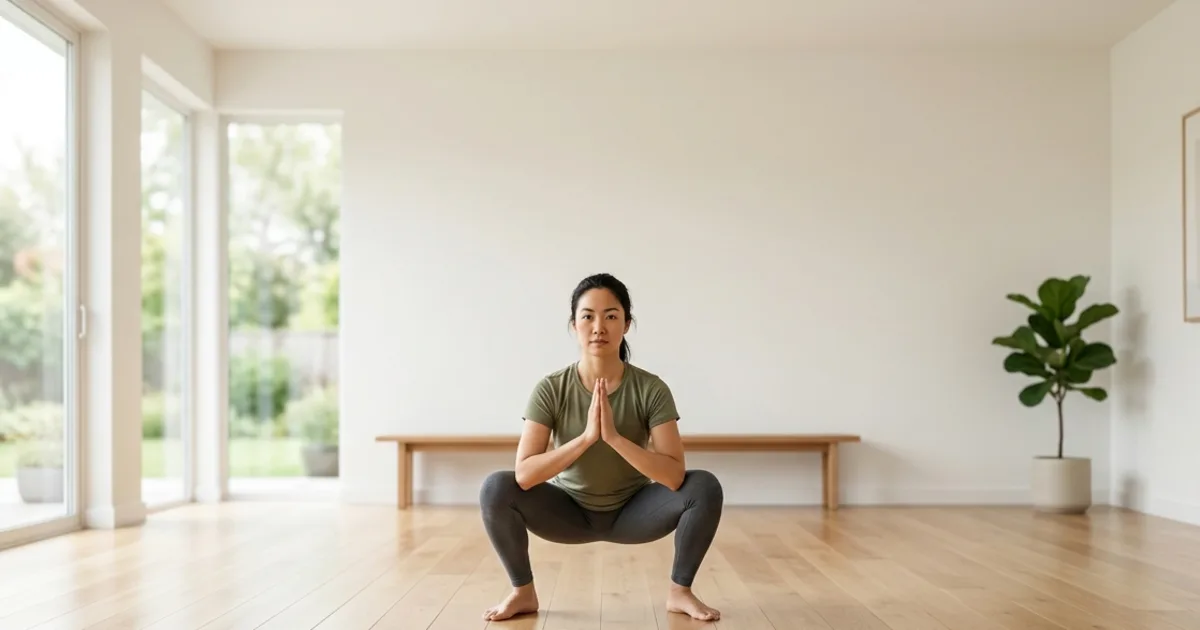
You can build muscle at home with nothing but your body weight, as long as you train hard enough. Knowing how to build muscle at home comes down to four things: take sets close to failure, make exercises harder over time, train each muscle at least twice a week and eat enough protein.
Can you really build muscle at home without weights?
Yes. Your muscles respond to tension and effort, not to whether the resistance comes from a barbell or from your own body, so learning how to build muscle without weights is mostly about learning to train hard with lighter loads.
A 2017 meta-analysis of 21 studies by Schoenfeld and colleagues compared light loads (60% of your one-rep max or less) with heavy loads, with every set taken to muscular failure. Muscle growth was similar across the loading range. Heavy loads won for maximal strength, which matters if you want a big one-rep max, less so if you want bigger muscles.
Push-ups have been tested directly. In a small 8-week trial, 18 young men trained twice a week with either bench press at 40% of their max or push-ups adjusted to the same load. Both groups grew their chest and triceps by a similar amount and gained similar bench press strength.
The catch: light loads only work when you push close to failure. Twenty easy push-ups with fifteen more left in the tank do very little. If you are wondering how to build your muscles with zero equipment, the honest answer is effort plus progression. The NHS guidelines for adults list bodyweight exercises such as push-ups as muscle-strengthening activity and recommend working all major muscle groups on at least 2 days a week.
Get your free AI training and nutrition plan in 60 seconds
How do you get progressive overload with bodyweight?
You make each exercise a little harder over time, either by doing more reps or by switching to a harder variation once you own the current one. You cannot add plates, so you change leverage, range and speed instead.
- More reps: the simplest lever. Add one or two reps per set each week.
- Harder leverage: move from incline push-ups to floor push-ups to feet-elevated push-ups.
- One limb at a time: a split squat puts far more load on each leg than a regular squat.
- Slower lowering: take 3 seconds on the way down. More time under tension, same exercise.
- Pauses: hold 1 to 2 seconds at the hardest point, such as the bottom of a squat.
- Bigger range of motion: elevate your front foot in a split squat or your hands on books for deeper push-ups.
- More sets: go from 2 to 3 or 4 hard sets per exercise.
A practical rule: pick a rep window of roughly 8 to 20 reps (legs can go to 25). Stop each set with about 0 to 2 reps left in reserve. When you hit the top of the window on every set, move to the next step on the ladder.
| Movement | Easier | Standard | Harder | Hardest |
|---|---|---|---|---|
| Push (chest, triceps) | Incline push-up, hands on a table | Floor push-up | Feet-elevated push-up | Archer push-up |
| Shoulders | Pike push-up, hands on floor | Pike push-up, feet on a chair | Wall-supported handstand hold | Wall handstand push-up negatives |
| Squat (quads, glutes) | Bodyweight squat | Split squat | Rear-foot-elevated split squat | Pistol squat to a box |
| Hinge (glutes, hamstrings) | Glute bridge | Single-leg glute bridge | Single-leg hip thrust, shoulders on the couch | Nordic curl negatives |
| Pull (back, biceps) | Row under a sturdy table, knees bent | Table row, legs straight | Pull-up negatives on a bar | Chin-ups |
Which home exercises build the most muscle?
Multi-joint exercises that let you load a muscle hard through a full range: push-up variations, split squats, single-leg hip thrusts, rows and chin-ups. Cover push, pull, squat and hinge and you train nearly every major muscle.
- Push-up variations for chest, front shoulders and triceps.
- Pike push-ups for shoulders, since regular push-ups hit them less.
- Rear-foot-elevated split squats for quads and glutes. Probably the best leg builder without weights.
- Single-leg hip thrusts and sliding leg curls (heels on a towel on a smooth floor) for glutes and hamstrings.
- Table rows and chin-ups for your back and biceps. Pulling is the weak spot of home training, so take it seriously.
- Single-leg calf raises on a step, with a slow lowering.
For table rows, use a solid, heavy table that will not tip, and test it before your first set. If you have no safe table, a doorway pull-up bar is the first piece of equipment worth buying.
What does a home muscle-building routine look like each week?
Three full-body sessions a week on non-consecutive days works for most people. Each muscle gets trained three times, with a day to recover between sessions.
Volume matters too. Research on weekly training volume shows a graded relationship: more weekly sets tend to produce more growth. A sensible target is around 10 hard sets per muscle per week, which the home workout routine below reaches once you are on 3 sets per exercise.
| Day | Session | Exercises (3 sets each, 8 to 20 reps) |
|---|---|---|
| Monday | Workout A | Push-up variation, split squat (each leg), table row, single-leg hip thrust, plank (2 x 30 to 45 s) |
| Tuesday | Rest or walk | 20 to 40 minutes of easy walking |
| Wednesday | Workout B | Pike push-up, reverse lunge (each leg), chin-up negatives or table row, sliding leg curl, single-leg calf raise |
| Thursday | Rest | Mobility or nothing |
| Friday | Workout A | Same as Monday, try to beat your reps |
| Saturday | Optional | Walk, bike, sport |
| Sunday | Rest | Full rest |
Next week, flip it: B on Monday and Friday, A on Wednesday. Rest 60 to 120 seconds between sets. A session takes about 35 to 45 minutes. Write down every set, because you cannot progress what you do not track. For more structured options, see our home workout plan with no equipment.
How should beginners start building muscle at home?
Start with two full-body sessions a week, 2 sets per exercise, and stop each set 2 to 3 reps before failure while you learn the movements. After 2 to 4 weeks, move to three sessions and 3 sets.
Good beginner workouts at home look boring on paper, and that is fine:
- Warm up 5 minutes: marching in place, arm circles, 10 bodyweight squats, 5 easy push-ups.
- Pick the easiest ladder step you can do for 8 clean reps. Incline push-ups count. Pride does not build muscle.
- Use a full range of motion and a controlled lowering on every rep.
- Add reps before adding difficulty. Only move up a step when the current one is easy for 15 to 20 reps.
- Sleep 7 to 9 hours. Recovery is where the growth happens.
Expect strength to climb within weeks and visible change to take longer. Our guide on how long it takes to build noticeable muscle sets realistic timelines.
Check with your doctor before starting if you have a heart condition, high blood pressure that is not controlled, a recent injury or surgery, or are pregnant and new to strength training. Stop and get checked if you feel chest pain, dizziness or joint pain that does not settle after a few days.
When do you need to add bands or dumbbells?
When you can do more than about 25 to 30 reps of the hardest variation you can safely perform, or when you cannot find a way to train a muscle (usually back and biceps). At that point, sets get so long that your breathing gives out before your muscles do.
- Doorway pull-up bar: fixes the pulling gap. Usually the best first buy.
- Resistance bands: cheap, add load to push-ups, rows, curls and face pulls.
- Loaded backpack: books or water bottles add 5 to 15 kg to squats, lunges and push-ups for free.
- Adjustable dumbbells: the biggest upgrade once legs outgrow single-leg work. Our dumbbell-only full body workout shows how to use them.
How much should you eat to build muscle at home?
Eat 1.4 to 2.0 g of protein per kg of body weight a day and a small calorie surplus. That protein range comes from the International Society of Sports Nutrition position stand, which also suggests about 20 to 40 g of protein per meal, spread every 3 to 4 hours.
For a 70 kg person, that is 98 to 140 g of protein a day, or roughly four meals of 25 to 35 g. For calories, a modest surplus of around 200 to 300 kcal above what keeps your weight stable is enough. If the scale climbs much faster than about 1 kg a month, trim portions. If you are new to training and carry extra body fat, you can often build muscle while eating at maintenance.
| Food | Portion | Protein (approx.) |
|---|---|---|
| Chicken breast, cooked | 100 g | 30 g |
| Canned tuna, drained | 100 g | 25 g |
| Plain Greek yogurt, low-fat | 200 g | 20 g |
| Eggs | 3 large | 18 g |
| Firm tofu | 150 g | 18 to 25 g |
| Lentils, cooked | 200 g | 18 g |
| Milk | 250 ml | 8 g |
Values vary by product, so check labels. For meal ideas, see our list of the best foods to eat to build muscle. If you have kidney disease, talk to your doctor before raising your protein intake.
How to build muscle at home with a plan made for you
The routine above works, but progress comes faster when your plan fits your level, your space and what you actually own. On Trainera, the free plan for solo users includes workout logging, a diet tracker and 1 AI training plan plus 1 AI nutrition plan a month, with no card needed. The AI coach TRAI builds a workout plan from 1,800+ real exercises (1,700+ with video) and a nutrition plan, and answers your questions in your language, so you can tell it you train at home with no weights and get a plan built around that.
If you train alone and want feedback on technique, TRAI Vision on the Platinum plan uses your phone or browser camera to count reps out loud on 902 exercises and give a form correction per rep on 252 of them. Pose detection runs on your device, and no video is uploaded.
Frequently Asked Questions
Keep Reading
Get your free AI training and nutrition plan in 60 seconds
1,800+ exercises, wearables and progress tracking, free with no card needed. AI food scanning comes with Premium. Train solo or with a certified coach.