Training in Gulf Heat and Summer: A Practical Guide for the GCC
How to train safely through Gulf summer heat and humidity, from timing and hydration to adjusting intensity and programming around the climate.
Get your free AI training and nutrition plan in 60 seconds
TL;DR
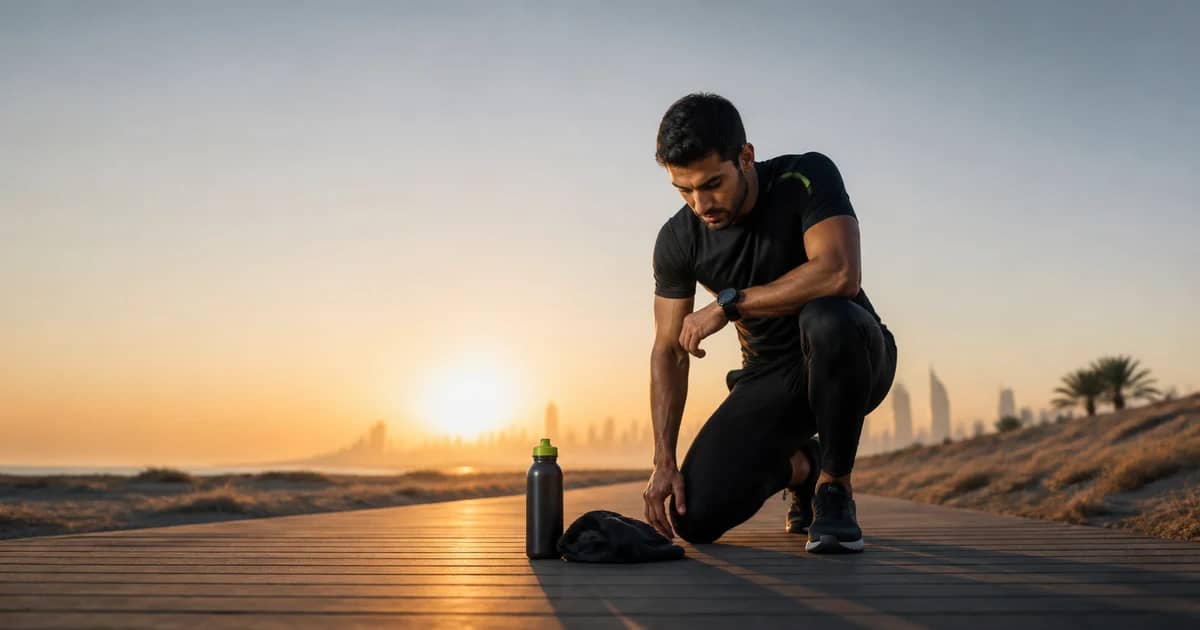
Summer in the Gulf changes how you should train, not whether you train. The heat, humidity and long daylight hours push most serious work indoors or into the cooler edges of the day, and your hydration and intensity need to adapt with the season.
- Time it right: train early morning before sunrise or late at night, and keep hard outdoor sessions off the midday and afternoon block.
- Respect humidity: coastal cities like Dubai, Abu Dhabi and Doha feel far worse than the dry inland heat of Riyadh because sweat cannot evaporate.
- Hydrate with electrolytes, not just water, and drop intensity on the hottest, most humid days instead of pushing through.
- A single app that plans, logs and tracks your hydration and heart rate makes hot-season training much easier to manage.
At a Glance
| Situation | Generic global advice | Gulf-adapted approach |
|---|---|---|
| Best time to train | Whenever fits your day | Before Fajr or after 9pm in summer |
| Outdoor cardio | Any daylight hour | Pre-dawn only from May to September |
| Hydration | Drink water when thirsty | Pre-load fluids plus sodium and potassium |
| Intensity in July heat | Keep pushing PRs | Lower volume, hold strength, watch HR |
| Where to train | Gym or park, your choice | Air-conditioned gym or home most days |
| Humidity awareness | Rarely mentioned | Central to coastal-city planning |
| Heart rate monitoring | Optional extra | Key heat-safety signal via wearable |
| Plan flexibility | Fixed weekly schedule | Shifts with weather and season |
| Language and layout | English-first apps | Full Arabic with RTL support |
Why Gulf Summer Is a Different Challenge
From late April through September, most of the Arabian Peninsula sits in serious heat. Riyadh and the inland deserts run hot and dry, often above 45C in the afternoon. The coastal cities are the real trap. Dubai, Abu Dhabi, Doha, Kuwait City and Manama combine high temperatures with humidity that can climb past 80 percent, and that humidity is what makes summer training risky. When the air is already saturated with moisture, your sweat cannot evaporate, so your body loses its main cooling mechanism. You can feel fine one minute and overheated the next.
This is why the standard advice you find in most global fitness apps falls short here. A plan built for a mild European or North American summer assumes you can jog outside at 6pm. In Jeddah or Doha in July, that same session can be genuinely dangerous. The goal for the Gulf is not to train less, it is to train smarter around the climate.
Indoor Versus Outdoor, and When Each Makes Sense
For four to five months of the year, indoor is the default. Air-conditioned gyms, home workouts and covered facilities let you keep your intensity high without fighting the environment. Strength work, hypertrophy training, conditioning circuits and mobility all move indoors comfortably. If you prefer training at home, you can build a complete routine with almost no equipment. Our guide on home workouts with no equipment in the Gulf covers how to structure that.
Outdoor training still has a place, but the window shrinks dramatically. Pre-dawn is the only reliable slot for outdoor cardio in peak summer, roughly the hour before Fajr when temperatures dip to their lowest. Late evening after 9pm is a second option, though coastal humidity often stays high well past sunset. Save your outdoor runs, cycling and sports for the cooler months from November to March, when the Gulf climate is genuinely pleasant and you can train outside almost any time.
Early Morning Versus Late Night
Both edges of the day work, and your choice usually comes down to lifestyle and prayer schedule. Early morning training, tied loosely to the Fajr prayer, gives you the coolest air of the day and a clear, uninterrupted start before work. It suits people who sleep early and want the session done before the heat builds. Aligning your workouts with the daily prayer rhythm is something many people in the region find easier to sustain. Our prayer-time training schedule guide walks through how to fit sessions around the five daily prayers.
Late-night training suits the Gulf's social rhythm, where evenings run long and gyms stay busy until midnight. The tradeoff is humidity and sleep. A hard session too close to bedtime can leave you wired, and coastal cities do not cool down much overnight in July and August. If you train late, keep the room cool, finish at least ninety minutes before sleep, and rehydrate properly afterward.
Hydration and Electrolytes in the Heat
Water alone is not enough when you are sweating heavily in Gulf humidity. Heavy sweat carries sodium, potassium and other electrolytes, and replacing only the water can leave you feeling drained or even lightheaded. Start hydrating before you train, not just during. Aim to drink steadily through the day rather than gulping a large amount right before a session. Add an electrolyte source, whether that is a proper sports drink, electrolyte tablets, or simply salting your food and eating potassium-rich foods like dates, bananas and laban.
A simple habit is to weigh yourself before and after a hot session. A drop of more than two percent of body weight means you under-drank and should replace it. Tracking your water intake daily helps you build the habit, and Trainera includes water tracking alongside your nutrition log so hydration is not an afterthought. If you want to dial in your overall intake, the free TDEE calculator gives you a baseline to plan food and fluids around.
Adjusting Intensity and Reading Your Body
Heat raises your heart rate for the same effort, so a workout that feels moderate in winter can push you into a hard zone in summer without any change in the actual load. The smart move is to hold your strength numbers where possible and pull back on volume and high-intensity conditioning during the worst weeks. This is not losing progress, it is protecting it. Trying to set personal records in July humidity usually leads to poor sessions and higher injury risk.
A wearable makes this much easier to manage. Trainera connects to Apple Health, Android Health Connect, Fitbit, Polar, Google Fit and Huawei Health, and the health dashboard shows your heart rate, active minutes and calories burned in one place. There is also a dedicated Apple Watch app with live heart rate and a rest timer, so you can watch your heart rate climb and back off before it becomes a problem. If your resting or recovery heart rate stays elevated after training, that is a clear sign the heat is taxing you and you should ease up.
Programming Around the Gulf Calendar
The most sustainable approach treats the Gulf year as two seasons. Summer, from roughly May to September, is your indoor strength and hypertrophy block. Keep training hard, but keep it in controlled environments and lower your outdoor and high-heat exposure. The cooler months are when you push outdoor conditioning, running, sports and any fat-loss phase that benefits from higher activity. Building your year this way means the climate works with your program instead of derailing it.
Ramadan adds another layer, since fasting and training overlap with heat in some years. We cover that fully in the training during Ramadan guide. For a broader look at losing fat while managing the local lifestyle and climate, the fat loss and Gulf lifestyle guide ties nutrition and training together. Trainera's AI training plans are built around your level and goal, and the drag-and-drop builder with multi-week programming lets you shift your whole plan from an outdoor-heavy season to an indoor one in minutes.
Putting It Together with One App
Managing timing, hydration, intensity and seasonal programming across separate apps and notes gets tiring fast. Trainera brings it into one place, in full Arabic with complete right-to-left layout if you prefer, plus 25 other languages with automatic detection. You get 1800 plus exercises with video demos, a plan builder, set and rep logging with a rest timer, automatic personal records, water and macro tracking, and wearable integration for heart rate, all designed to work whether you follow a coach or train fully on your own.
You do not need a coach to use any of it. Self-training mode gives you the full app, and if you later want guidance you can browse certified trainers in the marketplace. Start free and build a plan that respects the Gulf summer instead of fighting it. Start free with Trainera and set up your hot-season routine today.
Related reading
Frequently Asked Questions
What is the best time to train outdoors during Gulf summer?
Why is humidity more dangerous than heat in the Gulf?
Do I need electrolytes or is water enough in the heat?
Should I lower my training intensity in summer?
Keep Reading
Put this into practice with Trainera
Get your free AI training and nutrition plan in 60 seconds
1800+ exercises, wearables and progress tracking, free with no card needed. AI food scanning comes with Premium. Train solo or with a certified coach.